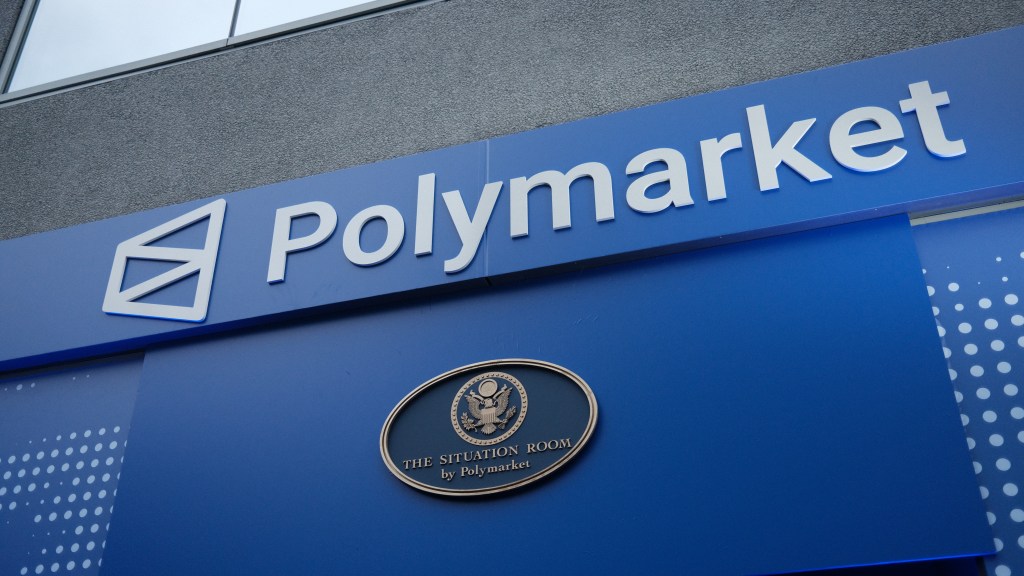
On Friday night, several dozen rain-dampened journalists huddled beneath two pergolas outside Proper 21—a restaurant on D.C.’s K Street known for happy hours and corporate power lunches. Inside, employees of the prediction market behemoth Polymarket were scrambling to salvage what was supposed to be the company’s first viral marketing stunt in the nation’s capital—a pop-up bar called the Situation Room, where the city’s many reporters, lobbyists, and policy nerds could monitor world events with the same gusto and social revelry as sports fans following March Madness or the Super Bowl.
But while free beer and wine flowed to the reporters outside, information to monitor did not—reporters waited outside while organizers tried to fix electrical and connectivity issues that rendered the Situation Room nothing more than a room full of black screens. By the time guests were allowed inside, only a few displays were working, and the event had shifted from a marketing gimmick to an unintentional metaphor for the prediction market industry’s stumbling courtship of the Beltway media establishment. But that dynamic could be changing: Even as the event fell flat, the industry’s underlying push to woo Washington is serious, well-funded, and accelerating.
In the months before Polymarket’s screens went dark on K Street, the prediction market industry was lighting up balance sheets across the media landscape. In 2025, Polymarket announced deals with X and Yahoo Finance, and in the first quarter of 2026 it has inked exclusive partnerships with Dow Jones—which publishes the Wall Street Journal, Barron’s, MarketWatch, and Investor’s Business Daily—and the newsletter platform Substack. Polymarket’s main rival, Kalshi, has landed several similar deals: In December, the company announced partnerships with both CNN and CNBC that would see the market’s prediction data integrated into the networks’ programming. Recent reporting suggests that Fox News is considering a similar deal with Kalshi, though no formal announcement has been made.
The extent to which each organization will embrace prediction market data differs, but the agreements all advertise some level of increased access to the probabilities surfaced by the markets. Dow Jones’ agreement with Polymarket, for example, will see Polymarket data “displayed through dedicated data modules on Dow Jones digital properties, including homepage and market-related pages, as well as through select print placements.” CNN’s partnership with Kalshi would similarly integrate Kalshi’s data “across CNN programming, led by CNN Chief Data Analyst Harry Enten” and give CNN journalists and producers “access to Kalshi’s real-time political, news, and cultural data for developing key storylines and visuals.” The financial structures of Polymarket and Kalshi’s deals with media organizations have not been disclosed.
Sports gambling and sports media.
Media partnerships with prediction markets—platforms that only gained more widespread popularity and legitimacy over the past several years—are a relatively new phenomenon, but the playbook of incorporating de facto gambling odds into media isn’t. Since the Supreme Court ruled in 2018 that a federal ban on sports gambling was unconstitutional, traditional sportsbook gambling has embedded itself deeply into sports journalism. Within a few years, almost every major sports broadcaster had a sportsbook sponsor, and popular sports podcasters were regularly reading ads for gambling platforms. “Sports gambling and sports media have always kind of been interconnected … even before it was legal and accessible,” Brian Moritz, a professor of journalism at St. Bonaventure University and expert in sports media, told The Dispatch. “But it’s taken a lot of people by surprise how prevalent it is and how, within just 10 years, it’s really come to dominate the space.”
In 2019, for example, Fox Corporation launched FOX Bet in partnership with the online gambling company Stars Group, and in 2021, the NFL gave DraftKings, FanDuel, and Caesars Entertainment the right to integrate betting content directly into NFL Media properties, including its website and app. Patrick Ferrucci, a professor of journalism at the University of Colorado Boulder, said this deep integration of online betting providers into the sports media ecosystem has changed both the industry’s structure and output. “You can see that a lot of content has changed,” he said. “It’s not like gambling and sports journalism going together are brand new, but you see far more content geared toward bettors [today].” That shift can create a feedback loop: More betting-oriented content drives more gambling activity, which drives more sportsbook revenue and attention on sports media. “You see a lot more content like this, which fuels people’s behavior,” Ferrucci said.
The consequences of media partnerships with gambling companies extend beyond content. While reporting his book Everybody Loses: The Tumultuous Rise of American Sports Gambling, journalist Danny Funt spoke with numerous sports reporters who described feeling pressure from the financial relationships their outlets had built with sportsbooks. That pressure, he said, cuts in two directions—not only encouraging journalists to normalize gambling, but discouraging them from covering it critically. “It pressures journalists to both promote and flatter these companies, but maybe more importantly, bite their tongue or pull punches if they’re inclined to cover something that would be embarrassing for the sportsbooks or embarrassing for the leagues for doing business with them,” Funt told The Dispatch.
“I can’t help but think that this is the tip of the iceberg, and that more and more organizations, especially as we enter election seasons, will strike these deals. If you’re fighting for survival, treading water, and laying off staff, and then a massive new revenue stream becomes available, it’s very difficult to stand on principle and turn that away.”
Danny Funt
Sports media companies are aware of the ethical issues that gambling partnerships present, and many large organizations—such as ESPN—introduced restrictions on employees using information gained through their jobs to place bets or gambling on events that they cover. “Internally, there are pretty strict firewalls in place between the journalism and news gathering aspects of [these companies] and the promotional gambling aspects of it,” Moritz said. But those firewalls don’t resolve the fundamental problem of perceptions of bias among audiences. “Journalism’s credibility is all in the eye of the reader … it’s perception, not reality,” Moritz said. “And these kinds of partnerships, they open up news outlets and individual journalists to [potential questions about] ‘why are you reporting the story?’”
Ferrucci framed the problem in similar terms. Even if an organization’s internal ethics are sound, gambling partnerships “take away all perceptions of distance or autonomy from journalism, which allows—fair or unfair—criticisms of credibility to be pretty easy,” he said. That ethical issue is complicated further by the fact that prediction markets can provide—and historically have provided—useful information to political analysts and hobbyists who leverage the markets’ probabilities in a similar manner to traditional polling. News organizations aren’t citing prediction market data simply because of paid partnerships—the markets have legitimate value for analyzing and understanding consensus expectations.
Will traditional media follow?
The question now confronting the news industry is whether it will follow the same path as sports media operations and team up with prediction markets. According to Funt, the speed at which prediction markets have been adopted by media organizations and gained traction in American culture is similar to what he observed during the rise of traditional gambling, and the partnerships are benefiting companies like Polymarket and Kalshi in similar ways—mainly through normalization and customer acquisition. “A lot of people probably don’t know what a prediction market is, or how you place a trade, or how you make money,” Funt said. “And the fact that these media organizations are giving [prediction markets] a stamp of legitimacy and talking about prices during coverage, I think that could make a big difference in making people say, ‘Okay, these sites are safe. They’re legit.’”
That disconnect becomes particularly acute on publishing platforms like Substack, where the spectrum of editorial standards is wide. “You’ve got people who come from a newspaper journalism background, who are very professional, very traditional in how they approach journalism and their ethics,” Moritz, who publishes his own Substack, said. “But you also have people who are just starting out, who are independent. You’ve got people who aren’t journalists who are writing. And you’ve got that weird middle ground.” When a prediction market company offers a Substack writer $20,000 for a single post leveraging its market data—as one writer, who asked to remain anonymous, told The Dispatch had happened to him—there is no institutional ethics review, no compliance department, and no editor to flag a conflict of interest. “Imagine you’re just doing this for fun, and you’re writing about sports, and somebody offers you $20,000 for one post,” Moritz said. “That’s real money.”
Moritz believes that these financial incentives, especially in an era of shrinking profits for newsrooms, helped facilitate the explosion of sports media partnerships with gambling companies. “You’ve got [the gambling industry] coming in with billions of dollars, looking for partnerships, looking for advertising, looking for basically access to any customer that they could get,” he said. “And so for sports media outlets, that was a source of revenue for them.” Traditional news media organizations are now facing the same economic incentives to embrace the lucrative prediction market industry. “I can’t help but think that this is the tip of the iceberg, and that more and more organizations, especially as we enter election seasons, will strike these deals,” Funt said. “If you’re fighting for survival, treading water, and laying off staff, and then a massive new revenue stream becomes available, it’s very difficult to stand on principle and turn that away.”
New ethics for new problems.
The news media’s embrace of prediction market partnerships could introduce many of the same ethical issues, pressures, and safety considerations that some in the sports media already face—even in cases where news organizations don’t have direct ties to prediction markets. Moritz told The Dispatch that coaches, players, and sports journalists regularly face abuse from gamblers who lose bets because of their actions, and that same phenomenon is already beginning to make itself felt in the traditional news media. For example, Emanuel Fabian, the military correspondent for the Times of Israel, recently faced death threats after he reported details about an Iranian missile strike that caused gamblers to lose a bet made on a prediction market.
Allowing news consumers to essentially bet on the outcome of current events also threatens the purpose of news at a more philosophical level. “I think the role of journalism and the role of the media should not be empowering people to make a little extra by predicting what might happen,” Moritz said. A common criticism in political media is that horse-race political coverage has already reduced much of politics to a numbers game, and adding easy betting to the mix threatens to continue that trend. “When you introduce gambling, especially on a political level, you reduce it even more,” Moritz said. “Now it’s not just an issue with a number on it, it’s something that you say, ‘Hey, I can make money off of this.’”
Subramaniam Vincent, director of the Markkula Center for Applied Ethics’ Journalism and Media Ethics program at Santa Clara University, told The Dispatch that the range of ethical questions posed by media adoption of prediction markets, and the potential solutions, are difficult to nail down. “I don’t know what ethics code will actually be able to address this,” he said. At the very least, Vincent believes that organizations should always disclose in their reporting when they cite information connected to a financial relationship, such as a partnership with a prediction market. “If a newsroom is going to have a partnership with a prediction market, they’ve got to disclose that on a partnerships page,” Vincent said. “But every time a story refers to prediction market data, that partnership should be linked so people know this is not independent sourcing.” Vincent also believes that media organizations—even those without specific partnerships with prediction markets—should introduce guidelines restricting employees from placing bets on subjects they cover. “There has to be some norm construction in newsrooms that basically says that no employee of the newsroom—whether that’s an editor, reporter, producer, designer, or anybody who’s talking to reporters—is allowed to bet on an outcome that is the topic of the newsroom’s reporting,” Vincent said.
Whether the media organizations that have struck partnership deals with Polymarket and Kalshi have introduced such ethics guidelines remains unclear. A CNBC representative confirmed to The Dispatch that the organization has a personal investment policy prohibiting investments into prediction market contracts, and a spokesperson for Time said that “existing policies prohibit employees and their household members from purchasing event contracts related to topics, individuals and events they cover in a journalistic capacity,” but representatives for Yahoo Finance, Dow Jones, CNN, FOX, and Sports Illustrated did not respond to requests for comment.
Significantly, the prediction market industry’s aggressive outreach to news organizations isn’t just a marketing play—it may be an existential one. Kalshi’s sports betting activity now represents roughly 89 percent of its revenue, and that concentration in sports contracts has been the primary engine behind the company’s explosive growth. But that engine is vulnerable—multiple states have filed legal challenges to Kalshi’s sports contracts, and there is active interest in Congress to restrict or regulate prediction market activity more broadly. Polymarket faces a version of the same problem: Its U.S.-regulated entity can currently only offer contracts on sports, meaning its entire domestic business is concentrated in the single category most likely to face new restrictions. The company is working to introduce broader prediction markets, like those it offers globally, to U.S. customers soon. “I think you’re going to start to see, in the near future, a Polymarket in the U.S. that looks like the Polymarket platform that most people know, and that you’ll see an expansion of products and asset classes across the spectrum,” Neal Kumar, Polymarket’s chief legal officer, told The Dispatch at the Situation Room pop-up.
If courts or legislators curtail sports event contracts, the prediction market industry will need to have already built robust demand for contracts on politics, economics, culture, and other non-sports events. Courting the country’s political media via partnerships is one mechanism for doing that—every time a CNN anchor reads Kalshi odds on a congressional primary or a Wall Street Journal data module displays Polymarket probabilities on a Federal Reserve decision, prediction market platforms stand to gain both new legitimacy and potential new customers. That strategy could carry consequences for the news organizations involved. Ferrucci sees the partnerships as part of a broader pattern in the media industry of “chasing whatever potential short-term revenue gain can happen” without adequate consideration of the long-term costs. “There’s just a chance for this going bad,” he said, “and I don’t see an upside for the organizations, necessarily, besides a short-term economic benefit.”
On K Street, the Situation Room’s screens eventually flickered to life—a handful of them, at least—and the journalists who stuck around throughout the weekend got a glimpse of the future Polymarket is selling: a world where odds are attached to everything and the crowd-sourced wisdom of betting markets is entertainment in and of itself. Whether the country’s news media is ready for whatever that new reality could bring remains to be seen. “It feels like we’re ripe for some kind of journalistic disaster. There’s too much money, too much speculation,” Moritz said. “It’s felt this way already for gambling, but especially now throwing in the prediction markets, this feels like a journalistic ticking time bomb. … This doesn’t feel like an environment that’s conducive to good commentary and journalism when everything is potentially being monetized to bet on.”