At last month’s British Academy of Film and Television Arts awards, an uncomfortable dilemma played out before a massive audience. A man with Tourette syndrome involuntarily shouted obscenities from the audience—including a racial slur—while black actors Michael B. Jordan and Delroy Lindo were presenting an award. The moment placed organizers and attendees in an impossible position: How should the public respond when one person’s uncontrollable condition collides with the dignity and expectations of everyone else in the room?
Soon after the incident, Dispatch contributor Jeremiah Johnson used the episode to explore what he called the “paradox of inclusivity”: “The BAFTAs were so inclusive,” he explained, “that they ended up excluding people.” While Johnson is careful to emphasize the inherent dignity of disabled people and the importance of making reasonable accommodations, he concludes:
If you are someone who literally and physically cannot prevent yourself from screaming the n-word at black folks in front of thousands of people (and millions watching at home), I don’t think it’s crazy to suggest that you should perhaps stay home from the BAFTAs and send in a pre-recorded message instead. Inclusion doesn’t require that every single space accommodate every possible behavior, regardless of the cost to others.
Said differently, when inclusion becomes unconditional—when no behavior is too disruptive, no boundary legitimate—shared spaces begin to collapse.
The BAFTA awards, of course, are a rarefied space, and the paradox of inclusivity this incident presents is a very unique one. But Johnson’s essay goes further, focusing on public spaces like buses, libraries, and schools—and if anything, the broader “paradox of inclusivity” concept that Johnson describes plays out more starkly in schools than almost anywhere else. Indeed, schools are where the paradox reaches its apotheosis because they are not merely another shared space: They are the institutions where we teach the next generation how shared spaces work.
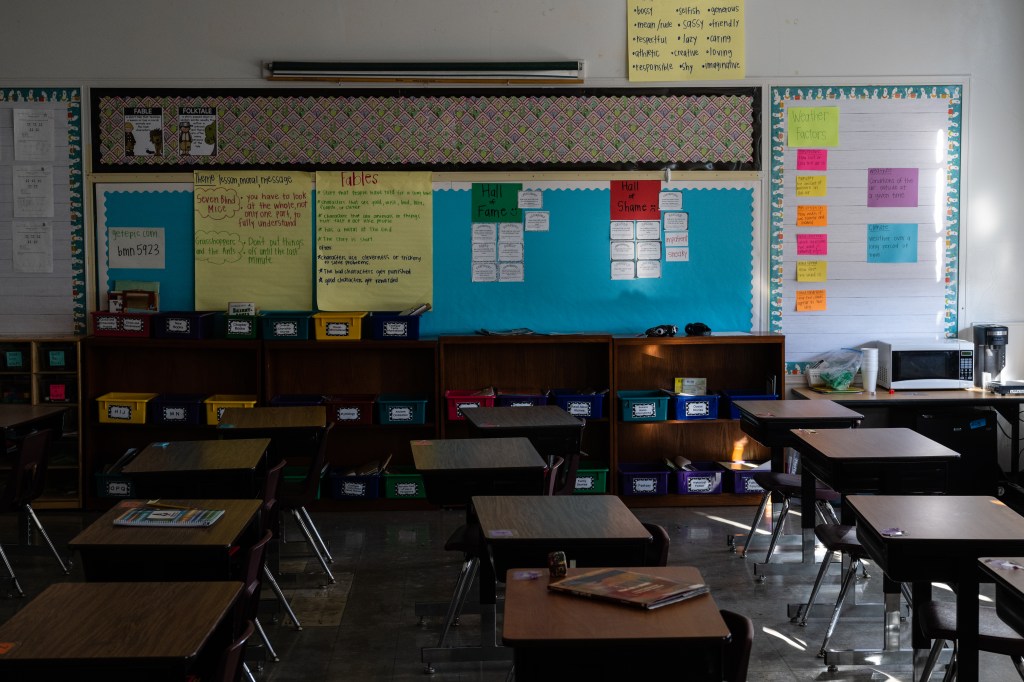
Schools confront the dilemma of inclusion every day to a degree outsiders may not fully appreciate. They are less visible than churches and other spaces; you cannot wander into a school uninvited. Yet inside those walls, maintaining order has become increasingly difficult. Inappropriate student behavior has long been a chronic challenge in American schools, but many teachers report the problem has grown more acute in the years since the pandemic disrupted schooling and children’s social development. The RAND American Teacher Survey, for example, finds that teachers report increased classroom disruption and student misbehavior, with managing student behavior ranking among their top sources of job-related stress.
Disorder doesn’t arrive in schools as a single incident. It spreads gradually, and behaviors once considered unacceptable become tolerated, then normalized. Eventually, the culture of the school bends around accommodating disruption. When that happens, learning becomes secondary to managing chaos. Reflecting on my own experience teaching in a low-performing South Bronx elementary school in my book, How the Other Half Learns, I wrote:
A single disruptive child can bring a classroom to a halt. Put three or four such children in a single room and even minor misbehaviors can have a cascading effect, bleeding away a teacher’s time and attention and student learning. When multiple children with serious behavior problems share a classroom, a level of disorder can ensue that tests the patience and skill of all but the most gifted teachers. When those behaviors become common across classes and grades, an entire school soon groans under its weight.
This is not a mere philosophical concern. Surveys consistently rank student behavior issues among the leading reasons teachers leave the profession. Predictable consequences ensue: Teacher turnover destabilizes schools, instructional continuity disappears, and new teachers arrive unprepared for the conditions they encounter, with many leaving as quickly as they came. Over time, the institution itself begins to falter and fail to serve its primary purpose: educating children.
Faced with these pressures, many schools have responded not by reasserting norms of order and academic purpose but by subtly redefining their mission. Over the past two decades K–12 education has increasingly embraced a quasi-therapeutic role, elevating “social and emotional learning” as a co-equal goal alongside academic instruction. Helping children develop resilience and self-awareness is undeniably important. But when schools drift toward a therapeutic orientation, it becomes harder to draw and enforce clear lines of what is accepted and what is not. And an institution charged with imparting knowledge and cultivating competence begins to forget its own primary purpose.
In the United Kingdom, where the BAFTAs controversy occurred, the debate over school “exclusions” has become particularly intense. Critics argue that suspensions and expulsions disproportionately affect disadvantaged students and therefore should be sharply curtailed. But as British educator Tom Bennett, the former government adviser on school behavior, has argued, removing a persistently disruptive student is sometimes the only way to preserve a safe and orderly environment for everyone else. “Schools aren’t magic; they can’t magically change people,” he told the BBC last year. “Sometimes you do need to remove a child from a mainstream environment.” Exclusion, in Bennett’s framing, is not an indication that schools have “given up” on a child. Nor is punishment the point. It’s simply the price of protecting the common good of the classroom.
Years ago, when I taught fifth grade in that South Bronx public elementary school, many of my students had a rule they said their parents and relatives had taught them to live by: Never “stay hit.” If someone struck you, you must strike back. An unanswered blow—“staying hit”—was intolerable and marked you as weak.
One afternoon, after a particularly acute stretch of disruptive behavior, I reached a breaking point. I turned my ire on the non-troublemakers, the diligent kids who came to school ready to learn every day, and demanded to know why they were staying hit: Their unruly classmates were taking something from them—their education—and they were absorbing the loss in silence.
I’m not proud of the moment; teachers should control their emotions better than I did that day. But what I said was in earnest and captured something real. In every classroom, the students who suffer most from disorder are often the ones least likely to complain.
The moral dilemma at the center of discipline debates is almost invariably framed around the disruptive child. Suspending a student means excluding him from class. It means denying him access to an education. But allowing him to stay can deny opportunity to a far greater number of students. Again from How the Other Half Learns:
When a school or teacher fails to engage or manage disruptive behavior, children are cheated. But who, exactly? The disruptive child who is suspended and excluded from class? Or the diligent student whose education bleeds away hour after hour, while her teacher responds to antisocial outbursts, or focuses on her classmate to prevent them? The weight of education policy and practice, as enshrined in impulse, empathy, and the law, comes down on the side of the disruptive child.
Schools occupy a unique place in this debate because they do more than simply reflect social norms—they help create them. Public transit works only when riders respect basic rules of conduct. Courts function only when citizens accept procedures and verdicts. Workplaces operate only when adults can tolerate standards and correction. Where do those habits come from? School.
It is in school where children first encounter the idea that their freedom ends where someone else’s rights begin. It is where they learn that effort precedes reward, that shared spaces require restraint, and that rules are not merely suggestions. If those lessons dissolve in the classroom, the effects do not remain there. They migrate outward into every other shared space and institution.
To be clear, none of this diminishes the moral achievement of expanding inclusion in American education. Schools that once excluded based on race, disability, or sex now offer all students the opportunity to participate in common classroom life. That progress is real and worth protecting. But excluding someone because of who they are is not the same thing as excluding behavior that undermines a school’s purpose. As Jeremiah Johnson writes, “inclusion is a means, not an end.” The end of schooling is learning. And learning requires the fragile conditions of order, attention, and shared norms.
The BAFTAs grappled with a rare, morally complicated edge case. But teachers navigate a version of that dilemma all day long, with students whose behavior is not involuntary, yet is often treated as if it were. Both situations force us to ask the same underlying question: Are there limits to what shared spaces can reasonably accommodate? If we say no, we may find those shared spaces crumbling around us.