The United States has a long history of trading with its enemies. During World War I, Congress passed the Trading With the Enemy Act to regulate—not prohibit—commercial transactions with wartime adversaries. The logic was straightforward: Sometimes the national interest requires controlled economic engagement even with nations the U.S. is actively fighting. The law remains on the books today, and its underlying premise that wartime trade can serve strategic purposes has informed American economic statecraft for more than a century.
The Trump administration now believes we are in such a moment, where it makes sense to allow the sale of sanctioned Iranian oil if it helps to stabilize global oil markets. But the administration’s approach is misguided—and it fails to prioritize measures that could not only keep money out of the regime’s coffers but also promote transparency in the process. In short, its decision will only help the regime in Iran.
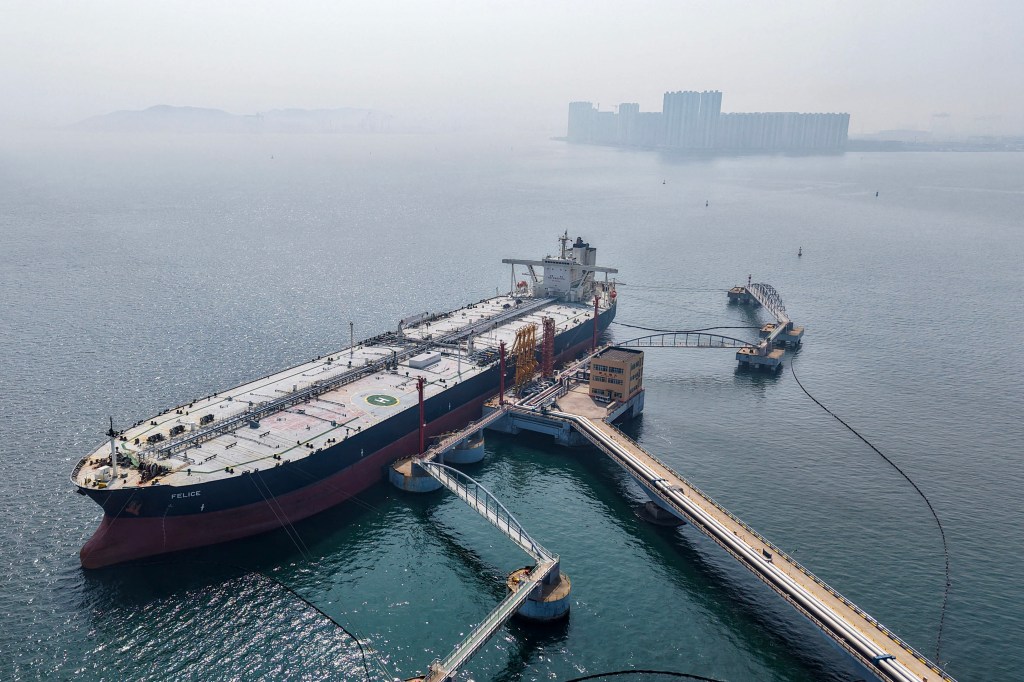
After markets closed on March 20, the Trump administration authorized the one-month sale of what Treasury Secretary Scott Bessent estimates will be 140 million barrels of sanctioned Iranian crude currently held on tankers at sea, which he said could help suppress prices for roughly 10 to 14 days—though that estimate may only hold if accounting for the previously authorized sale of sanctioned Russian crude as well. The general license goes so far as to allow for the import of Iranian crude into the United States. More than anything else, the authorization is meant to signal to global markets that Washington does not seek to interfere with access to energy flows while the Strait of Hormuz remains effectively closed. But the U.S. does not need Iranian oil, and facilitating its sale in global markets will not stabilize prices or meaningfully add to supply. It will, however, strengthen the regime that the U.S. and Israel are currently fighting.
The bulk of Iran’s seaborne crude was already flowing to China through sanctions-evading payment corridors that Tehran has spent years constructing. These Chinese buyers were purchasing Iranian oil at steep discounts before the sanctions relief, and they will continue buying it now. Instead of requiring that Iranian supply go to oil-starved Western markets, the general license effectively removes the legal risk that had at least partially constrained Iran’s illicit oil sector.
What’s more, the authorization contains no escrow mechanism, no restrictions on payment channels, and—unlike recent Venezuelan oil-related general licenses—no reporting requirements on pricing, quantity, counterparties, or the financial institutions facilitating payment. The only notable prohibition is on transactions involving North Korea, Cuba, and Russian-occupied Ukraine. That means the sale of Iranian crude could still involve Russia, which is reportedly providing Iran with intelligence to target American troops.
All of this is happening as the Iranian parliament is working to establish a tax and toll system for what Iran is calling “non-hostile” vessels seeking to sail through the strait. Already, Iran’s Islamic Revolutionary Guard Corps (IRGC) is running a transit corridor through its territorial waters, serving as a shakedown at sea worth up to $2 million per voyage. As of March 23, as many as 20 ships had used what some are calling the “Tehran Toll Booth.” That represents roughly 10 to 20 percent of all traffic through the waterway since the war began. Ships bound for India and China have already passed through, while other governments are reportedly seeking access. The IRGC appears to be policing the system from Larak Island, about 20 miles off Iran’s southern coast, where it is reportedly validating which ships may proceed. Iranian state media claims at least one vessel has already been turned back for lacking approval.
Making matters worse, CNN reported this month that Iran may permit tankers to transit only if their cargo is traded in Chinese yuan. In other words, the administration is relaxing sanctions on Iranian oil just as Tehran may be building a yuan-based transit regime at the world’s most important energy chokepoint. And because the general license includes no reporting requirements, Washington has no reliable way to know whether the transactions it is authorizing are helping entrench that system.
The administration’s sense of urgency is understandable. And trading with the enemy is sometimes necessary. But Congress passed the Trading With the Enemy Act—and later the International Emergency Economic Powers Act—because it recognized that wartime commerce with adversaries demands extraordinary controls. This authorization imposes none. The administration should therefore immediately amend the authorization to establish an escrow mechanism ensuring revenue does not reach Tehran or yuan-denominated accounts in China, require entities relying on the license to report transaction details to the Treasury Department’s Office of Foreign Assets Control, and strike the IRGC’s facilities on Larak Island to ensure Iran does not establish a monopoly over access to the strait.
President Donald Trump said on Monday that both the United States and Iran are interested in making a deal. The start of negotiations makes restricting the regime’s access to cash more urgent, not less. A more sensible policy would be one that prioritizes allied coordination on energy and supply ahead of foreseeably disruptive military strikes. But that is a lesson to be applied ahead of the next conflict. For now, Washington appears left with few means of assuaging market worries—that is, aside from gaining control over the Strait of Hormuz and restoring the flow of global shipping itself.