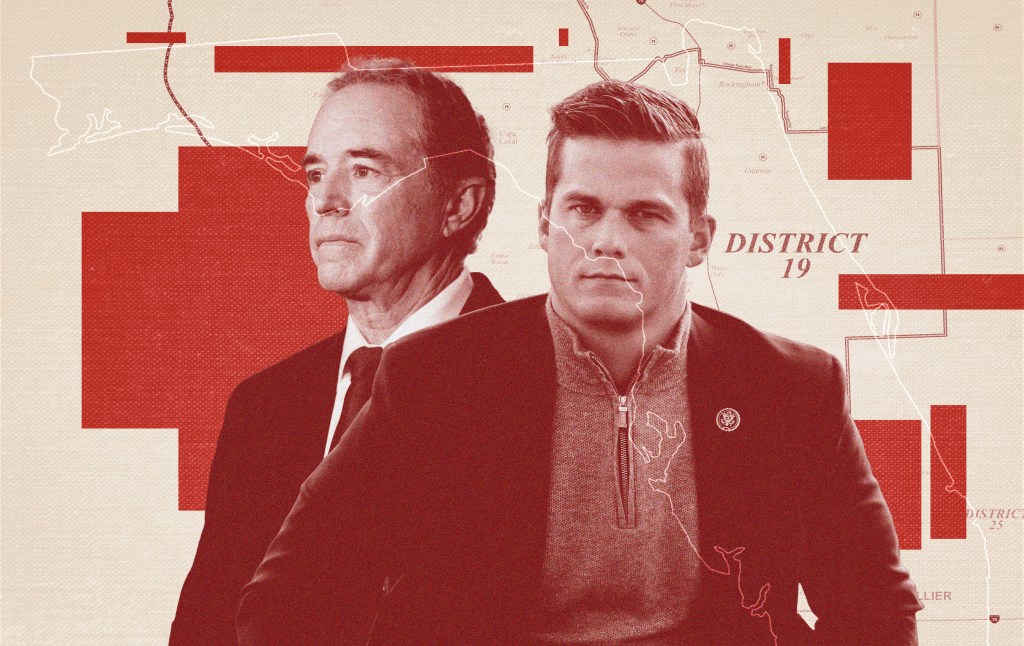
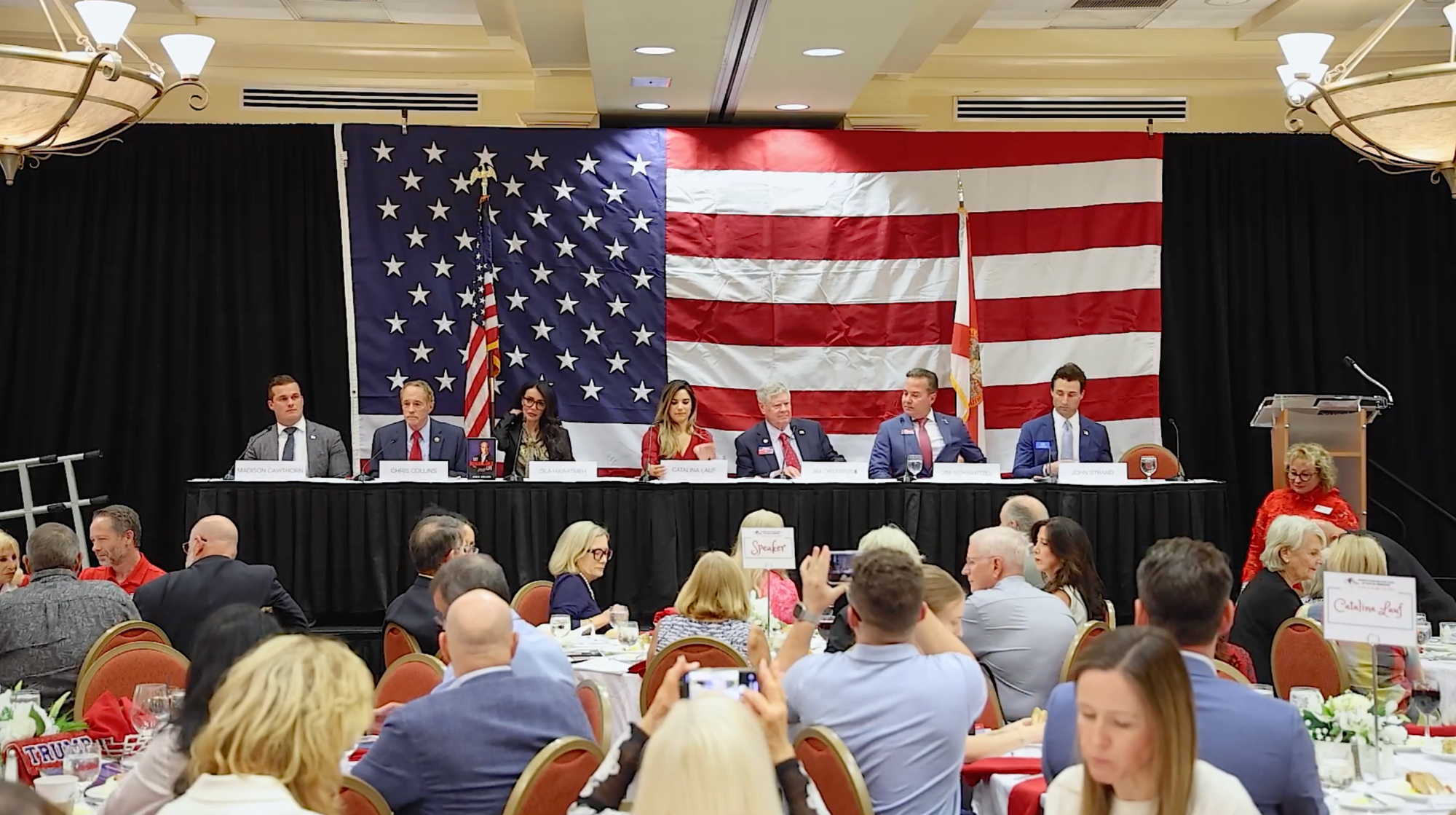
BONITA SPRINGS, Florida—On a warm January evening in southwest Florida, sitting on a dais with six other candidates in front of a massive American flag, former U.S. Rep. Madison Cawthorn presented himself to the ladies of the Women’s Republican Club of Naples Federated as the best candidate for Florida’s 19th Congressional District, summoned by the call of one of the greatest political thinkers of the Western world. “The reason I got involved in politics really boils down to a quote by Plato,” Cawthorn explained. “It said that you can either be involved in politics or you’re destined to be ruled by lesser men.” Not Plato verbatim, but close enough for government work.
And Cawthorn has worked in government before—representing North Carolina’s 11th District for a single term, from January 2021 to January 2023. It was an eventful but unproductive tenure, befitting a man who boasted to colleagues shortly after he was sworn in, “I have built my staff around comms rather than legislation.” Cawthorn’s congressional service began with a rousing speech to the pro-Trump mob at the U.S. Capitol on January 6, 2021—he praised their willingness to fight, declared the 2020 election fraudulent, and later voted against certification. It ended with a flurry of bizarre and discrediting moments over the weeks leading up to the GOP primary for his reelection campaign. Cawthorn claimed that he’d attended cocaine-filled orgies with colleagues on Capitol Hill (he later recanted); he was featured in a series of leaked photos (wearing women’s lingerie) and videos (one showing a male Cawthorn staffer placing his hand on Cawthorn’s crotch and another of a naked Cawthorn simulating sex with a man in bed). A week after he lost that primary contest, the House Ethics Committee announced it was investigating the congressman for a possible improper relationship with a staffer and for a potential conflict of interest in his promotion of the LGB (Let’s Go Brandon) cryptocurrency. (He was ultimately fined $15,000 for the latter.) Cawthorn’s study of Plato apparently ended before the four cardinal virtues of a philosopher-king.
That Cawthorn is a viable candidate—indeed, given his name recognition and MAGAworld celebrity status, he’s considered a real contender—says a lot about the contest in this dark red corner of Florida’s Gulf Coast and about the state of the Republican Party in the Trump era. The GOP primary is August 18, and the campaign—or the online campaign, anyway—is well underway.
When Republican voters here describe a politician or activist as “ultra-MAGA,” it’s almost always meant as the highest compliment. A local grocery chain serves MAGA beer on tap, and its aisles were packed shoulder-to-shoulder for the “Seed to Table” inaugural party in January 2025. The district’s waterways held some of the first “Trump Boat Parades.” The main country music station calls itself “Trump Country.”
“Obviously, it’s a very pro-Trump, pro-MAGA district,” says Rep. Francis Rooney, who served as U.S. ambassador to the Vatican under George W. Bush and represented the district during Trump’s first term.
The seat is currently held by Rep. Byron Donalds, a conservative and Fox News regular, who is giving it up to run for governor. Republican voters in his district speak of him with reverence—and so does Donald Trump. “Byron Donalds would be a truly Great and Powerful Governor for Florida,” Trump posted on social media, offering his “Complete and Total Endorsement.”
Donalds has long been touted as a Republican rising star and made little secret of his interest in higher office. Would-be replacements have been talking openly about running for at least three years and the prospect of an open seat here has made the district something of a magnet for MAGA retreads from around the country.
Each of the seven candidates onstage during the January candidate forum made a claim that is demonstrably, provably false. Six are not from the district they seek to serve. Five have run for office in another state. Three have been endorsed by Trump in a previous race. At least three have spent time in jail. Two served in Congress and left in disgrace after scandals. Two have gotten Trump pardons. And one will be the next member of Congress from southwest Florida.
Cawthorn explained to the crowd that he’d moved to Florida in 2022 and fallen in love with voters in southwest Florida after the eye of Hurricane Ian “went right over my house.” “I came down here to get away from politics,” he insisted, “but when I saw the cast of characters that were running to replace Byron Donalds, and after Charlie Kirk was brutally assassinated, I realized I had to get involved.” (In fact, Cawthorn told Punchbowl in November 2024—10 months before Kirk was killed and long before any other candidate had announced—that he was “very much interested” in running if Donalds gave up his seat.)
Chris Collins, the candidate seated directly to Cawthorn’s left, seemed untroubled by the implication he was a lesser man and one of the unworthy “cast of characters” who had allegedly motivated Cawthorn’s attempted political resurrection. Collins, bizarrely, absorbed the insults by offering Cawthorn a nod of his head and a warm smile before joining the crowd in a round of applause. “My name is Chris Collins and I’m running for Congress to ensure a bright future for our children and our grandchildren.”
If that name sounds familiar, there’s a reason. Collins represented the citizens of New York’s 27th Congressional District from January 2013 until October 2019. Like Cawthorn, he also left office in disgrace—not merely an accumulation of scandals, but insider trading charges that led to his resignation and jail time—and is relatively new to southwest Florida. “When I return to Congress I will work with Donald Trump to help make America great again, just like I did when he appointed me as the congressional liaison to the White House during his first term,” Collins said, with evident pride. Although Collins used his opening remarks to emphasize (again and again) his coziness with Trump, he left out the best evidence of their close relationship: Trump pardoned Collins after his guilty pleas and let him out of prison just two months into a two-year sentence.
To Collins’ immediate left was Ola Hawatmeh, a self-styled MAGA influencer and congressional aide who lost a GOP primary race in New York in 2020 and moved to Florida. Next to Hawatmeh? Catalina Lauf, a first-term Trump appointee at the Department of Commerce, who moved to Florida from Illinois, where, over the last several years, she was a candidate in GOP congressional races in three different districts—the 11th in 2022, the 16th (briefly) in 2021, and the 14th in 2020. Lauf finished third in that GOP primary—losing, in an odd coincidence, to the man seated directly to her left on the dais at the Naples forum.
Jim Oberweis, a successful investor and onetime dairy magnate, has run and lost so many times that he’s known in Illinois as the “Milk dud.” Oberweis ran for U.S. Senate in Illinois in 2002 and 2004. He ran for governor in 2006. He ran for the House in the 14th Congressional District in 2008 (in a special election and the regular election). He ran for the U.S. Senate again in 2014, winning the GOP primary and losing to Sen. Dick Durbin. (He ran for the Illinois state senate in 2012, and served for eight years.)
Next to Oberweis was Jim Schwartzel, the one candidate present who was born and raised in the district. Schwartzel owns the aforementioned “Trump Country” radio station.
The final candidate on hand for the Naples forum, John Strand, moved to the district in 2022 from California and was, like Madison Cawthorn, among the mob of pro-Trump agitators who gathered at the U.S. Capitol on January 6, 2021. Unlike Cawthorn, who had been sworn in as a member of Congress three days earlier, Strand was not allowed to enter the Capitol that day. He was convicted by a jury on five counts—including obstructing an official proceeding of the government, a felony. Strand, who was released following a Supreme Court decision restricting the use of the obstruction charge, is unapologetic about his behavior on January 6. The tagline on his opening ad points to the date of the GOP primary and urges voters to back him. “On August 18, 2026, let’s storm the Capitol for real.” Strand, like Collins, is the recipient of a pardon from Trump, who was of course impeached for his role in instigating the violence of that day.
Three of the candidates who didn’t make it to the event are also transplants. Linda Sawyer has been active in Michigan GOP politics for years and has run unsuccessfully for House seats each of the last four cycles, in three different Michigan districts. Johnny Fratto, a Roger Stone-endorsed MAGA activist who ran and lost in a GOP primary across the state in 2024. (Fratto, who launched his campaign with a MAGA rap video because “this is what’s grabbing eyeballs,” has since withdrawn and endorsed Cawthorn.) Dylan Modarelli recently relocated from New Jersey and ex-Marine Mike Pedersen is the only candidate other than Schwartzel who is a longtime district resident.
My interest in this contest began during the Super Bowl. Watching the game with relatives in the Fort Myers area, one ad stood out. Between the over-the-top cinematic commercials that dominate Super Bowl Sunday—Clydesdales and Ben Stiller and giant hairballs and a clean-shaven Guy Fieri—was a boring political ad featuring a gray-suited old man bragging about his ties to Donald Trump.
A narrator with a gravelly “Ford Tough” voice described “successful businessman, America First fighter” Chris Collins over clips of Collins doing politician things. The ad cut to an undated video of Trump praising Collins at a rally. “Chris Collins”—jump cut—“right from the beginning he said Trump was going to win. Now I love him.”
I hadn’t thought about Collins for years and vaguely remembered his legal troubles, so I did a quick search on my phone. Sure enough, there was a story on Collins and the ad. A few more clicks and I learned that Cawthorn was running, too. The terrific political website Ballotpedia had a full list of the candidates—and down the rabbit hole I went. (It was considerably more interesting than the game.) Surely, there was a candidate who could thwart the comeback attempts of these two miscreants, right? And even in this super-MAGA district there might be someone running as an old-school, limited-government conservative who could prevail in a race with a field of Trump acolytes?
A quick tour of the campaign websites didn’t inspire confidence. The tagline for Ola Hawatmeh, “Trump Conservative. Florida First.” (Literally Florida second, of course, since she’d first run for Congress in New York.) “Catalina Lauf is a proud former member of President Trump’s Administration and is running for Congress in Florida’s 19th District to fight for the America First agenda.” The first words on Jim Schwartzel’s website: “Just like President Donald Trump, I am a businessman—not a politician—and I’m ready to be your conservative fighter in Congress.” John Strand: “President Trump is leading the Great American Comeback—but he needs soldiers in the trenches. I’m ready to fight this battle.”
Chris Collins: “Standing with President Trump since Day One. First Member of Congress to endorse Donald Trump for President in 2016. Founder and Chair of the TRUMP caucus. Former Congressional Liaison to the White House.” Madison Cawthorn’s website fronts a popup video of Cawthorn and Trump together, and his bio boasts, “In Congress, Madison quickly became one of President Trump’s fiercest and most trusted voices in advancing the America First movement.” (His page also features the Cawthorn campaign’s new Trumpy video game, “Sink the Drug Boats.” Really.)
The only candidate whose website didn’t lead with Trump is Jim Oberweis, who allows visitors to take a deep look at his views on issues and makes few mentions of Trump at all. Is Oberweis planning to zig while the others zag? Apparently not. His campaign is nudging the White House political team for a Trump endorsement—something the president gave Oberweis when he ran in Illinois in 2020.
They’re not alone, of course. Each campaign is pulling every string it has to connect the candidate to Trump in the hopes that he’ll endorse.
“A Trump endorsement is the golden ticket,” says Jacob Ogles, a political writer for Florida Politics.
“For a congressional race, if Trump were to enter—particularly for this district—it would potentially be a field-clearing exercise and be decisive,” says Brett Doster, a longtime Florida GOP strategist.
In addition to Oberweis, Trump has endorsed both Cawthorn and Collins in previous contests. The Super Bowl ad featuring Trump declaring his love for Collins has created the misimpression among some voters here that Trump is backing the former New Yorker in this contest. It’s not dishonest, exactly, but if people draw the wrong conclusion it’s unlikely Collins will lie awake at night wrestling with his conscience.
Chris Collins was first elected to Congress in 2012, representing western New York, and served without distinction for his early congressional career. But he made quite a splash in early 2016 when he became the first sitting member of Congress to endorse Donald Trump’s presidential bid. “For those Americans who want a brighter future for their children and grandchildren, it is the Donald Trump train they need to be on,” Collins told CNN’s Erin Burnett, who noted that he was a “lonely man” in his backing of Trump. The early bet paid off. When Trump was elected, he tapped Collins as a congressional liaison with the White House, and over the course of the next several years, often gave him a prime seat directly to his left when he hosted congressional Republicans for meetings.
He was attending a congressional picnic on the White House lawn on June 22, 2017, when he received an email from a business associate. Collins was on the board of Australian pharmaceutical company Innate Immunotherapeutics, which had developed a promising drug to mitigate the symptoms of multiple sclerosis.
MIS416, the company’s on major product, had been in the final stages of FDA approval for about a year. In the months before the results came in, the company was bullish about approval. Members of Collins’ family, including his son, Cameron, and Cameron’s fiancee and father-in-law to be, bought shares of the company. (Several of Collins’ GOP colleagues had purchased Innate stock, too—Reps. Mike Conaway, Doug Lamborn, Billy Long, and Markwayne Mullin.)
“I have bad news to report,” Innate CEO Simon Wilkinson wrote in the email Collins received at 6:55 p.m., noting that there had been “no clinically meaningful or statistically significant differences in [outcomes] between MIS416 and placebo.” Collins, who was attending the picnic with three guests who had also invested in the company, replied 15 minutes later. “Wow. Makes no sense. How are these results even possible???”
One minute after hitting send on his reply to Wilkinson, Collins and his son traded six missed phone calls in four minutes—a flurry that finally ended when they connected for a six-minute phone call. Prosecutors alleged that Rep. Collins shared the bad news with his son—four days before it would become public—and that Cameron Collins began to sell his shares the next morning. The younger Collins also told several others about the results of the trial—leading those investors to sell their shares, too. In all, prosecutors said, those investors saved $768,000 based on the tip from Rep. Collins—avoiding losses that would have come when the stock plunged 92 percent in value after the results were reported to the world.
Collins awoke at 6 a.m. on April 25, 2018, to FBI agents showing up at his Washington, D.C., apartment and in brief questioning denied that he had shared the insider information with his son. On August 8, 2018, Collins was charged with lying to the FBI on top of charges related to insider trading. Collins struck a posture of defiant anger. “I am innocent of the meritless charges that have been placed against me, and I’m confident I will be exonerated,” Collins insisted in a local TV interview, with MAGA hats displayed over his shoulders.
“I am standing here today perhaps as my last time to address the people that I have disappointed and to apologize to them from the bottom of my heart. I stand here today as a disgraced, former member of Congress that will have that asterisk by my name.”
Chris Collins
After then-House Speaker Paul Ryan stripped him of his committee assignments, Collins initially announced he would abandon his reelection campaign. He abruptly reversed that decision a few weeks later, again claiming his innocence and narrowly defeating his Democratic opponent to keep his seat. Collins said the case cost him votes, but vowed to move on with his legislative work. “It is what it is and I know I’m innocent, and I’m confident I will be exonerated, and stick it on the shelf,” he said.
Collins didn’t discuss the case much as the two sides prepared for trial, but when he did it was all bravado. “I am innocent of the charges,” Collins said in July 2019. “Why would I ever even enter a plea deal? I’m innocent.”
Two months later, Collins accepted a plea deal and three months after that tearfully confessed his guilt at his sentencing hearing. His lawyers spoke first. Attorney Jonathan New conceded that his client “lied to the FBI” and “made bad, wrong, illegal decision to lie about the fact that he had tipped his son to the information” and then just kept lying, because “one lie leads to another.’
Jonathan Barr, another lawyer for Collins, told Judge Vernon Broderick: “He accepted responsibility for his crimes, he has demonstrated sincere remorse. There is no excuse for the conduct. He doesn’t make any excuses for the conduct.”
Then it was Collins’ turn. He started by offering gratitude to the judge for his impartiality. “I want to begin by thanking you for what I see as a very insightful time you have spent looking at this case, the questions that you have asked that tells me your decision today will be a very well thought-out, considered opinion, and I frankly, considering my actions, I can’t ask for anything more than that,” he said, choking up. “I’m sorry. I’m not an emotional person.”
He turned from gratitude to shame. “I violated my core values and there is no excuse. None whatsoever. So, I am standing here, probably the last time I will do anything in public,” Collins said, explaining that his shame was so overwhelming he’d decided to move out of state, to a place where he’d be protected by relative anonymity.
You know, after I pled I went—I did, I left Buffalo, I went to Florida. … I cannot face my constituents. What I have done has marked me for life. People feel sorry for me. They shouldn’t. They do. And to walk into a restaurant and have people come up and say that, that’s not—I mean, I did what I did and I violated my core values. I don’t deserve their sympathy. It’s awkward to the point I can’t go home. At least where I am somewhere where no one knows me, I’m not faced with that.
Then Collins offered a series of apologies. “I am standing here today perhaps as my last time to address the people that I have disappointed and to apologize to them from the bottom of my heart,” he said, specifically directing his words to his family, his constituents, his congressional colleagues, and the president. “I stand here today as a disgraced, former member of Congress that will have that asterisk by my name.” Collins even apologized to the federal law enforcement officials whose work brought him to this point. “I apologize from one end to the other, to the FBI for lying to them. I mean, trustworthy as they think, I’m not going to make an excuse but I lied to them, and I can never justify that and I can’t take it back. I did it and I should not have.”
Collins hinted that he was suicidal after his arrest and lamented that his grandkids would one day come to understand his misdeeds. At one point, he expressed gratitude that his mother, who had died the previous year, “went to her grave as a 92-year-old not knowing that her son disgraced the family.”
Michael Wooten, a local Buffalo reporter who was in the courtroom, said in a live report immediately after the hearing that Collins offered “about as full-throated an apology as you can imagine” and echoed the views of a legal expert in concluding it “probably shaved some time off of his sentence.”
Judge Broderick sentenced Collins to 26 months in prison, which Collins began serving on October 13, 2020. A little more than two months later, on December 23, 2020, Trump pardoned him. Collins was free to return to the quiet life of anonymity he’d made in southwest Florida, where he could avoid the unwanted attention and abiding shame of his fall from grace. At least for a little while.
Solitude can be boring, especially for a public figure who’d grown accustomed to being recognized, even celebrated, for his public service. So he soon emerged with a new story, a Trump-era theme and echoes of the remarkable comeback his political idol was attempting. I’m a victim. The FBI entrapped him, the DOJ targeted him, Republicans abandoned him, and he said what he’d said only to save his son.
Collins claimed federal law enforcement had gone after him because he was such an effective spokesman for the president. “The bias in the agenda of the FBI and the DOJ to take down Trump and his MAGA supporters is obvious,” Collins told a crowd at a July 2023 “United We Stand Trump Flotilla,” opening his remarks by proclaiming, “I’m baaaaaack.”
“They took me down. They persecuted me into a guilty plea by inexcusably going after my 24 year-old son.” Why did the DOJ do this? They wanted “my resignation from Congress, which silenced my voice supporting Donald Trump on cable news.”
Collins offers an exhaustive—and exhausting—version of this revisionist history in his book, My Remarkable Life: The First Sitting Member of Congress to Endorse Donald J. Trump for President, published in December 2025. Collins proudly displayed the book on the table in front him during the Naples candidate forum.
He was candid about his motivation for writing the book in an interview he gave to longtime Buffalo News reporter Jerry Zremski. “I’m hoping it’s interesting enough that people will read it, and when they come away having read it, they’ll realize the Department of Injustice persecuted me, prosecuted me, railroaded me, coerced me into that guilty plea—which will help me then also win my election.”
“I don’t think that we should stop at Venezuela. I think that we should take Greenland. I think we should take the Panama Canal. I believe that we should have complete hegemony of the Western hemisphere.”
Madison Cawthorn
The book is not interesting enough that many people will read it. Collins writes of his time in Washington with a shocking lack of self-awareness. He mixes dull, jargon-laden descriptions of companies he’d invested in with accounts of his trips on Air Force One, mingling with influential figures, and Trump pointing him out at rallies. When I ordered my copy in mid-February, the sales-tracking company BookScan had recorded 112 sales of My Remarkable Life over the first two months.
And there’s little chance that anyone familiar with the facts of his case, however sympathetic they might be at the outset, will believe that he was unjustly prosecuted. Here’s how Collins describes the details of the “bad news” email he received and the phone call that his lawyers have acknowledged he made to tip off his son to the failed trial. “I have no memory of what happened between 7:00 PM Thursday and Friday morning. I have since learned about ‘dissociative amnesia,’ a rare condition stemming from emotional shock or trauma, which can cause memory loss for brief periods. This describes my mental state after reading Simon’s email … I have a vague memory of making these calls but cannot recall the content of the conversations.”
And what about Judge Broderick, whose wisdom and impartiality Collins had praised at sentencing? “Biased and personal” and “appointed by President Barack Obama” with “a willingness to ignore judicial norms.”
The prosecutor? “[Geoffrey] Berman consciously chose to indict me with the deliberate and inappropriate expectation that it would significantly harm my reelection prospects.”
And the FBI agents to whom he’d apologized? “Their sole intent was to entrap me into making a false statement that could be used against me.”
I called Michael Wooten, the Buffalo television reporter who’d covered the Collins sentencing, to get his reaction to the new story. “I was just completely flabbergasted,” he says. “It was the polar opposite of what I heard in the courtroom. I don’t think Chris Collins is an award winning actor. There were tears—it didn’t seem like he was reading a script.”
Collins is already running ads implying he’s Trump’s choice. And in a Trumpy district, where the candidates are aligned on policy, that’s a big advantage. But he may have an even Trumpier Trump card: the president’s pardon. It’s true that John Strand also got a Trump pardon, but that was a blanket pardon of January 6 rioters. If Collins wants to demonstrate that he’s really Trump’s guy, the president’s pardon of him, by name, is something none of the other candidates can claim. In politics before Trump, a candidate would go out of his way to avoid bringing attention to his criminal past; in this new world, he could well run on it—and it might actually help him.
Six days after seeing the Super Bowl ad, I was back in southwest Florida to cover the race. I reached out to several candidates and their campaigns and strategists to get a sense of campaign happenings I could attend. First up, on Valentine’s Day? The President’s Day “Freedom Fleet: A Presidential Road Rally.” It sounded like a big deal. “The streets of Southwest Florida will thunder with patriotism as the America First Republican Club, Inc. unleashes Freedom Fleet — a full-throttle Presidential Road Rally celebrating 250 YEARS of American Freedom and the Greatest President in all of History, Donald J. Trump!” the flier promised. “This isn’t just a local parade. This isn’t just another event. Featured patriotic vehicles are traveling from as far away as TEXAS. Answering the call. Crossing state lines. Joining a convoy that proves the American spirit is alive, mobile, and unafraid.”
Unafraid? They made vehicles crossing state lines sound adventurous and vaguely dangerous. I’d driven nearly 20 hours straight to Florida over the Christmas break, crossing through five different states. And though I’d endured several rounds of fast-food stops, and the shared gastrointestinal consequences of those choices, I hadn’t even realized my own bravery.
Before the “Presidential Road Rally,” I’d reached out to the organizers in advance but hadn’t gotten a response, so I showed up in downtown Fort Myers at the start to take it all in. One of the first vehicles I spotted was a white Ford Expedition—the MAGA equivalent of an over-bumper-stickered, left-wing Subaru. But instead of “Coexist” or “Eat the Rich” or “No Uterus, No Opinion,” the Expedition was festooned with MAGA flags, stickers and die-cut vinyl letters for do-it-yourself signage. A big T-R-U-M-P across the back window (TR in red, U in white and MP in blue.) A homemade “Let’s go Brandon” message below that. A “My Family” sticker on the right tailgate, a “Welcome to America, Now Speak English” sticker on the left bumper. The back of the car featured 10 pro-MAGA stickers, the driver’s side another 15.
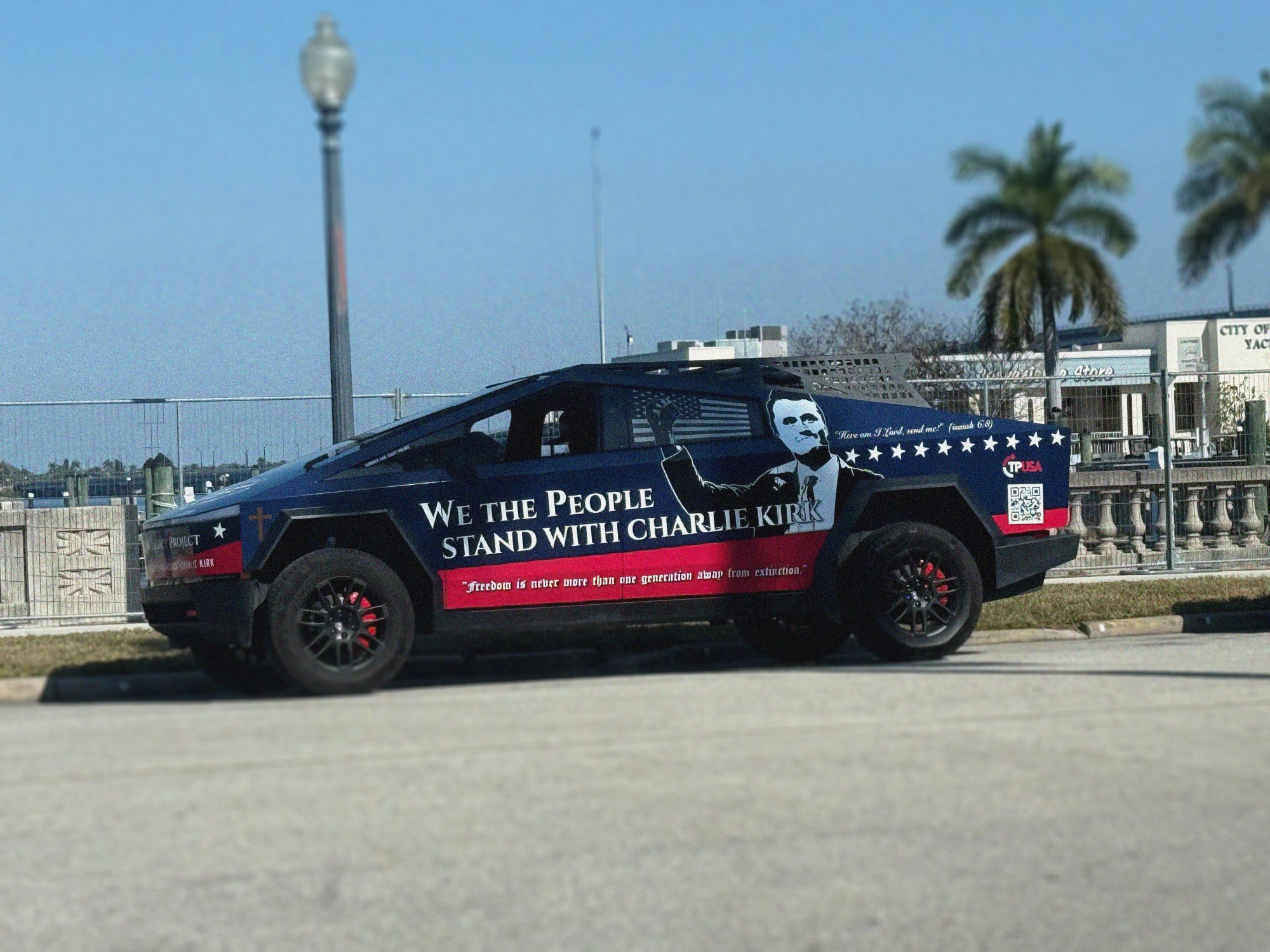
A white BMW boasted a hood painted with an American flag featuring an angry bald eagle in the middle, stars-and-stripes side mirrors and a Molon Labe (“Come and Take Them”) sticker down the front windshield. There were two guys decked out in American flag suits—stripes on the left, stars on the right—one wearing a red Make America Great Again hat and the other a matching cowboy hat. (The MAGA hat guy won that head-to-head “best dressed” contest, given his American flag Chuck Taylors.) There was a full-sized patriotic RV, with a back panel featuring a remake of Arnold Friberg’s The Prayer at Valley Forge painting, a Tesla Cybertruck fully wrapped with a Charlie Kirk tribute, a couple of Jeeps with multiple Trump flags, and a handful of cars undecorated but for red-white-and-blue ribbon or a small flag. The total number of vehicles fluctuated as they wound their way through the streets of southwest Florida—topping out at 18, not including the used 2009 Cadillac with cheetah print floormats that I’d borrowed for the ride.

I hadn’t expected to be part of the parade. My plan was to drive alongside the caravan and take it all in. But a tricky merge and a welcoming gesture from one of the flag-draped Jeeps and suddenly I’d become part of this “rolling tribute to our Presidents, our Constitution, and the freedoms handed down across two and a half centuries.” The parade itself was boring—a slow, two-hour caravan with frequent horn-honking and occasional scrambling to keep the fleet together. No real street thunder here. I had the same thoughts I’d had in high school, when classmates spent hours “driving the strip.” What’s the point? Nearly everyone we passed paid some attention—supportive fist pumps and eager hand-waving, extended middle fingers and angry shouts about ICE and immigration. But the vast majority of the people along the route—pedestrians and fellow drivers alike—wore expressions that conveyed their confusion. Some bemused, and even in this deep red district, some disgusted.
The Freedom Fleet ended at a restaurant in Cape Coral called “Foster’s Grille,” sister restaurant of one in northern Virginia, featuring exceptionally cold tap beer, excellent cheesesteaks and a very cool tribute to cops on the wall behind the bar, with an array of police patches from around the country.
I spied Madison Cawthorn at a table with a few attendees and campaign volunteers. Cawthorn, who is paralyzed from the waist down and uses a wheelchair, was wearing an American flag polo shirt with “MAGA” running down the right side of his rib cage. I stopped him to say hello as he made his way toward the men’s room. He offered an enthusiastic greeting, as if he were seeing a long lost friend, and a strong handshake. I wasn’t sure whether he actually recognized me or was just being polite—he’d offered similarly effusive greetings to pretty much everyone he encountered—so I introduced myself as a journalist with The Dispatch and NBC News. He squinted a bit and nodded his head as he tried to place me. It all seemed to click when I mentioned that I’d been a regular on Fox News for years. I told him I was reporting a story on the GOP primary and mentioned that I’d watched the candidate forum in January. He seemed excited. I asked him for an interview—today if possible, but anytime over the rest of the week if he preferred to spend time with voters at the rally. He gave me an enthusiastic yes—he does everything with enthusiasm, it seems—and when I asked him for the best way to contact him if we didn’t connect after the rally, he eagerly shared his cell phone number—or, at least, a cell phone number.
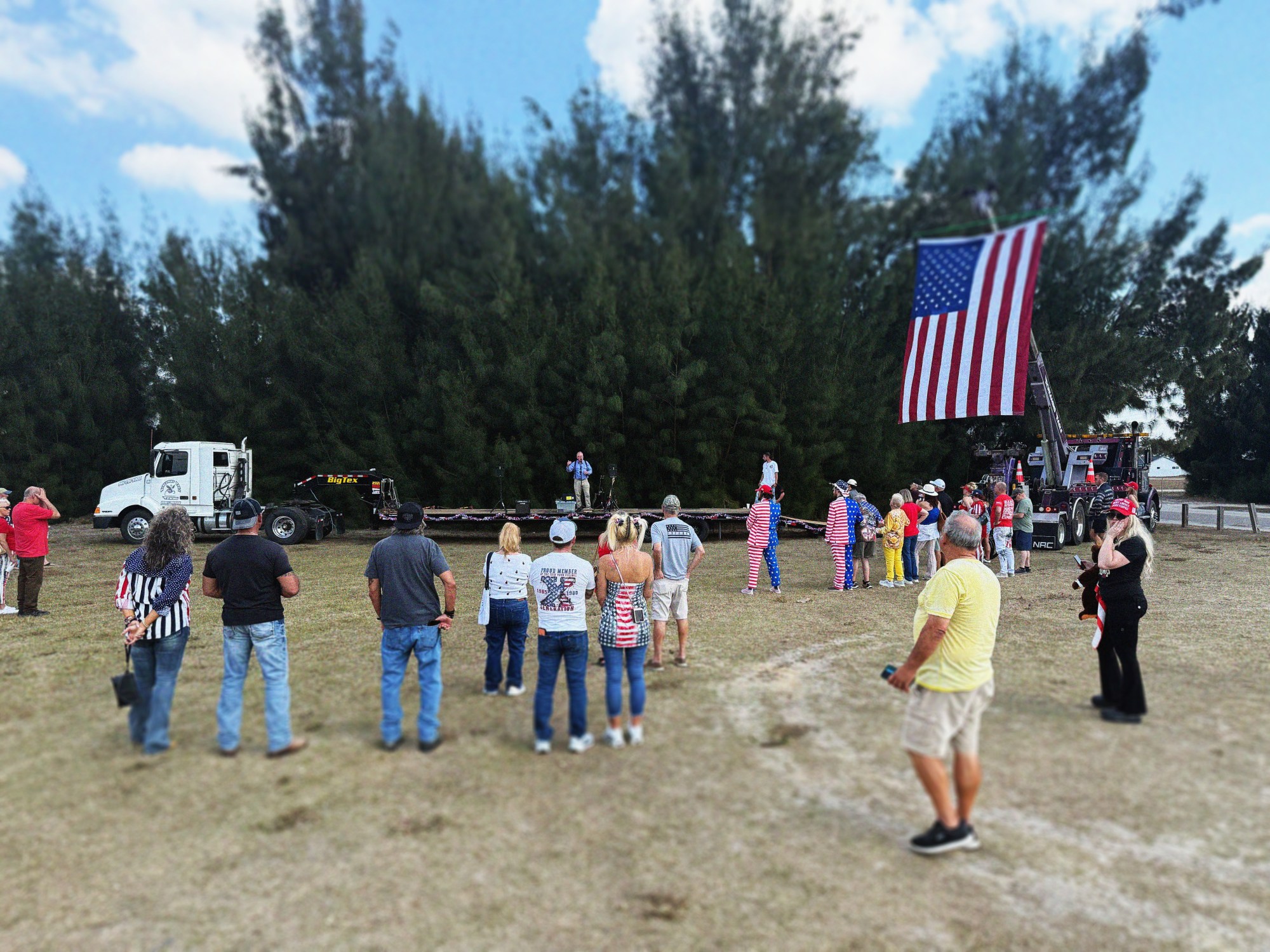
The flier for Freedom Fleet had promised a massive party on a lot adjacent to the restaurant where “the rally explodes into a full celebration,” including a “powerful keynote address” from a mystery guest. There was a flatbed stage, a crane with a massive American flag and several merch tents, with everything from “Gulf of America” hats to Valentine’s Day cards (“You Stole My Heart Like a 2020 Election”). But the rally was a dud, with roughly 50 attendees in total by my count. The main speaker was an America Firster from New Zealand named Trevor Loudon, who introduced himself as an expert in communism and told the crowd he would let them in on a secret plot—“a little communist operation that’s affecting Florida right now that you’ve probably never heard of.”
The Chinese Communist Party, it turns out, is taking the U.S. state by state. The CCP had already stolen a gubernatorial election in Virginia, he warned, and Florida was in its sights. Virginia went from red to blue “because in 2007, a pro-Chinese communist group called the Freedom Road Socialist Organization, the people who started Black Lives Matter, they set up a voter registration group in Northern Virginia called New Virginia Majority, with lots of Soros and foundation money.” How did they do it? “They were using GIS computerized maps that had every single precinct in Virginia mapped out, they could tell you where all the ethnic communities lived,” Loudon explained. “Now, those maps were made on contract working out of the Geography Department of Wuhan University, China. So Chinese maps, Chinese money flipped Virginia.”
And now it’s going nationwide. How does it work? “They used the Obama formula to run candidates of color, energize the minorities, and win elections.” This portends doom for right-thinking Americans, he worried. “They flipped Virginia. If they can flip North Carolina and Georgia, which they’ve almost done, and Arizona, and one more southern state by using the minority populations in those states, they will basically take control of the Electoral College. If they can get either Texas or Florida, there will never be another Republican president in American history.”
Loudon spoke for 25 minutes. Cawthorn was next. As he looked out at the smattering of voters before him, he warned about complacency. “You know, for so many people they feel like our nation is in peril during these midterms coming up,” Cawthorn said. “They feel like the voting population that went out and elected Donald Trump is not really enthused, and wanting to get out to the polls, to be able to elect and keep a majority so that Donald Trump can execute his plans. And my friends, I think that they might be right.” The problem, he said, was go-along-to-get-along types in the Senate, who don’t say what they really believe for fear of being called a racist, or Nazi, or bigot.
Cawthorn didn’t go deep on policy—it was a short speech, and Cawthorn never goes deep on policy. Domestically, he wants lots of arrests. “If you don’t like this country, you can just leave. And if you don’t want to leave, and you want to try and destroy our country from the inside, we will arrest you, and we will deport you,” he said. Also, the people responsible for “waste, fraud, and abuse”—turning their backs on the American taxpayers—“they must all be arrested.” On foreign policy, he’d like some more wars. The U.S. should start acting like the “preeminent superpower that this world has ever known” and stop making apologies for our strength. “I don’t think that we should stop at Venezuela. I think that we should take Greenland. I think we should take the Panama Canal. I believe that we should have complete hegemony of the Western hemisphere.” (These comments came before the war in Iran, but since Cawthorn’s argument for starting these wars was that China or Iran would start them to occupy the Western Hemisphere if we didn’t start them first—truly—I think he’d be okay with it.)
As the program wrapped up, I caught up with Mercedes Price-Harry, chair of the Lee County Republican Party, a powerful post in one of the district’s two main counties. Price-Harry came to politics in the Tea Party era and is a libertarian-minded acolyte of Ron Paul. She’s very happy with the enthusiasm that the MAGA movement has brought to Republican politics here, in general, even if she’s not on board with all of the policies coming out of the White House. She was disappointed with the turnout at the event and pointed to off-year complacency as part of the explanation. In 2024, with Trump on the ballot, these kinds of events typically drew hundreds of people. The boat parades in southwest Florida drew hundreds and hundreds of people and made national news. “It’s a midterm election year. I think this year is a little wonky,” she said. (As we spoke, I noticed Cawthorn slipping out a side road to his getaway car—so no interview. And when, over the next few days I texted the number he gave me to follow up, he didn’t respond.)
“I think that Republicans generally saw that we were able to, in our mind, save the country from the brink,” Price-Harry said. “We got our guy in, and so we can kind of sit back a little bit, relax. And I think that’s where everybody—that’s where I think the average person is.”
That’s undoubtedly true. And if it’s a problem for Republicans here, it’s a problem across the country. A Washington Post/ABC News poll taken last month shows Democrats have a major advantage in voter enthusiasm—the largest since the 2006 midterms that Democrats dominated. Asked whether they are certain to vote in November’s elections, 79 percent of Democrats responded in the affirmative, compared to just 65 percent of Republicans.
But there’s a curious thing about this race, now less than five months until the August primary. It’s not just that people aren’t showing up at events. There’s not much actual campaigning taking place.
During the week I spent in the district in February, there were three events scheduled—total. The Freedom Fleet rally, a Ronald Reagan dinner, and a meet-and-greet with Jim Pedersen. I had returned to southwest Florida with plans to rush from campaign event to campaign event, running myself ragged and filling up multiple notebooks with observations from speeches, happy hours, candidate interviews. But there wasn’t much traditional campaigning to cover. The Pedersen meet-and-greet was postponed, as it happens, and rescheduled for later in the month. (Both gatherings are still listed on the campaign’s website under the “events” tab, with no new events on offer. But even if it’s out of date and the listings are sparse, Pedersen gets credit for even having an “events” section of his website—something that few other candidates have.)
Some of this can be explained by macro trends in campaigning evident well beyond Florida’s Gulf coast. The digitization of our political lives continues apace—livestream meetings replacing handshakes, short-form videos instead of stump speeches, emails and texts instead of clipboards and door-knocks. Some of it may be timing—even though the ad wars have begun, the primary is still five months away.
But in my conversations with strategists, candidates, party officials and others, they point to a much bigger reason. Right now, at least, the race in Florida 19 isn’t so much a contest about winning the hearts of voters so much as it is a competition to win the backing of one man: Donald Trump.
“Nobody’s really campaigning—except to campaign to Trump,” says Francis Rooney, the former representative for the district. “The idea of Trump, the impact of Trump and MAGA is so overwhelming right now that the people want to be in that tent. And so they’re focusing on the things that are going to get the attention of the MAGA leadership.”
They’re not subtle. Ola Hawatmeh, who attended a Mar-a-Lago ceremony in January to celebrate the announcement of “President Donald J. Trump Boulevard” in West Palm Beach, earlier this month proposed the “President Donald J. Trump Superhighway” in the 19th District on the other side of the state. There are large parts of Collins’ book that read like an open appeal for Trump’s endorsement. Schwartzel named his radio station “Trump Country” for goodness sake.
“President Trump has incredible political instincts,” Catalina Lauf says to me, sipping a smoothie at Juice Society in Estero. And an endorsement from Trump “is hugely important.”
“This is a Trump district. I don’t know if the president will get involved. I can assume … I don’t think President Trump or the White House would make the wrong decision in an endorsement out here,” she adds, making clear that she thinks she’s the right choice. Because the district is so Trumpy, the next representative can be an aggressive advocate of the president’s priorities without worrying about the political ramifications of doing so. “I think President Trump and the White House team are going to want to choose the greatest fighter, not only for the people here, but for the agenda.”
Lauf emphasizes the qualities she has that will stand out to the White House. Wealthy rivals like Collins, Oberweis, and Schwartzel can give their campaigns lots of cash, but her grassroots support is stronger, she says. “Look at all these guys loaning themselves money,” she says. “I don’t need to loan myself money. Why? Because I have real support … We raised $1.3 million off small dollars. Our average contribution is $15.”
And she’s showing up in places where her rivals have not—and where the president is sure to notice. “I’m the only candidate on Fox News, getting airtime,” she points out. “These things all matter.”
There’s no question that Lauf would be a fighter. The Naples candidate forum was largely a kumbaya affair, with candidates making nice with one another, largely agreeing on policy and using their time to provide their MAGA bona fides. But Lauf used her opening statement to take issue with Cawthorn’s derisive characterization of the field and to go straight at both Cawthorn and Collins for their legal troubles. “I just want to say, Madison you called us a ‘cast of characters?’ You were arrested two weeks prior to getting into the race, so I find that pretty rich,” she charged, accurately, staring down the dais at her opponent. “And also, Chris Collins, you say ‘your accomplishments’? You were federally indicted for insider trading and using your secrets in Congress. So, please don’t call us a ‘cast of characters’ here.” She delivered the lines with just the right level of indignation that she landed the blow—and then continued on with her opening.
There’s also no question she would be very loyal to the president. We spent nearly 90 minutes talking about this race and this moment in American politics. Lauf was pretty down-the-line MAGA, but it was easy for me to imagine her making Reaganite arguments if we’d spoken 40 years ago or even advocating for George W. Bush if our conversation had taken place 20 years earlier. We agreed on a few things (Joe Biden was a crummy president, Chris Collins is remarkably shameless, the smoothies were terrific) and disagreed on many. I don’t think Friedrich Hayek would rationalize Trump’s tariffs as a way to level the playing field with international competitors; I think Trumpy populism is an obstacle to limited government, not a path to it; and I’m certain the 2020 election wasn’t stolen.
We spent some time on that last one. Lauf had claimed during the January forum that Trump won in 2020. “You’ve said Trump definitely won in 2020, Joe Biden definitely didn’t win in 2020. I think you’re wrong. But what’s your very best argument?” I asked.
“You know, we Illinoisans are raised with the term ‘vote early, vote often’? To say that there wasn’t some sort of meddling—this stuff has been going on for a long time.”
I allowed that voter fraud exists and pointed out that I’d covered it firsthand in Wisconsin years ago. But I pointed out that many of Trump’s own political and legal advisers told him the election wasn’t stolen. “Is there a specific thing you’ve seen that makes you come to the conclusion that Trump won and Biden lost?” She pointed to Illinois Gov. J.B. Pritzker.
“Pritzker—again, I will use Illinois because I’ve seen it firsthand. Pritzker put in, I believe it was $40 million into a mail-in ballot harvesting program and, first of all, the money that it took – Republicans can’t even compete with something like that. They get all of these union organizations to go and get ballots—this is real stuff.”
She further argued that election truthers were silenced and that there wasn’t enough time for a real forensic investigation and that we need to go back to paper ballots. Debatable, perhaps, but not specific evidence that Trump had won and Biden lost.
When I pointed out that Trump lost 61 of 62 court cases—many in front of judges he’d appointed, she remained unconvinced.
“I’m sorry, I don’t believe Joe Biden got that many votes. I just don’t.”
If this was the best argument, it wasn’t a very strong one. Then again, she’s not trying to convince me. She’s not even trying to convince the voters, though it’s probably an argument that plays well in a GOP primary in a Trump district.
In a race where a Trump endorsement could effectively end the race, she’s trying to convince Trump—not that he won, which he may or may not really believe himself. She’s trying to convince him that she’ll make his case and that she’ll fight hard on his behalf. So even if it’s not a good argument, it’s a necessary one.