We’ve unlocked this edition of The Morning Dispatch, our flagship daily newsletter explaining all the news you need to know today in fewer than 15 minutes. To get the full, unlocked version every day, become a Dispatch member today.
Happy Thursday! Scientists have found that dogs have been human companions for at least 15,800 years, about 5,000 years earlier than previously thought. Researchers still can’t say what those first dogs looked like—but confirmed they were very good boys.
A California jury on Wednesday found Meta and YouTube negligent for failing to warn that certain addictive features on their online platforms could be harmful to users. The jury assessed Meta to be liable for $4.2 million in compensatory and punitive damages, and Google—YouTube’s parent company—at $1.8 million. The lawsuit was filed by a now 20-year-old woman who said that she began using social media at age 6 and argued that certain platform-designed features, such as addictive scrolling and personalized algorithm-provided recommendations, contributed to her suffering from anxiety, depression, body dysmorphia, and suicidal ideation. A Meta spokesperson said in a statement that the company was “evaluating our legal options,” whereas a Google spokesperson said the company plans to appeal the ruling.
- The decision came just one day after a jury in New Mexico found Meta liable for $375 million in civil penalties for failing to protect children from sexual predators on its platform and willfully misleading users about its safety.
- The plaintiff in the suit had also initially filed against TikTok and Snap, but both companies reached settlements before the case went to trial.
- The case served as a bellwether for roughly 2,000 similar pending lawsuits brought by parents and school districts.
Iran Rejects Ceasefire Offer
Iranian state-sanctioned media reported Wednesday that the Iranian regime had rejected a 15-point ceasefire offer presented by President Donald Trump. Two Pakistani sources told the Associated Press that the U.S. set several conditions in the deal, including requiring Iran to scale back its nuclear development programs, limit its missile production, and reopen the Strait of Hormuz. In exchange, the proposal offered sanctions relief and civilian nuclear cooperation, with monitoring by the International Atomic Energy Agency. Instead, Iran issued its own five-point counterproposal via state television, calling for a complete halt to U.S. and Israeli attacks and assassinations, mechanisms to prevent a recurrence of war, payment of war reparations, an end to hostilities against Hezbollah in Lebanon and pro-Iranian militias in Iraq, and international recognition of Iran’s sovereignty over the Strait of Hormuz. Iranian Foreign Minister Abbas Araghchi noted to the Iranian press that the White House had previously demanded “unconditional surrender,” adding that, “the fact that they are talking about negotiation now is exactly an admission of defeat.”
- While not confirming details of the U.S. ceasefire offer, White House press secretary Karoline Leavitt warned that if Iran walks away from the negotiating table, “Trump will ensure they are hit harder than they have ever been hit before.”
- Axios reported that Iranian officials informed mediating nations that they suspected Trump’s push for peace was a ruse, considering Trump’s decision to send troops to the Middle East.
- The Wall Street Journal reported that Israeli forces conducted an air strike targeting a naval outpost in the Caspian Sea, a critical link in a supply route that Iran and Russia used to trade weapons, ammunition, and drones.
DOD Reaches Framework Agreements to Restock Munitions
The Defense Department announced Wednesday that it had reached new framework agreements with three defense contractors—Lockheed Martin, BAE Systems, and Honeywell—to increase their munitions production. The Pentagon stated that Lockheed Martin and BAE Systems agreed to quadruple production of Terminal High Altitude Area Defense (THAAD) interceptor missile seekers, while Honeywell will “surge production” of munition critical components, arranged under a $500 million multi-year investment. “We are providing the certainty our partners need to invest, expand, and hire,” Under Secretary of War for Acquisition and Sustainment Michael Duffey said in a statement. “This is how we place the industrial base on a wartime footing.” To learn more about America’s munition supply, read the March 19 issue of TMD.
- On March 13 the Pentagon requested from Congress the “reprogramming” of $1.5 billion in congressionally appropriated funds for defense interceptor missile purchases from Lockheed Martin and RTX (formerly Raytheon).
- Though it didn’t cite the Iran war, the request stated that the funding would support long-term purchases for the Defense Department, allowing defense contractors to scale up production capacity.
Supreme Court Rules 9-0 in Internet Provider Case
In a 9-0 decision Wednesday, the Supreme Court ruled in Cox Communications, Inc. v. Sony Music Entertainment that internet providers such as Cox cannot be held liable for copyright infringement by users of their internet services. The decision overturned a previous federal appeals court ruling. Writing for the seven-justice majority opinion, Justice Clarence Thomas said that legal precedent holds that companies cannot be found liable for copyright infringement “for merely providing a service to the general public with knowledge that it will be used by some to infringe copyrights.” Thomas also noted that Cox did not design its network to facilitate copyright infringement, but “simply provided Internet access, which is used for many purposes other than copyright infringement.”
- Justice Sonia Sotomayor, in a concurring opinion joined by Justice Ketanji Brown Jackson, wrote that plaintiffs didn’t provide evidence that “Cox had the requisite intent to aid copyright infringement.”
- Also on Wednesday, the Supreme Court also ruled 8-1 in Rico v. United States that federal law does not automatically extend a criminal defendant’s period of supervised release when that defendant evades supervision.
More Details of LaGuardia Crash
National Transportation Safety Board (NTSB) Chair Jennifer Homendy said that a runway safety system meant to provide collisions “did not alert” shortly before an Air Canada commercial plane collided with a Port Authority firetruck at New York City’s LaGuardia Airport on Sunday. The crash killed two pilots and injured at least 41 people. Homendy explained that the system failed to alert “due to the close proximity of vehicles merging and unmerging near the runway, resulting in the inability to create a track of high confidence.” According to the NTSB, which is still investigating the collision, the firetruck—which had been dispatched to respond to a United Airlines aircraft that reported an issue with fumes onboard—was not equipped with a transponder at the time of the incident.
- Homendy said two air traffic controllers were working in the control tower that night, which she said was “standard,” and noted that the agency has so far not uncovered evidence suggesting the two workers were fatigued.
- FlightRadar24, an online flight tracking platform, told ABC News on Wednesday that the plane was traveling at between 93 and 105 mph at the moment it collided with the firetruck.
Kristi Noem’s tenure as secretary of the Department of Homeland Security was marked by—and ended in—controversy. There was a $220 million advertising campaign that funneled contracts to companies tied to Noem; allegations of micromanagement, petty infighting, and a widely reported affair with her top adviser, Corey Lewandowski; and most notably, in January, federal agents in Minneapolis killed Renee Good and Alex Pretti, less than three weeks apart.
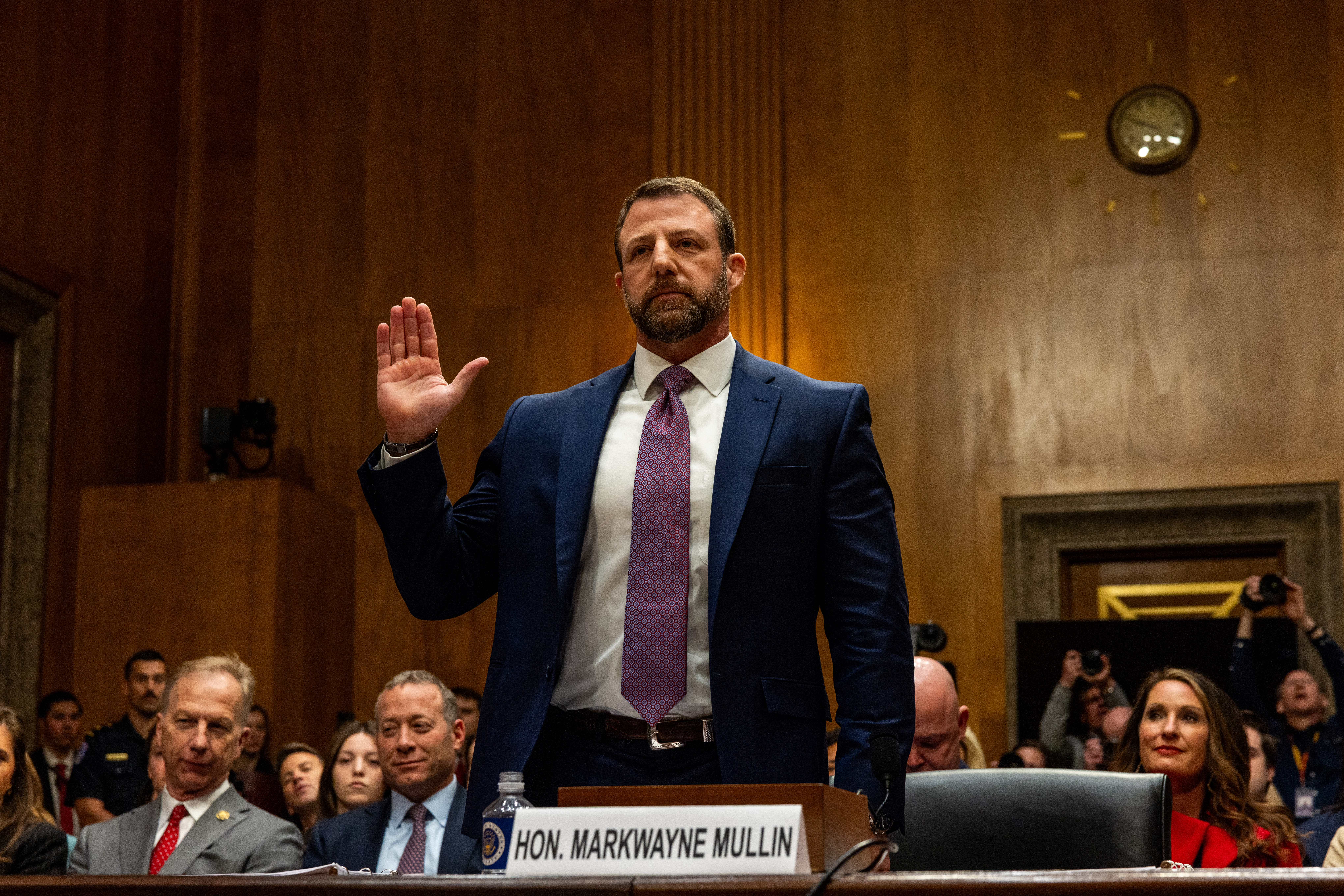
Markwayne Mullin—previously a senator who challenged the head of the Teamsters Union to a fist fight during a Senate hearing, and now Noem’s replacement—is pledging to restore calm to U.S. immigration policy. “My goal in six months is that we’re not in the lead story every single day,” Mullin said during his confirmation hearing last week. “My goal is for people to understand we’re out there. We’re protecting them, and we’re working with them.” Mullin made it out of committee on an 8-7 vote last week and was confirmed by the full Senate on Monday, 54-45.
But even if the actions of immigration agents in the various agencies overseen by DHS—Immigration and Customs Enforcement (ICE), U.S. Citizenship and Immigration Services (USCIS), and Customs and Border Protection (CBP)—no longer dominate the headlines, what else will change under Mullin? More than a year into an administration that has aggressively controlled immigration, what does U.S. immigration policy actually look like now?
This edition of The Morning Dispatch is fully unlocked. To receive the full version every day—and access all of our stories, podcasts, community benefits, and Dispatch Voiced, which allows you to listen to our written stories in your own podcast feed—join The Dispatch as a paying member.

Getting a full picture of the Trump administration’s immigration enforcement is harder than it should be. Detailed monthly data, which used to be a DHS specialty, is currently hard to come by.
“The available data that we had often relied on is no longer being published,” Colleen Putzel-Kavanaugh, an associate policy analyst at the Migration Policy Institute, told TMD. Multiple government shutdowns—including the ongoing shutdown of DHS itself—combined with the administration’s reluctance to share data, have left specific numbers on arrests, deportations, and migrant flows largely unavailable. That makes it difficult to assess how the administration’s withdrawal of its highly visible operations in Minneapolis, Los Angeles, and Chicago has affected broader enforcement numbers.
But policies have been changing. After Minneapolis residents launched mass protests in the wake of Good and Pretti’s deaths, the White House replaced CBP official Greg Bovino, who had been leading federal efforts in the city, with Tom Homan, the White House’s border czar. Homan pledged to back off from neighborhood sweeps conducted by roving federal agents and to focus on cooperating with local law enforcement.
Last week, Mullin also promised that immigration agents would return to ICE’s longstanding practice of only entering homes with a judicial warrant. Under Noem, DHS had begun allowing agents to enter homes with an administrative warrant issued by an executive branch agency such as ICE against people issued a deportation order, but not approved by a judge. “A judicial warrant will be used to go into houses, into place of businesses, unless we’re pursuing someone that enters in that place,” Mullin said.
Additionally, Homan has already reduced CBP agents’ roles in interior immigration enforcement operations, which had not been their role historically.
Returning CBP to its traditional role should improve agents’ interactions with the public, Theresa Cardinal Brown, a former DHS official and immigration policy consultant, told TMD. “The differences in the operational style, the kind of training to deal with the public are very different among all these agencies,” she pointed out.
Border patrol agents, Brown said, are used to operating in isolated regions on the U.S. border, often solo, where most people they encounter are either illegal immigrants or potentially dangerous drug traffickers. “It really is a different enforcement environment than in an urban area, where you are encountering a lot of people and encountering sort of in-your-face opposition to what you are doing,” she said.
Homan, whose background is with ICE, not CBP, “understands, I think, as a law enforcement officer, that their operational success is dependent, in a large part, on the public trusting that they’re going to do it in a professional way,” Brown added.
Bovino did not share this mentality. “We wanted total border domination,” he said of his strategy in an interview this week. “When you use terms like that, perhaps it scares some of the weaker-minded people.”
But a calmer approach doesn’t necessarily mean fewer deportations. “We’re not surrendering our mission at all, we’re just doing it smarter,” Homan said in January. Splashy raids targeting Home Depot parking lots may have generated fear and arrests in immigrant communities, but they didn’t translate to a proportionate rise in deportations. “There were a lot more arrests than there were deportations, because they were getting people who weren’t in a position to be deported when they were out on the streets,” David Bier, the director of immigration studies at the Cato Institute, told TMD.
As of early February, the overall number of illegal immigrants in federal detention stood around 70,000, a record high. A funding package passed last year will also allow DHS to acquire enough warehouses and detention facilities to hold more than 100,000 people, further increasing that record (although in many areas, local opposition is slowing down federal efforts). The federal government also claimed in December that 1.9 million people had self-deported in the first 11 months of Donald Trump’s second term, aided by programs that offer to pay for their ticket out of the country. But independent analyses place that number closer to 200,000.
Legal immigration levels are also in sharp decline, thanks to a wide range of policies from White House.
In December, Trump ordered that seven countries be added to a pre-existing list of nations facing a blanket travel ban on national security grounds. He also enacted more limited travel restrictions on residents from 15 other countries. And in January, the State Department announced an indefinite pause in immigrant visa issuances from 75 countries, including Brazil, Colombia, Pakistan, Bangladesh, and Nigeria, arguing that immigrants from those countries were disproportionately likely to use welfare programs.
Yet visa and citizenship applications are so backlogged that suspending inflow from specific countries mostly re-shuffles the existing queue, Aaron Reichlin-Melnick, an attorney and senior fellow at the American Immigration Council, told TMD. What is more likely to reduce legal immigration levels, he said, are new restrictions barring the spouses and children of U.S. citizens from certain countries from applying for any immigrant or non-immigrant visa. Previously, there had been no cap on these visas. “By limiting immigrant visas for those categories, you actually do drop the net number of people who can come to the United States,” Reichlin-Melnick said.
The Trump administration is also reducing the U.S. demand for immigrant labor. Last month, a new wage-weighted lottery system for H-1B visas—the traditional route through which companies sponsor high-skilled workers from abroad—took effect. That comes after the administration imposed a new $100,000 “supplemental filing fee” on new petitions in September. Together, the changes likely make it too expensive for many small and mid-sized businesses, as well as universities, to hire skilled foreign talent. With lottery selection notifications set to be sent by March 31, the number of workers entering the U.S. by this route will likely fall.
With these moves, DHS and the federal government have thrown “sand in the wheel” of U.S. immigration, Putzel-Kavanaugh said. Tightening more routine processes—such as revoking student visas and scrutinizing applicants’ social media accounts—has also helped the administration shrink the number of immigrants in the U.S., she said.
Refugees are the one category where the president has the authority to set an exact ceiling, thanks to the Refugee Act of 1980. The only refugees currently being admitted in significant numbers are white South Africans—nearly 2,000 of whom have arrived since last May, and who make up the majority of the administration’s 7,500 2026 refugee slots, which is the lowest annual allocation on record.
Noem also used her authority as DHS secretary to classify millions of American residents as illegal immigrants. In a series of determinations last year, she declared that immigrants from 13 countries—including Haiti and Venezuela—who had been authorized to live and work in the U.S. under the Temporary Protected Status (TPS) program were no longer subject to it. “They effectively created an additional 2 million illegal immigrants in the past year,” Bier said.
Together, these changes have produced a substantially different immigration system—though some analysts expect numbers to tick up modestly in 2026, as the bureaucracy adjusts to the new rules and processing backlogs that built up during the transition begin to clear. “Once these policy changes have settled a bit, the procedural side can catch up a little bit,” Cecilia Esterline, a senior immigration policy analyst at the Niskanen Center, told TMD.
But any rebound starts from a historic low. Researchers now estimate that in 2025, the U.S. experienced net negative migration, the first time in at least 50 years that more people have departed the U.S. than arrived.
Even with a less aggressive and better-managed DHS, that trend is likely to continue, according to Bier: “This is a wholesale change in the legal immigration system, a rewrite unlike really any that we’ve seen, at least going back to the Great Depression.”
Today’s Must-Read

The Republican primary to fill the House seat of Florida’s Byron Donald is crowded—and quirky. At a candidate forum earlier this year attended by seven candidates, each made a claim that is demonstrably, provably false. Six are not from the district they seek to serve. Five have run for office in another state. Three have been endorsed by Donald Trump in a previous race. At least three have spent time in jail. Two served in Congress and left in disgrace after scandals. Two have gotten Trump pardons. And one will be the next member of Congress from southwest Florida. Reporting from the Sunshine State, Steve Hayes has the details on Madison Cawthorn, convicted felon and former New York Rep. Chris Collins, and the other cast of Trumpy characters running for this Gulf Coast House district.

In Other News
- New Jersey Gov. Mikie Sherrill signed three immigration-related laws: one to prevent jails and prisons from handing over non-violent inmates to federal immigration enforcement upon their release, one to bar law enforcement agents from wearing facial masks, and to set limits on state and local governments and health care providers for collecting immigration data.
- Transportation Security Administration Deputy Administrator Ha Nguyen McNeill said in a House of Representatives hearing that unless Congress provides funding, TSA may need to decide “which airports we might try to keep open and which ones we might have to shut down as our callout rates increase.”
- The Justice Department will pay Trump’s first-term national security adviser Michael Flynn $1.25 million in a settlement agreement after he sued the government for malicious prosecution.
- The Army announced it will raise the enlistment age limit from 35 to 42 and allow prospective recruits with no more than one marijuana possession or drug paraphernalia conviction to join without waiting for a special waiver.
- British police arrested two people suspected of setting four ambulances owned by a Jewish community organization on fire earlier this week. The Islamic Movement of the People of the Right Hand (HAYI) previously claimed responsibility for the attack.
- The U.K. government is moving to cap donations from British citizens living abroad to political parties, in addition to banning cryptocurrency donations.
- The Israeli parliament’s national security committee voted to advance a bill permitting death penalty sentences for Palestinians convicted of terrorism to a final, full-chamber vote.
- China’s Foreign Affairs Ministry demanded that the Japanese government investigate and “severely punish” a 23-year-old military officer who allegedly scaled the wall of the Chinese Embassy in Tokyo while armed with a knife.
- Ukrainian President Volodymyr Zelensky said in an interview with Reuters that the U.S. is making prospective security guarantees in a potential peace deal with Russia conditional on Ukraine agreeing to cede its eastern Donbas region to Russia.
- Russian forces shot down and killed a Russian aviation YouTuber and his passenger after mistaking his ultralight aircraft for a Ukrainian drone.
- Meta is reportedly laying off several hundred employees across numerous divisions, including Facebook, virtual reality arm Reality Labs, global operations, and recruiting and sales.
- Namibia’s government enforced local ownership regulations to block SpaceX’s Starlink network from competing in the country’s telecommunications market.
- The Belgian-based pharmaceutical company UCB announced a $2 billion project to construct a drug manufacturing facility in the outskirts of Atlanta.
- The Swiss-based sneaker company On Holding said its CEO Martin Hoffmann is stepping down, and that two of the business’s co-founders, David Allemann and Caspar Coppetti, will serve as co-CEOs.
- BlackRock CEO Larry Fink told the BBC that sustained high oil prices could start a “stark and steep recession.”
- “How Can America Be So Miserable When It’s So Rich?”—by Advisory Opinions’ David French (New York Times)
- Noah Smith on the resilience of the U.S. economy amid oil and gas price spikes caused by the Iran war. (Noahpinion)
- Alex Trembath on why the climate movement would be wise to acknowledge scientific uncertainties. (Asterisk Magazine)
- James Crisp on how a renovation project at a Dutch church led to the discovery of what could possibly be the skeleton of Charles de Batz de Castelmore d’Artagnan, the bodyguard for former French King Louis XIV, who was fictionalized in Alexandre Dumas’ The Three Musketeers. (The Telegraph)
- HBO releases the first trailer for the TV show version ofHarry Potter and the Philosopher’s Stone. (YouTube)
The Independent: Conservative Activist Who Claimed 2020 Election Against Trump Was Rigged Is Convicted of Election Fraud
Euronews: Venezuela Deploys Robotic Dogs for Patrols in Caracas
RNZ: Health NZ Staff Told To Stop Using ChatGPT To Write Clinical Notes
Let Us Know
Have any thoughts or questions about today’s newsletter? Drop us a note in the comments or via email at tmd.questions@thedispatch.com. We read every submission, and your message could be featured in an upcoming “Behind the Scenes” segment.
Have any thoughts or questions about today’s newsletter? Become a member to unlock commenting privileges and access to a members-only email address. We read every submission, and answer questions in the following edition of TMD.