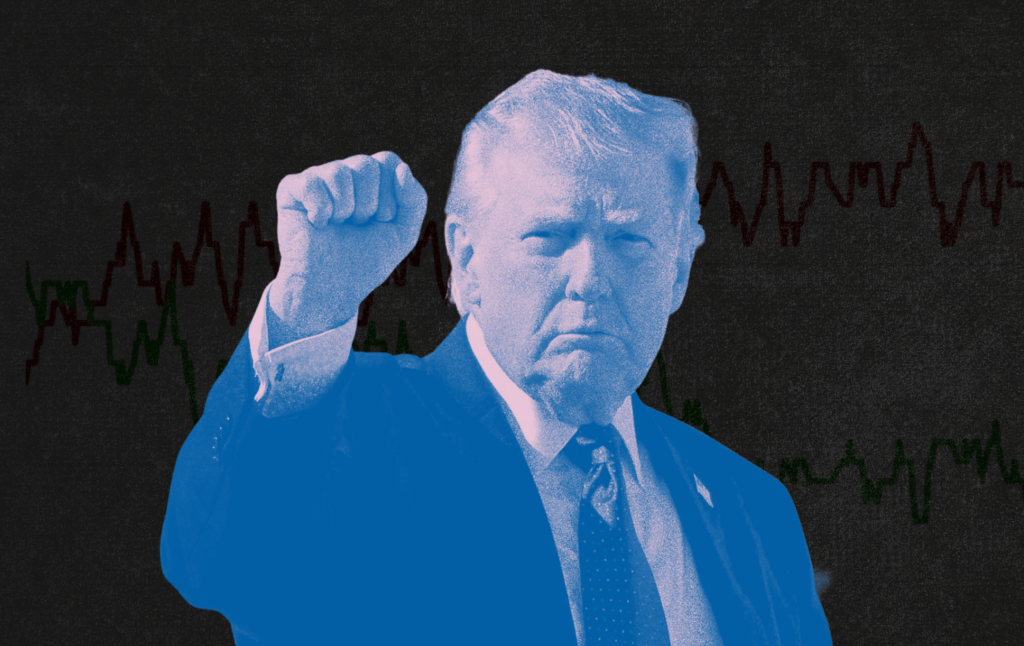
A steep decline.
The president’s job approval stands at 40.1 percent in Nate Silver’s polling tracker. That’s the worst number of his second term. His net job approval is underwater by 16.7 points, another new low. Until a few weeks ago, he hadn’t been net negative by more than 15.
Yesterday RealClearPolitics had Trump at 41.1 percent, a second-term low in their tracker and a number he’s seldom reached since 2018. To put in perspective how poor that is, he was at 41.1 percent on the day he left office in January 2021, two weeks after the insurrection.
The data in some individual polls are garish. A new Fox News survey, for instance, has the president at 25-75 approval among independents, 50 points below water. The only reason his overall job approval is north of 40 (barely, at 41) is because Republicans remain cultishly behind him at an 84-16 clip.
His approval in the same poll among Hispanics, a cohort he nearly won in 2024, is 28-72.
The Iran war is unpopular—Americans split 42-58 on it in the Fox News survey—but it’s the economy, formerly a pillar of Trump’s political strength, that’s killing him. A Reuters poll published on Tuesday found 29 percent approve of how he’s handling it, worse than any rating Joe Biden got throughout his four-year term. (Reuters has him down to 36 percent in approval overall.) And a CBS News survey taken last week saw Americans split 18-53 when asked if they’re financially better or worse off because of the president’s policies.
The new political site The Argument drilled down on that by conducting its own survey on the economy. Trump’s approval on the issue is 39-58, it found; more respondents believe the economy will get worse this year than that it’ll get better; and fully 65 percent said their income isn’t keeping up with the cost of living.
Importantly, as in the CBS data, many blamed elements of the president’s agenda for their misery. Sixty-two percent told The Argument that tariffs negatively affect the cost of living, versus 14 percent who think the effect is positive. And 46 percent said Trump’s actions on immigration were hurting the economy while 28 percent claimed those actions were helping.
This is what the numbers look like now, before gas prices have gone stratospheric due to the impasse in the Strait of Hormuz and stagflation has set in. The only reason Republicans remain competitive on the congressional generic ballot at the moment is because the Democratic Party is as popular as a urinary tract infection, trailing even ICE in approval polling.
Which is not to imply that the two parties are especially “competitive.” The GOP trails by 5.4 points in RCP’s generic ballot tracker today, one of the largest advantages Democrats have had in Trump’s second term. That gap is about to widen in all likelihood: A Quinnipiac poll taken last week saw Democrats up 11 points, nearly triple the biggest lead they’d previously had in that survey during this cycle.
If this is what Republican numbers look like under a leader with good political instincts, what the hell would they look like under a leader with bad ones?
President Costanza.
The strange thing is that Trump’s reputation for political savvy was affirmed as recently as 2024.
Granted, it didn’t take a genius that cycle to grasp that, with voters exasperated by high inflation and runaway immigration, the opposition party should probably run on reducing inflation and immigration. Still, Trump’s message was the correct one and it paid off in spades: He became the first Republican in 20 years to win the national popular vote, helped his party to majorities in both houses of Congress, and showed shocking strength among constituencies like nonwhite voters that traditionally have eluded the GOP. Good instincts!
Then he got sworn in and began demonstrating instincts so unbelievably and consistently terrible that they can only be described as Costanza-esque.
Having gotten elected to make life more affordable for Americans, the new president immediately undertook to make life more expensive. He jacked up the price of foreign goods through a remorseless series of tariffs; when the Supreme Court gave him an opening to retreat by striking those tariffs down, he turned around and reimposed many under a different law. He’s now taken political ownership of a sluggish economy that might otherwise have been blamed on Biden’s policies, an error that will almost certainly cost his party control of the House, if not the Senate.
Immigration enforcement began promisingly when Trump moved to seal the border. Then he turned ICE into a masked goon squad, granted them de facto legal impunity to crack heads, and surprised many voters by proving that when he talked about “mass deportation” as a candidate he meant mass deportation. After a fiasco in Minneapolis in which the killings of two Americans by federal agents were captured on video, support for Trump’s immigration agenda has fallen so sharply that House Republicans are being urged to stop talking about the deportation strategy. The president himself reportedly believes that the Stephen Miller/Kristi Noem deport-’em-all regime went “too far.”
Amid all of that, he repeatedly betrayed the ethos of his 2016 “America First” campaign by manufacturing one foreign crisis after another. He kidnapped the leader of Venezuela; he threatened to seize Greenland by force if America’s longtime ally, Denmark, didn’t give it up; he bombed Iran last summer, pronounced its nuclear program obliterated, and is now bombing the country again in part because it remains a long-term nuclear threat. At a moment when voters are begging him to focus on the cost of living, his thirst for military adventures appears unquenchable. Cuba is next, he likes to remind reporters.
The Iran war would be a grave political error even if it were going well. Because of the standoff in the Strait of Hormuz and what it augurs for global inflation and a U.S. ground incursion, it’s much worse than that. A “f—king clusterf—k” is how one unnamed Republican senator described it to Semafor. One House member briefed yesterday about the possibility of boots on the ground told NBC News afterward, “There was no plan, no strategy, no end game shared, and they didn’t give any answers. It’s unclear if there isn’t a plan or if there is a plan and they wouldn’t share it with members.”
The latest this morning is that Trump has reportedly begun warning aides to wrap things up in Iran in the next few weeks. If he bugs out before reopening the strait, it’ll be the TACO to end all TACOs. If he doesn’t bug out, uh oh.
Does any of this sound like what a politician with genuinely good instincts would do?
The “good instincts” timeline of Trump’s second term is trivially simple to imagine. He proceeds with border enforcement but prioritizes removing violent criminals, a crowd-pleasing move that builds support for mass deportation later. He attacks Iran’s nuclear facilities, perhaps, but uses the success of that mission to justify refraining from a second, riskier offensive. (“The threat has been neutralized for now.”) And, of course, he postpones the tariffs until the affordability crisis has eased, assuring Americans that he won’t thrust them into any expensive trade wars until the cost of living is under control.
Easy peasy—but not easy enough for him, it seems. And so we have a mystery: What happened to Donald Trump’s allegedly stellar instincts?
Theories.
One possibility to which I’m partial is that the president’s political savvy has always been overblown.
Across three presidential campaigns, he twice got fewer votes than his opponent and fell short of a majority in the third. He wasn’t facing world-beating opponents either. His first two general election campaigns pitted him against uncharismatic Democratic establishment dinosaurs and the last against an emergency substitute who had underwhelmed everyone as vice president. She still came within a point and a half of him in the popular vote.
For all of his shrewdness in 2016 in offering a nationalist alternative to a conservative primary field, I wonder to this day how much of Trumpmania was due to his agenda and how much to his celebrity and persona. Imagine that he had run on John Kasich’s platform that year and that Kasich had run on his. Not only does Kasich still not win the nomination in that scenario, I suspect, but he still finishes behind Trump.
If you want to call the president’s boorish showmanship and pro-wrestling approach to politics a matter of “instinct,” then I suppose Trump has good instincts—for galvanizing a comparatively less educated populist Republican primary electorate. Among the wider electorate, his persona has always been off-putting to at least as many people as it’s attracted. His true instinctual gift as a politician is building support that’s not particularly wide but a thousand miles deep: A natural authoritarian, he’s demagogued his way to an unshakeable “us and them” bond with much of the right unlike any we’ve seen from an American political leader in our lifetime.
So maybe the answer to the question of what happened to Trump’s political instincts is … nothing. He’s a cult leader who benefited tremendously in his presidential runs from intense partisan polarization. Maintaining an iron grip on his base and combining that with just enough “lesser of two evils” support from the wary middle was enough to earn him a dubious reputation for good instincts.
Another, more Trump-friendly answer to the instinct question is that the president had and still has sound political instincts. It’s just that the damned idiots around him keep steering him wrong.
You’ll hear that one reliably from right-wing media on occasions when even they can’t stomach defending something he’s done. (“Whichever adviser told him to do this needs to be fired!”) It helps explain why Lindsey Graham has become a punching bag this month for postliberals who are uncomfortable with the Iran war. Graham is a weirdly bellicose hawk, a man who never met a bombing campaign he didn’t like, but blaming him for Trump’s war is a transparent way to go on deluding oneself that our “America First” president’s pristine political instincts toward peace remain intact.
His policies would be unerring, you see, if only the swamp creatures under whose sway he’s fallen would stop leading him awry.
It’s a nice theory, doubtless comforting to chuds everywhere, but it has a problem: Trump is obviously less restrained in his second term by those around him than he was in his first. To many on the right, the whole point of reelecting him was to give him another crack at the job without any globalist uniparty deep-staters like James Mattis or John Kelly around to talk him out of his postliberal impulses this time. Trump 2.0 was to be Trump unleashed. At last he would be able to act on, well, instinct.
And he has! He started a world war on trade last year, out of the blue, on “Liberation Day.” He created a secret immigration police force and gave it carte blanche to deport as many illegals as its agents could get their hands on, criminals or no. He chased glory abroad, intoxicated by the thought of an imperial legacy that might see him acquire Greenland, subjugate Venezuela, and destroy Iran. And he turned the swamp of Beltway politics into an Everglades for himself and his toadies.
There’s no reason to believe that the president is acting against his own instincts in anything, including our current war.
But I do think there’s an important difference between his first term and his second that helps explain his political downfall: Trump’s second term is for him, not for us.
Policy and politics.
His first term wasn’t really for “us” either.
His big domestic achievement was a traditional Republican tax-cuts bill that mostly benefited the upper class, remember. But numerous forces conspired to prevent the kind of intimidation tactics, policy earthquakes, and blatant corruption that have become commonplace over the past 14 months. His advisers weren’t all bootlicking yes-men; government institutions hadn’t lost as much of their power to check him; and he couldn’t afford to alienate swing voters too aggressively with a reelection campaign looming.
All of that has changed. And so the answer to why Trump’s political instincts seem so poor lately might be this simple: Insofar as they conflict with his policy instincts, he’s resolved this time to follow the latter in every instance.
This term is for him, not for us. He’s going to do what he wants to do.
My guess is that he doesn’t distinguish sharply between his political and policy instincts—or even, perhaps, between “him” and “us.” It goes with the territory of being a messianic nationalist, no? You can’t be a savior endowed by providence to save your country and be wracked with doubt that your own policy preferences don’t reflect the will of the people. By definition, a megalomaniac’s preferences are correct.
He, more so than anyone, has bought the hype about his alleged political instincts, in other words. So when he concludes that a smart thing to do in an inflationary era is to tariff the whole world or start a war that might foreseeably wreck global oil commerce, he has no good reason to wonder how Americans might feel about it. Either they’ll think it’s brilliant or they’ll think it’s brilliant eventually, in the fullness of time. He’s doing the right thing because he’s the one doing it.
That’s how we’ve landed in a place where Donald Trump, populist hero of the working man, goes around saying things like “no one gives a sh-t about housing.” The people don’t give a sh-t about it because he doesn’t give a sh-t about it, and his political instincts about what is and isn’t worth giving a sh-t about are unerring. Next stop: 35 percent job approval.