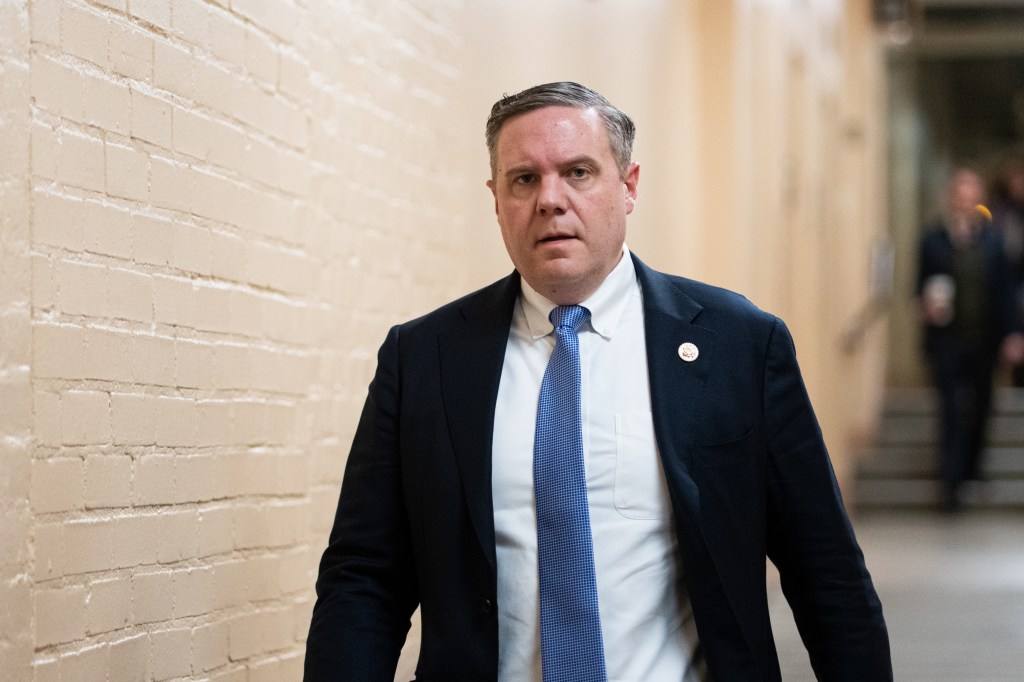
Rep. Jeff Hurd lost Donald Trump’s endorsement for reelection in Colorado’s 3rd Congressional District after breaking with the president on tariffs last month. Trump endorsed him again weeks later despite holding firm on trade thanks to intense lobbying by Republican leaders in the House of Representatives and allies across Washington, D.C.
Trump’s reversal saves the GOP a nasty primary battle in a competitive seat that could have elevated a weak Republican nominee and netted the Democrats a crucial pickup in their bid to capture the House majority. With Hurd leading the charge for the party along Colorado’s vast western slope, chances of a Democratic flip shrink considerably. But the inside story of how House GOP leaders and other Hurd cheerleaders convinced Trump to change his mind on the endorsement is worth studying because it reveals how the president makes decisions on a range of issues.
The process that led to the re-endorsement, detailed to The Dispatch by knowledgeable Republican sources and culminating in a Hurd-Trump telephone call, also serves as a reminder of the president’s ability to be ruthlessly pragmatic when strategically confronted with the political precariousness of his preliminary position. “He was gracious; it was constructive,” Hurd said this week in a brief interview, describing his conversation with Trump. “I think he recognizes the importance of working together, unified, in holding [this] seat.”
The White House did not respond to an email requesting comment.
In mid-February, the House voted to cancel tariffs Trump had levied on Canada as part of a global trade war he instigated soon after reentering the White House 14 months ago. House Republicans have deferred to the president on tariffs, even since the Supreme Court’s rebuke last month. But on the measure that would have repealed tariffs on Canadian imports had it passed the Senate, six House Republicans joined with most Democrats to ensure passage. Hurd was one of them. Trump pulled his endorsement on February 21.
In the social media post cutting Hurd loose, the president simultaneously announced his “complete and total endorsement” of Hope Scheppelman, a Navy veteran and nurse practitioner. Trump said it was only the second unendorsement he had issued, after spurning Mo Brooks in favor of Katie Britt in the 2022 Alabama Senate primary. Britt won the nomination and was elected to the Senate five months later.
“Based on a lack of support, in particular for the unbelievably successful TARIFFS imposed on Foreign Countries and Companies which has made America Richer, Stronger, Bigger, and Better than ever before, I am hereby WITHDRAWING my Endorsement of RINO Congressman Jeff Hurd,” Trump said in a lengthy post. “Congressman Hurd is one of a small number of Legislators who have let me and our Country down. He is more interested in protecting Foreign Countries that have been ripping us off for decades than he is the United States of America.”
But House Republican leaders, defending a majority that rests on roughly a handful of seats and worried Scheppelman would lose to the eventual Democratic nominee in the midterm elections, didn’t presume the matter closed. Joined by Hurd’s allies among House GOP committee chairmen and Republican lobbyists, conference leadership launched a full-court press—initially aimed at simply persuading Trump’s political operation to keep its financial powder dry during the primary.
Notably, and as a deliberate strategy, they did not directly bombard the president with pleas to change his mind.
Rather, they engaged senior White House officials and others in the president’s orbit. The goal was to create an information flow around Trump, such that individuals he likes and trusts, and with whom he was prone to chat on a regular basis, might communicate concerns about Scheppelman’s November viability and the hope that the myriad political groups aligned with the president would not spend money on her behalf in the June 30 primary. This is the same strategy GOP candidates use to vie for Trump’s endorsement in open-seat primaries.
“The first ask, for the first week after the endorsement, was getting all of Hurd’s allies—colleagues, leadership, K Street, former members—to lobby the White House,” a Republican source familiar with the effort told The Dispatch, requesting anonymity to speak candidly. “Probably 45-50 [people] called over to the White House. That could have been, they had a one-on-one conversation with somebody they’re friendly with—it’s not like they were calling the president—thus creating the buzz and the conversations.”
Not until the week leading up to Trump’s March 20 announcement that he was re-endorsing Hurd, 46, did the congressman’s supporters even begin to believe he might drop Scheppelman.
“Congressman Jeff Hurd, of Colorado’s 3rd Congressional District, should in no way, shape, or form, be impeded from winning the District in that the Democrat alternative is a DISASTER for our Country. Therefore, I will be fully supporting Jeff’s Re-Election,” Trump said in a social media post in which he also explained that Scheppelman was on board with his decision and would be joining his administration “in a capacity to be determined.”
Although a full re-endorsement wasn’t expected, myriad factors helped bring about that outcome.
Chief among them: Hurd’s beef with the president wasn’t personal. His vote to revoke tariffs on Canada was based on addressing the economic headwinds Trump’s trade war has fanned in his district, particularly the adverse impact on the agriculture, construction, energy, and manufacturing sectors. Additionally, Hurd has a history of otherwise backing the Trump administration’s agenda almost entirely—and being a reliable vote for House GOP leadership. Plus, although not on the House Democrats’ list of top targets, Colorado’s 3rd Congressional District is not completely safe for Republicans, especially with the possibility that a blue wave could crash ashore on Election Day.
But it’s potentially safer with Hurd. Recall that in 2022, Rep. Lauren Boebert barely held off Democratic challenger Adam Frisch. In 2024, the MAGA-aligned Republican shifted to Colorado’s 4th Congressional District, a more reliably red seat. Hurd succeeded Boebert as the Colorado 3 GOP nominee in 2024 and handily defeated Frisch. Scheppelman was viewed as similar to Boebert in style and temperament, and the district is the size of Pennsylvania and is served by four media markets. It would have cost Team Trump millions to make Scheppelman competitive, with no guarantees.
Just prior to Trump’s surprise re-endorsement, top House GOP leaders—Speaker Mike Johnson and Majority Leader Steve Scalise, both of Louisiana; Majority Whip Tom Emmer of Minnesota; Conference Chair Lisa McClain of Michigan; and Rep. Richard Hudson of North Carolina, chairman of the National Republican Congressional Committee—hosted a fundraiser for Hurd. It was a show of force that sources say further clarified for the White House the political stakes for the party in Colorado 3.
“Jeff Hurd is an important member of our team here in Congress, and I’m glad he and President Trump worked out their differences,” Hudson told The Dispatch. “We’re going to hold that seat.”