Editorial note: this essay originally appeared at The Giving Review.
***
Nonprofit public-policy research organizations—“think tanks,” in common parlance—have become much more politicized, partisan even, than when their creation and financial support were first legislatively incentivized by tax-code provisions. The incentivization was to encourage charity in general—including, relevant to this context in particular, furthering scholarly research to better inform policy debates and formulation.
Institutional and individual donors who fund these think tanks, who almost always benefit from the same or related tax-code provisions in the process, have played and continue to play a large role in creating and maintaining tension with, if not outright divergence from, this original legislative intent.
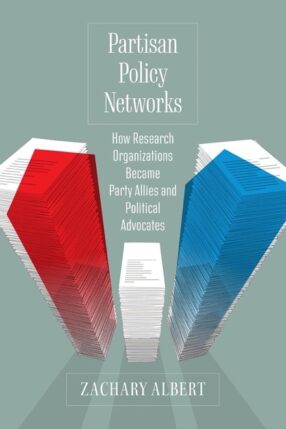
Zachary Albert‘s first book, Partisan Policy Networks: How Research Organizations Became Party Allies and Political Advocates, sheds much helpfully refulgent light, including in the form of facts and figures, on these phenomena.
Indicative data
Before a prime example, some necessary boilerplate tax-policy background. Policy-research organizations that seek and achieve the status of a public charity under Internal Revenue Code (IRC) § 501(c)(3), of course, are subject to limits or outright prohibitions on their lobbying or electioneering efforts in order to get and keep that status. They are tax-exempt, and contributions to them are tax-deductible.
A growing number of these (c)(3) think tanks have created an affiliated entity for which they’ve sought and achieved the status of a social-welfare group under IRC § 501(c)(4). These (c)(4) groups, according to Internal Revenue Service language that Albert quotes, “may engage in some political activities”—including “direct or indirect participation or intervention in political campaigns”—if such efforts are not their “primary activity.” They are tax-exempt too, recall, but contributions to them are not tax-deductible.
“The ability to engage in direct advocacy and activism while still retaining the legal and popular patina of a think tank is highly desirable for policy-demanding groups,” Albert writes in Partisan Policy Networks, available at a discount from Penn Press by following these instructions. “For this reason, the tendency to form (or transform into) a politically active do-tank is increasingly pervasive ….”
The below chart, from a sample of 65 influential think tanks he compiled for the book, “shows the share of think tanks founded in each decade that can be considered ‘politically active,’ meaning they have engaged in lobbying or have an affiliated 501(c)(4),” as described by Albert, an assistant professor of politics at Brandeis University.
Politically active think tanks by founding decade
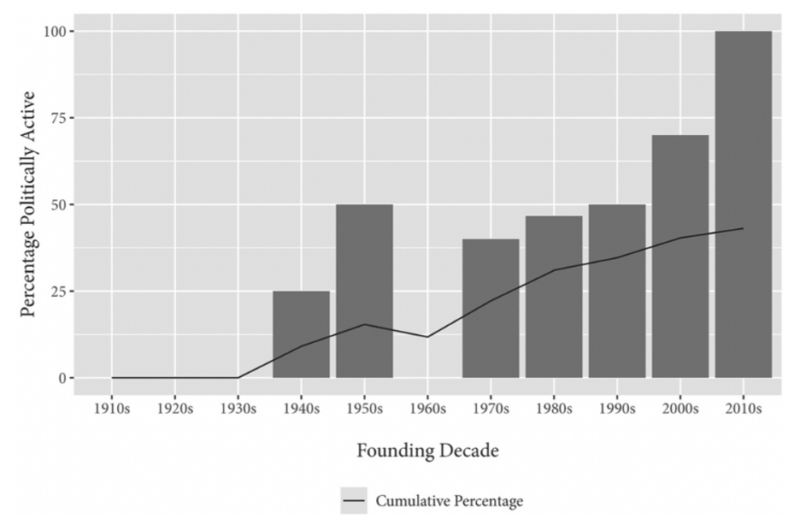
“The solid line tracks the cumulative percentage of all think tanks considered politically active over time,” he continues. “The chart shows that the majority of think tanks founded prior to 1990 did not go on to engage directly in politics, with only two think tanks … eventually becoming politically active. The vast majority of early think tanks started as and continue to be politically disinterested.”
Then, nonprofit “think tanks founded since the 1990s are more likely than not to engage in direct political activism, often but not always through an affiliated advocacy organization,” according to Albert.
These organizations are largely ideological and often have partisan policy preferences. There are some notable exceptions … but in general those that seek to influence the political process in more direct ways also seek to move policy in a specific ideological direction and work through a single political party to do so. The ability to employ advocacy tactics through their affiliated 501(c)(4)s, or just engage in lobbying through their think tanks, allows them to provide direct and indirect subsidies to their preferred party, aid it in their joint policymaking efforts, and act as allies in the partisan policy network.
Later in the work, he also presents and explains data supporting the idea that partisan research organizations “rely far more on ideologically extreme donors, especially individuals.”
Albert’s next book—Small Donors in the US: Myths & Reality, co-authored with Raymond J. La Raja—will be released later this Spring by The University of Chicago Press.
He was kind enough to join me for a recorded conversation earlier this month. The 16-minute video below is the first part of our discussion; the second is here. During the first part, we talk about how so many think tanks have become partisan political organizations, including the role of their funding in the process.
Decline of the technocratic, Progressive vision
Internally and externally, think tanks were originally thought of and seen, as the sayings go, as “ivory towers” or “universities without students.” Their changed nature is “part of the broader, I think, decline in this early technocratic vision of what policy research should be, which came out of the Progressive movement in the early 20th Century,” Albert tells me. “Of course, these groups were involved in political debates, but they were kind of anti-politics. They were opposed to the horse-trading and compromises and party bossism that dominated the period,” and they “believed that you could use objective research to come up with the best solution to policy problems and advocate that in a very technocratic way.
“That started to diminish, that view, especially in the 1970s,” he continues. “Conservatives, I think to some degree correctly, saw that technocratic vision as being a big part of the New Deal, as being a big part of liberal policy, and they started creating their own organizations”—reflecting their founders’, and their funders’, “perspective as being a virtuous corrective to what was going on.” Then, “there’s a liberal reaction in the early 2000s during the Bush Administration, as well.
“Some of what I document here is basically a path-dependency,” Albert says. “There was this proof of concept” with The Heritage Foundation, which
was founded in the 1970s by former Congressional staffers who wanted a think tank that was active in politics, that was useful for politicians, that was meeting their demands and influencing outcomes. That was a highly successful model pretty much from the start. I think a lot of folks just saw that and wanted to start doing that type of stuff, as well.
This relates to patrons who are funding these organizations. They want to see impact increasingly.
Seed money and the light bill
In Partisan Policy Networks, Albert separates “what I would call institutional funders—which are corporations, government, private foundations, other nonprofits, and interest groups, and things like that—from individual donors,” Albert tells me. “I separate them because I find that they actually behave in very different ways, and different types of think tanks rely on different sources of money.
“One of the things I look at are the funders of the seed money that helps found these groups,” he continues. “The money is given in expectation of some form of politics, some particular viewpoint, and so that has a little bit of a path-dependent effect.
“But then I also look at ongoing fundraising,” Albert says. “How do these think tanks keep the lights on, sustain their operations? The big difference that I find between more of the academic model and the more-political model is that the academic groups rely much more on institutional money, even if that money has a viewpoint, has a perspective.” Institutional donors don’t want research they fund “to be seen as totally biased and disregarded by decision-makers, and so they care about the processes and quality of the research a bit more than a lot of individual donors,” often solicited by and responsive to direct-mail appeals or their now more technologized equivalents.
“[G]roups that rely on individual donors are very loud about proclaiming their independence and that they’re not able to be bought” and they maintain “[t]here’s not pay for ‘pay-for-play’ going on,” he notes. “On the other hand though, right?, they need to keep their donor base happy, just as a political candidate would, as a political party would. So you are maybe replacing one form of bias, an institutional bias, with another—which is a bias towards the preferences of your” individual funders.
“The downside of that is that you are continually producing research products that are very public-facing, that are very short-term-focused, to appeal to the preferences of those individuals,” Albert says, and “this is very highly correlated with a much more-partisan and much more-political approach to policy research.”
Distinction without a difference, and dismissable decisions
Regarding the book’s data about the (c)(3)-(c)(4) distinction—or, lack of one—that is indicative of this approach, “the people I talked to that worked at these places said, effectively, that that makes no difference, they work hand in glove, they’re one organization with a common goal,” according to Albert. “There’s almost no firewall between the activities of the two. It’s purely a technical and legal distinction.”
Might that thus present a potential avenue for reform? Well, “most folks know next to nothing about think tanks and care even less about them, although that’s probably not true of your readers,” Albert answers, so it’s difficult to interest policymakers in addressing the subject. And if and when “the enforcement agencies are required to make a subjective decision about whether that constitutes political activity that violates the law, it’s easy to dismiss their decisions either way as politicized themselves, right?”
In the conversation’s second part, he discusses differences in the two parties’ policy networks, corporate support of both networks, and how to consider improving the research product available to policymakers and the public, including by strengthening parties.