There comes a time in every home cook’s life when you wake up and think, “Tonight is feeling very cashew curry!” This instinct could naturally lead to the Googles, not so long ago a pathway to legacy media outlets and needlessly difficult but variously exciting recipes by chefs and restaurateurs. Search now leads to (largely) young women in fetching aprons whose culinary origin stories seem to always stem from a dead relative.
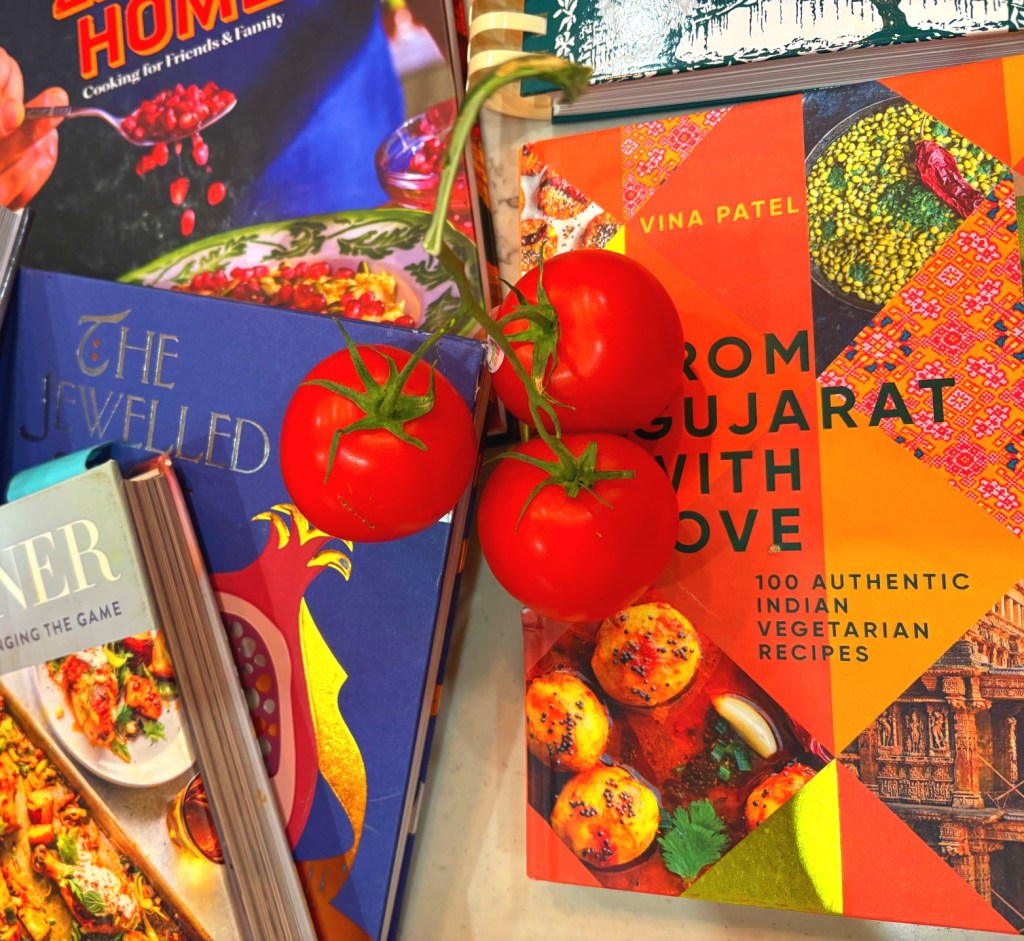
I turned instead that morning to a hutch that holds my cookbooks, an admittedly dusty piece of furniture with a door that I have not bothered to fix and currently hold closed with a candlestick. From there I grabbed From Gujarat With Love: 100 Authentic Indian Vegetarian Recipes, a book that previously instructed me how to make this particular curry, as well as a simple butter paneer, a kheer with cherries, and a double-layered roti.
I have many single-subject books like those for Jewish holidays and a seriously ancient soup tome I will never part with, a full collection of Meera Sodha books, Michael Solomonov projects I have made or admired, and a Masaharu Morimoto edition that helped me through the pandemic when I watched every episode of the Japanese show Midnight Diner. This last one led me to an ochazuke preoccupation that went on for several months and a short-term commitment to homemade dashi.
Cookbooks offer a sense of discovery, rather than the mildly creepy feel of being discovered, generally by an algorithm. Rediscovering them left me awash in memories and self-admonition, not unlike flipping through your photo reel and thinking of a friend you deeply miss and owe a text. It is a return to the thing that made me fall in love with home cooking so many years ago, the most functionally analog thing besides an iPod, offering a deep list of tools, ingredients, techniques, culinary history, and context that the quick-click recipe cannot provide.
“Cookbooks are time capsules, and tightly-formed cultural extracts,” Amanda Hesser, who was the co-founder of Food52, the O.G. community-driven cooking resource (RIP), and whose Chocolate Dump It Cake is a recipient of one of my janky bookmarks, told me. “Great cookbooks aren’t a collection of recipes,” said Hesser, who now writes the Substack Homeward. “They’re a point of view brought together through writing, history, design, technical instruction, and taste.”
Cookbook sales data is notoriously difficult to come by because the publishing industry loves to keep sales figures proprietary, and all book data is highly fragmented across sellers. Last year Circana, a market research firm, put out a study concluding that baking books were killing it versus other cookbooks, which agents and publishers disputed. But industry experts generally agree that while cookbook sales soared during the pandemic, the market is now basically stable, influencers have joined celebrity chefs in leading sales of new books, and they are not, like the Instant Pot, DOA.
“As a hyper-specialized literary agent that represents a list primarily of cookbook authors, I have steadily sold the same number of proposals year over year,” said Sally Ekus, the owner of the Ekus Group, which specializes in culinary writers. “One could argue that if anything, the abundance of recipes online has led to an increased interest in the vast diversity of culinary topics. This has opened up space for niche cookbooks that publishers weren’t acquiring even a few years ago.”
Indeed, if web recipes offer a quick metro ride to dinner—I just need something to do with these chicken thighs—cookbooks are a slow luxury cruise through cuisine. If you’re cooking Indian, it’s good to learn how to make garlic paste, or what ingredients you need for your own garam masala. For newcomers to the kitchen, cookbooks will tell you what you must own: tomato paste, chickpeas, a basic fish spatula, various vinegars. Those who want to go deep get pastes and seeds and maybe a shamoji.
It’s about breadth and scenery over brevity and snapshots, a warm bath before bed, not the fast shower post gym.
Cookbooks offer 10 different ways to make pasta, the reason something might fail, and the way to prevent it along with the logic of the technique. Rose Levy Beranbaum first forced me to weigh my eggs, Meera convinced me that I have to use fresh tomatoes no matter what for my curries, and Marcella Hazan was the godmother of the good, simple ingredients doctrine.
One can certainly turn to YouTube videos for help, but only a cookbook such as Irene Kuo’s seminal The Key to Chinese Cooking can take you through the entire journey of holding a knife to the proper technique for seasoning a wok to using chopsticks to stir or swishing over stirring. And there is a reason Hazan’s butter-and-onion tomato sauce recipe will always outshine that of some influencer of TikTok who insists on additions of ketchup. The recipes are tested, often multiple times, and generally trustworthy and do not include comments from home cooks who changed seven of the nine ingredients and then complain that the recipe failed. It’s about breadth and scenery over brevity and snapshots, a warm bath before bed, not the fast shower post gym.
Even as we tighten the purse strings, cookbooks remain a thing we will spring for. “Cookbooks by definition are aspirational,” said Kimberly Witherspoon, a founding partner of InkWell Management, which has represented some of the biggest names in cookbooks.
In my final stanza of this ode, I will praise the narratives of cookbooks over internet recipes, all due respect to Patti Potatoes or whatever rando gave you tips for your frozen blueberries. To be clear, I have never gotten on board with the world-wide whiners who want internet writers to “just give me the recipe” instead of sharing the familial or other background of how a recipe came to be. Plowing through pop-ups and prose is the price you pay for that recipe, friends! Do we come into your place of business and demand goods and services because they “should be free?” Let these bots tell their stories!
Still, opening chapters, as well as the head notes on recipes, are part of the joy of a great cookbook, and why serious home cooks often have one on their nightstand pile. There are stories of regions, dining trends, marriages, losses, and commitments. My own cookbook on homemade junk food is essentially my Gen X American autobiography, and the meatloaf book I wrote with my friend Frank Bruni is a ride-along to our relationship and collective experiences. I collect Junior League cookbooks not because I ever have a hankering for a seven-layer salad, but because I love understanding the world from which they sprang.
My friend Debbie, who lives in a remote place in southern Africa where mail doesn’t really come and bookstores are a flight away, is the perfect candidate to never touch a cookbook. Yet the opposite is true, and she occasionally sends me a snippet from a sauce-stained tome. “Before the Internet, cookbooks were a necessity,” she said, “but now it’s just the joy of physical form and the memories they bring.”
Among her collection of books are pages covered with notes made by her late mother, her grandmother’s first handwritten school recipe book, her father’s favorite lasagna recipe, and the Ken Hom potstickers made for the first time with a daughter during COVID. “In our family, cooking has always equaled, ‘I love you,’” she wrote to me. “You can’t get that reminder from a screen.”