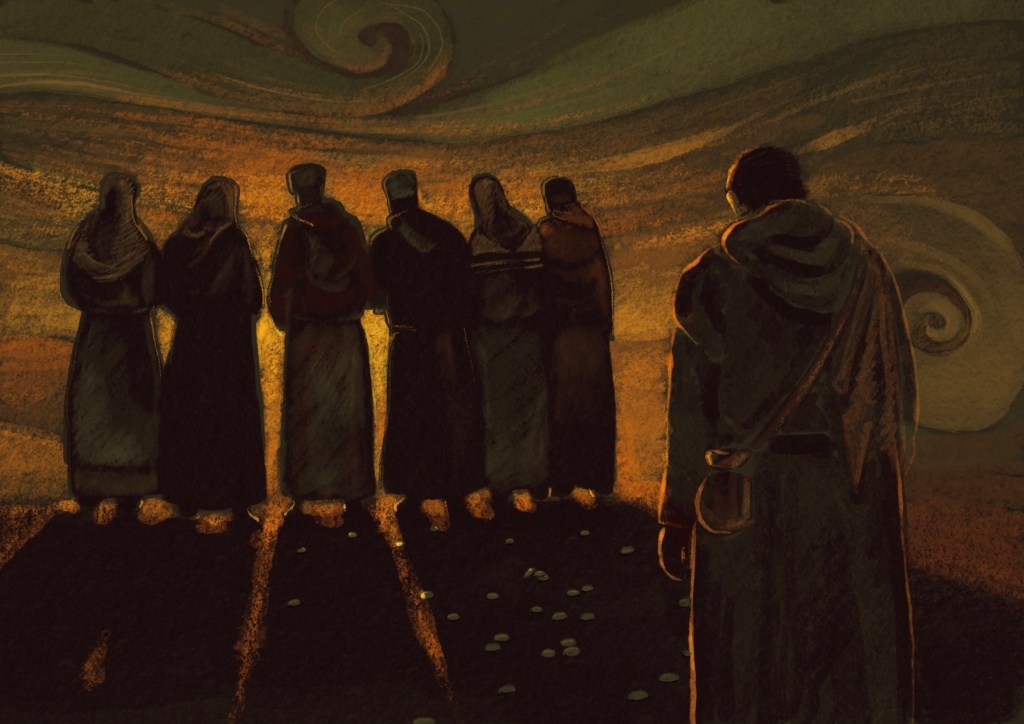
Recent examples include the well-documented failures within both the Catholic Church and the Southern Baptist Convention where abuse was concealed or minimized in order to protect the institution’s reputation rather than the vulnerable it was called to serve. Or high-profile leadership collapses where patterns of domineering, lack of accountability, and institutional insulation allowed dysfunction to persist. Too often the experience for those inside and outside the church is an echo of what Judas heard: “What is that to us? See to it yourself.”
Such failures invite not only critique but reflection, for it is important to remember that the religious authorities who dismissed Judas were not cartoon villains. Like leaders in every age, they were vulnerable to the subtle drift by which power meant for ultimate good becomes power used for self-preservation.
In 1991, playwright-turned-Czechoslovakian President Václav Havel, upon receiving the Sonning Prize for his contribution to European civilization, reflected on what he called the “temptations of power.” Political authority, he noted, is not inherently corrupt. It arises from the legitimate need for leadership and the desire to serve the common good. Yet power carries with it a subtle and intoxicating affirmation of one’s own importance. Privileges accumulate in the name of responsibility leading to the question Havel posed in his speech: “Where does the interest of the country stop and the love of privileges begin?”
The danger, Havel suggested, is rarely an explosive scandal. Instead it is a gradual self-deception where the power and privileges of the office begin to malform the person. What appears to confirm one’s identity quietly hollows it out. A leader can become, in Havel’s haunting phrase, “a captive of his position, his perks, his office,” transformed into what he described as little more than a stone bust of himself, outwardly impressive but inwardly lifeless. In one of his most direct confrontations with the religious leaders of his day, Jesus saw this very danger as well as its impact, describing them as “whitewashed tombs.” The result is not merely personal corruption but pastoral harm as they “tie up heavy burdens, hard to bear, and lay them on people’s shoulders,” demanding of others what they themselves will not practice.
Perhaps this “burden” in part explains the decrease in Americans who formally belong to churches and the increase in those who believe the church is less influential in American life. In 25 years at Redeemer Presbyterian Church in New York City, I had countless conversations with self-described atheists and agnostics whose resistance to Christianity was shaped less by indifference than by a mix of disillusionment and anger. The anger was directed less at Jesus than at parents or churches who, in their experience, had distorted or betrayed his teachings.
As Russell Moore observed in his book Losing our Religion, many younger people have left the church not because they have lost belief in what the church teaches, but “because they believe the church itself doesn’t believe what the church teaches.” Teaching that would, if enacted in love, directly addresses the paradox of our moment: a society that is by many measures more materially prosperous than ever, yet marked by rising loneliness, anxiety, and a persistent sense of dislocation.
English writer Julian Barnes gives voice to these realities at the beginning of his memoir Nothing to Be Frightened Of with the confession, “I don’t believe in God, but I miss him.” Despite describing the Christian story a “beautiful lie … a tragedy with a happy ending,” he finds that sacred music and poetry stir something irreducible in him, something not found in what he describes as “the secular heaven of self-fulfilment.” He calls this the “haunting hypothetical of the unbeliever… (which is) What if it were true?” Perhaps this is what haunted Judas that night. The possibility that somewhere in the temple, with its sacrifices and rituals of atonement, that even he, the great Betrayer, might find a way to turn the story of his life from a tragedy to one with a happy ending.
It is no revelation that we are living in a moment in which entire categories of people are treated as cultural lepers. Particular votes, affiliations, tweets, or loyalties render a person beyond redemption. To support, in another’s eyes, the wrong candidate or cause is for many the equivalent of Judas’ kiss of death. And once irredeemability becomes culturally codified, identity is permanently fused with one’s worst act. History becomes a prison, and both hope and progress disappear, leaving in their place apathy and cynicism.
This is why the Jewish political theorist Hannah Arendt argued in her book The Human Condition that without forgiveness, human beings remain trapped in the consequences of their past actions, writing: “Without being forgiven, released from the consequences of what we have done, our capacity to act would, as it were, be confined to one single deed from which we could never recover; we would remain the victims of its consequences forever.” Judas dropping his silver on the ground was the moment he became trapped.
If the only message available is, “Good luck with that,” the future is bleak indeed.
But that is exactly what is heard anytime religious communities measure faithfulness by ideological alignment rather than love of God and neighbor. When political movements care more about purging the impure than persuading the prodigal. As Mark Lilla argued in his book The Once and Future Liberal, when a political vision loses a shared civic narrative, what he calls a political catechism, the fragmentation undermines the ability to persuade a broader public, and the political tents get smaller and smaller.
But the moral architecture of Christianity, that forgiveness is possible and that our stories, individually and collectively, are not permanently defined by our darkest chapters, fuels the progressive creativity on which our republic thrives. Historically this has taken concrete form in movements that believed people and systems could change. Abolitionists who refused to accept slavery as permanent and civil rights leaders who appealed not only to law but to conscience. Even the ordinary rhythms of civic life like jury deliberations depend upon the possibility that people are more than their worst act and that a shared future can be forged from a divided past.
Which brings us full circle. The political parade that began with palm branches and visions of Jesus overthrowing Rome’s oppressive government ended in his crucifixion. It was a death designed to publicly humiliate anyone foolish enough to challenge Rome’s power. Yet Christians went on to make the astonishing claim that what began with Judas’ kiss of death became the fulcrum on which history was forever changed. That the man who died on the cross was, and is, the king of the world.
Pastor and writer Frederick Buechner once observed that the symbol of Christianity is not a star, a crescent, or a lotus, which are images of beauty and light. Instead it is the cross, an instrument of oppression and execution. This is because the cross represents hope that the worst the world can do is not the end of the story. Or as the historian Tom Holland wrote in his book Dominion: “The heart of Christianity is a tortured corpse.”
As Holland goes on to argue, this claim reshaped the moral imagination of the West, giving rise to what modern people now take for granted: mercy for the powerless and dignity for the despised. This is why the cross stands as a rebuke to any attempt to appropriate Jesus in triumphalistic causes. Weakness is power in his kingdom. Jesus who rode into Jerusalem that day did not come to conquer his enemies but to die for them. Nor did he come to leave us to try and wash away the guilt of our own “damned spot” like Lady Macbeth. To “see to it ourselves,” as Judas was told in the temple. Instead he “saw to it” himself by dying on the cross, the penultimate sacrifice of atonement.
All of this is meant to shape the community that bears Jesus’ name, ensuring that no one who comes carrying their own pieces of silver will hear the words, “What is that to us?” Instead, they should find what Judas went looking for that night: grace for a new beginning.