Over the past decade, the woke left insisted that everything was taboo. The Founding Fathers were recast as villains. The Constitution was treated as a relic of oppression. Even ordinary civic rituals—the Fourth of July, patriotism, the language of merit—fell under suspicion. Eventually, many Americans grew weary of the constant denunciations, and a backlash was inevitable.
Backlash movements, however, rarely stop at restoring balance. In the vacuum created by the waning of the woke moment, some voices on the right have embraced the opposite impulse. If the left once declared that everything was forbidden, the right now behaves as if nothing is. Words once understood as plainly degrading are deployed for shock value. Historical horrors become material for irony or provocation. Even ideas that once sat far outside respectable political discourse—Holocaust revisionism, racial nationalism, open misogyny—are occasionally waved around as if transgression itself were a virtue. It is a pendulum swing into another form of cultural decay.
The most troubling place where this shift is visible is within the ecosystem of right-wing youth political organizations, which are increasingly shaped by online subcommunities—part meme factory, part grievance forum. The language, humor, and sensibilities emerging from these spaces were never designed for persuasion or governance. They thrive on provocation, irony, and the thrill of violating social norms.
Consider this, for instance. On March 8, the College Republicans at my alma mater, New York University, posted the following message for International Women’s Day:
Happy International Women’s Day to all the right wing foids and e-girls out there! Obviously women being involved in politics has kinda been a disaster for us. You guys reallyyyy like voting Democrat. But shoutout to the real ones holding it down for us, love u.
The term foid, a crude contraction of “female humanoid,” originates in the lexicon of incel forums on platforms such as 4chan and Reddit, where it is deployed explicitly as a way of stripping women of personhood. The irony is that the post tries to flatter conservative women while speaking in a dialect borrowed from communities that openly demean the entire female sex.
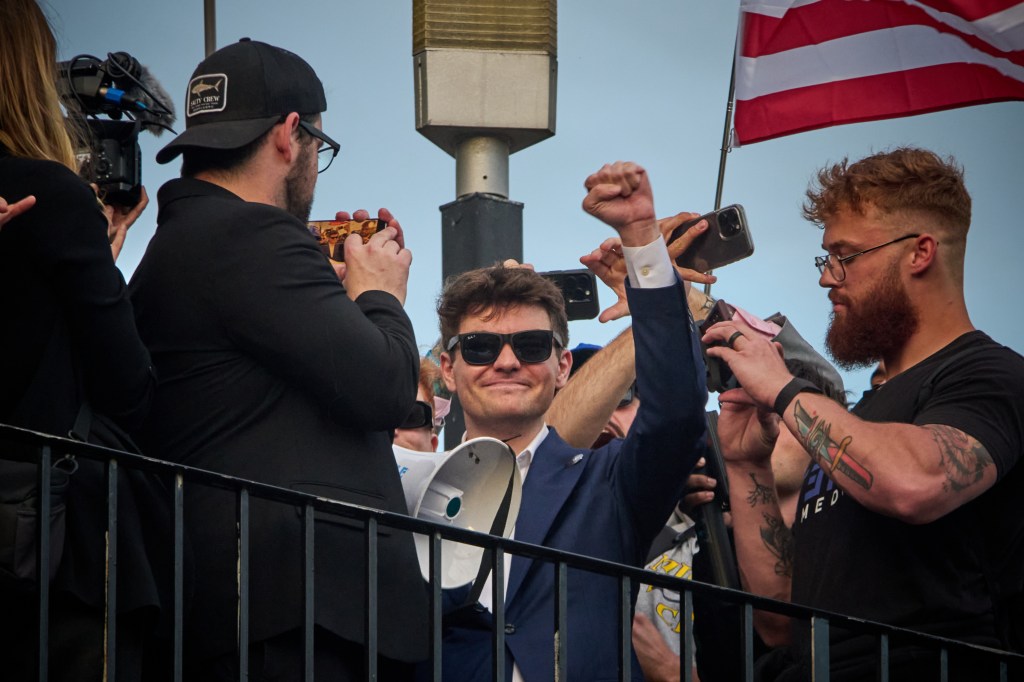
This is not an isolated incident. About a month ago, the president of NYU College Republicans, Ryan Leonard, met up with Clavicular, the online alias of Braden Eric Peters. Clavicular is an influencer who rose to prominence through the “looksmaxxing” manosphere community on platforms like Kick and TikTok. In his content, women are frequently described as “targets,” or “slayables”—terms drawn from the same corners of the internet that treat relationships as a competitive game rather than a human bond. In September 2025, Leonard also hosted Nicolas Kenn De Balinthazy—better known online as Sneako—as part of an official NYU College Republicans event. Among other things, Sneako has promoted conspiracy theories about Jewish influence in politics and media, and has flirted with rhetoric praising figures such as Hitler or treating Nazism as a subject for provocative commentary.
The point is not that a student political club must limit itself to speakers who fit comfortably within polite, mainstream consensus. Political organizations should—and often do—host controversial figures. Yet controversy alone does not confer seriousness. There remains a meaningful distinction between inviting thinkers who challenge prevailing orthodoxies and elevating personalities whose primary currency is provocation.
What these choices reveal is that the cultural reference points of the American right no longer lie in conservative intellectual traditions or political theory grounded in argument and debate. Instead, they stem from a loose constellation of streamers, influencers, and online commentators whose audiences are predominantly young men navigating an internet grievance culture organized around attention—earned through spectacle and the continual escalation of rhetorical transgression.
Furthermore, figures from these spaces are increasingly finding their way into positions of influence within youth political organizations themselves. A recent example is Kai Schwemmer, who was appointed political director of College Republicans of America in early March. The organization serves as a national umbrella group that charters and supports College Republican chapters on campuses across the country.
Controversy alone does not confer seriousness.
Schwemmer developed an online following as a streamer who was once closely tied to the “America First” and groyper movement associated with white nationalist provocateur Nick Fuentes. Schwemmer appeared in a 2021 video promoting Fuentes’ “White Boy Summer” tour and was later featured as a “special guest” at Fuentes’ 2022 America First Political Action Conference. Schwemmer’s appointment immediately drew criticism from observers across the political spectrum—including many within the broader conservative movement—who raised concerns about the message his elevation sends about the direction of right-wing youth politics.
To be fair, the controversy surrounding Schwemmer’s comments and affiliations dates back to when he was 18 and 19 years old. In response to the criticism, he wrote on X: “My comments in high school and as a teenager should not be taken to accurately reflect my views or demeanor now. I condemn all forms of hatred, including antisemitism, obviously. I’m not a groyper. … In the past, I’ve spoken in ways that were unnecessarily crass or demeaning. I’m conscious of that fact, and since returning from my service as a missionary, I have made adjustments to become a better disciple of Christ.”
That explanation may very well be sincere. People do mature, and political movements should allow space for personal growth. However, the issue here is not merely one individual’s past statements. The real question is why the pipeline of youth conservative politics so often draws from these digital fringe circles in the first place.
When the pool of rising leaders is molded chiefly by internet notoriety rather than intellectual rigor and institutional judgment, the result is performative transgression, conspiratorial thinking, and a constant appetite for outrage. In that sense, the Schwemmer controversy is less a scandal than a symptom of currents that have begun to surface with unsettling regularity across right-wing youth political organizations.
In October 2025, Politico reported on a cache of private text messages from leaders of the Young Republicans, an organization for Republican Party members between the ages of 18 and 40. The messages, exchanged over seven months, revealed a torrent of racist and hateful remarks circulating in a group chat of roughly a dozen Gen Z and millennial Republicans.
Defenders of the Young Republicans were quick to frame the scandal as little more than youthful mischief. The vice president of the United States, J.D. Vance, struck such a note while appearing on the Charlie Kirk Show. “The reality is that kids do stupid things, especially young boys,” he remarked. “They tell edgy, offensive jokes. That’s what kids do. And I really don’t want us to grow up in a country where a kid telling a stupid joke—a very offensive, stupid joke—is cause to ruin their lives.”
But many of the individuals involved were not teenagers testing the boundaries of humor. They were adults—some in their late 20s or 30s—holding leadership positions in Republican politics. Peter Giunta, the former president of the New York State Young Republicans and a vocal supporter of Donald Trump, was among the most active participants in the group chat. At the time the messages were sent, he was serving as chief of staff to New York Assemblyman Mike Reilly. In the thread, Giunta wrote, “I Love Hitler,” and in another message remarked, “If your pilot is a she and she looks ten shades darker than someone from Sicily, just end it there. Scream the no no word.”
Other participants contributed similar remarks. William Hendrix, the vice chair of the Kansas Young Republicans, used variations of a racial slur more than a dozen times in the chat. Bobby Walker, who at the time held the position of vice chair of the New York State Young Republicans, referred to rape as “epic.”
What makes this episode significant is that the behavior occurred among individuals entrusted with leadership positions in organizations tasked with cultivating the next generation of conservative activists. A great number of figures on the right tend to dismiss campus political organizations as frivolous sideshows. Yet historically, they have been training grounds for future leadership.
What may appear today as juvenile behavior should not be dismissed so easily.
President Calvin Coolidge, for example, was an active member of the College Republican Club while attending Amherst College from 1891 to 1895. Former House Speaker Paul Ryan was likewise deeply involved in College Republican politics during his time at Miami University in Ohio, and his early political engagement included working as an intern with the College Republican National Committee and later working as an aide to a U.S. senator. Even former Secretary of State Hillary Clinton began her political life within the Republican fold. During her freshman year at Wellesley College in 1965, she served as president of the Wellesley Young Republicans, though she later changed her political affiliation. Correlation is not causation. Many members of the College Republicans and Young Republicans never enter public life. But these organizations have long functioned as launchpads for those who do.
Seen in this light, what may appear today as juvenile behavior should not be dismissed so easily. The cultural norms that take root within youth political organizations often become the habits and assumptions later carried into positions of real political influence within the governing class.
According to the conservative writer Rod Dreher, a Washington insider—speaking anecdotally—estimated that “between 30 and 40 percent” of Gen Z staffers working in official Republican circles are admirers of Nick Fuentes. There is no hard data to substantiate the claim, but Dreher noted that this impression surfaced repeatedly among young conservatives living inside that world. Not every Zoomer who identifies with Fuentes agrees with all of his views, or even with the way he expresses them. What draws them, Dreher suggests, is his anger, his theatrical defiance, and his willingness to violate taboos.
When one perceptive young conservative was asked what the groyper movement actually wants, his answer was telling: “They don’t have any demands. They just want to tear everything down.”
Whatever many on the left may wish to believe, this phenomenon cannot be reduced to white supremacy or sexism alone. Some of the ideology’s most visible agitators do not even fit those categories. Among them are figures such as Kanye West—whose song “Heil Hitler” has circulated within this coalition—alongside Myron Gaines, a Sudanese-American podcast host who has engaged in Holocaust denial and Nazi apologetics, and Amy Dangerfield, a female cultural commentator who has argued for repealing the 19th Amendment.
The deeper question, then, is why these circles hold such appeal for young Americans in the first place. In earlier generations, young conservatives often found community in churches, local associations, and civic organizations. Today, by contrast, many encounter politics for the first time through digital communities, where identity tends to form around shared grievances and a style of adversarial humor.
For a number of young men, the surrounding cultural landscape has felt inhospitable from the very beginning. Their formative years unfolded alongside the rise of a highly moralized strain of identity politics that permeated schools, media, and online discourse. Frequently, they encountered slogans declaring that “men are trash,” heard ordinary male competitiveness described as “toxic masculinity,” and absorbed the message that masculinity itself was implicated in society’s injustices. Women have unquestionably faced real disadvantages, yet 16-year-old boys can hardly be expected to accept being cast as inheritors of guilt for problems they neither caused nor had any meaningful role in sustaining.
At the same time, traditional markers of masculine success—stable careers, marriage, family formation—have grown more difficult to attain. Online culture magnifies these pressures by turning social life into a constant ranking system of attention, attractiveness, and dominance. In such an environment, grievance-oriented communities offer something emotionally potent: a narrative that explains humiliation while promising the restoration of dignity and status.
Meanwhile, for some women disillusioned with modern dating culture or frustrated with progressive gender politics, that narrative can carry its own appeal. It offers the reassurance of clearly defined roles and social order—an image of stability that can feel comforting amid a cultural atmosphere many experience as confusing.
That search for belonging intersects with another, quieter development: the fading of historical memory. As British podcaster Konstantin Kisin has observed, “Every generation … only really learns what to do, how to think and which pitfalls to avoid from the two preceding generations with which it has direct contact. We don’t learn lessons from history so much as we learn them from our parents and grandparents.”
For many younger Americans, the defining political traumas of the 20th century exist only as distant abstractions. The catastrophes that once gave words like fascism their moral gravity—world war, genocide, and the fall of democratic societies—no longer occupy the cultural imagination with the same immediacy. Without deeply ingrained taboos, the allure of strongman politics can take on a strangely novel quality: an aesthetic of defiance that promises order, purpose, and decisive action in a political world many experience as chaotic and humiliating.
Many observers hope that the American right’s intellectual class—its think tanks, public intellectuals, and political leaders—will eventually correct the movement’s trajectory before its fringe elements consume it from within.
In an ideal world, a figure like J.D. Vance could have played that role. A millennial conservative, Vance’s own story suggests a model of personal discipline and moral seriousness. As he recounts in Hillbilly Elegy, he grew up amid the social decay of a fractured family and a struggling Appalachian community. He might easily have succumbed to the same nihilism that overtook many of this rising generation on the right were it not for the stabilizing influence of his grandmother, the discipline instilled by the United States Marine Corps, the intellectual formation he received in law school, and the personal grounding provided by his wife, Usha Vance, as well as his religious faith.
Vance could have decisively repudiated the groyper-adjacent corners of the movement. He could have drawn a clear boundary, the way Barry Goldwater rejected the excesses of the religious right associated with the Moral Majority, or Ronald Reagan repeatedly dismissed the conspiratorial politics of the John Birch Society.
But Vance appears too focused on his political future to risk alienating a considerable segment of the young Republican base. And while commentators like Ben Shapiro have recently become more vocal in criticizing these radical tendencies, the traditional gatekeeping structures that once constrained those tendencies have eroded. Think tanks and allied media organizations that once disciplined fringe behavior before it could metastasize into the mainstream no longer play that role with the same consistency.
In some cases, they have even shown a troubling degree of tolerance for—if not outright sympathy toward—these more extreme factions. The extent of that shift was underscored when Kevin Roberts, president of the Heritage Foundation, publicly defended Tucker Carlson after he effectively sanitized and elevated Nick Fuentes’ ideas for a mass audience rather than subjecting them to sustained scrutiny. Roberts described Carlson as a “close friend” of Heritage and suggested that engaging Fuentes in this way should not be treated as beyond the pale.
Beneath the noise of TikTok outrage exists a far larger constituency.
That breakdown in the traditional gatekeeping structures has only accelerated the emergence of alternative prestige systems on social media, in which notoriety itself becomes currency. A young activist can build a substantial following online and then convert that visibility into a measure of institutional authority. In other words, even if figures like Vance and Shapiro were to speak out forcefully against the radical right, there is little reason to believe their words would meaningfully rein it in.
Nevertheless, the story of conservatism in America has never been written solely by its loudest voices. Beneath the noise of TikTok outrage exists a far larger constituency. They are parents, churchgoers, small business owners, students, and professionals who gravitate toward conservatism because they believe it offers a philosophy of stability, responsibility, and ordered liberty. This is the self-silencing majority.
Silence, though, carries consequences of its own, and history offers ample testimony to this fact. The revolutionary fervor of the woke left began to exhaust itself because movements animated mainly by denunciation and disruption rarely survive contact with the practical demands of governing. The groyper subculture that is now gaining visibility on the right may well follow a similar trajectory. But even if it ultimately collapses beneath the weight of its own contradictions, the damage it leaves behind could linger for years.
That danger is why silence from the broader conservative public cannot be the default response. If we allow conservative youth institutions to fall captive to internet nihilism, we will gradually forfeit the credibility required to lead anything beyond an online audience. At their best, these institutions function as crucibles of civic responsibility. They connect politics to the everyday work of community life: organizing volunteer efforts, supporting local charities, strengthening churches and civic associations, and helping young people navigate the practical challenges of adulthood. These works provide moral and social foundations far more promising than authoritarian aesthetics, racial grievance politics, or the theatrical cruelty that has become fashionable in certain darker precincts of the internet.
That is because conservatism has never been a creed of destruction. It has been a tradition devoted to preserving the institutions that make freedom possible: the rule of law, constitutional government, civil society. Its greatest thinkers—from Edmund Burke to Russell Kirk—understood that liberty endures only when citizens exercise discipline over their passions and humility before the lessons of history.
If this generation of conservatives intends to carry this inheritance forward, we must decide whether we want to build institutions or merely burn them for entertainment.