At the best of times, Americans get bitchy when the price of filling up the fuel tank goes up, and these are not the best of times: We are, rather, the better part of a decade into elevated inflation thanks to the COVID-era disruptions and the continuing orgy of government spending for which that awful epidemic provided a convenient pretext. Donald Trump, because he is an imbecile, is doing everything he can think of to make that inflation worse: disrupting regular trade, imposing taxes that put upward pressure on prices, providing direct financial subsidies to politically important groups (farmers again) where possible, pressuring the Fed to cut interest rates, dreaming up new ways to inflate housing prices (such as 50-year mortgages), etc.
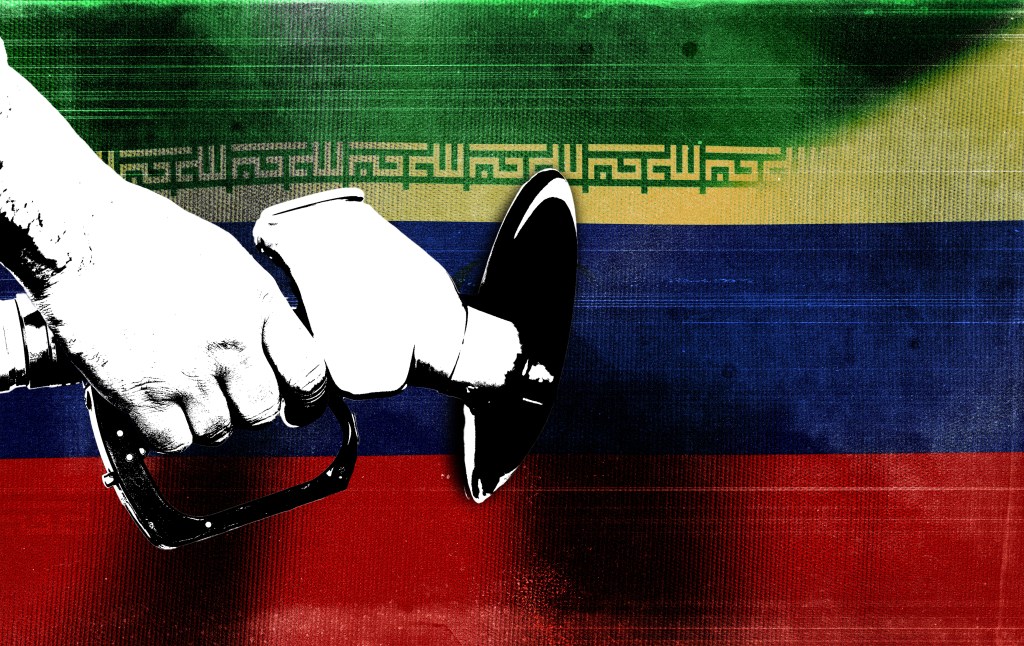
The upshot of that is that we are offering sanctions relief to the petroleum-dependent country with which we currently are at war (undeclared, unauthorized, and illegal) because apparently we cannot afford to fight a war with Iran without simultaneously subsidizing the economic activity controlled by the very same fanatical miscreants we supposedly are trying to depose.
Writing in The American Conservative in 2018, William S. Smith took a familiar line: Donald Trump is not the problem—the awful old conservative establishment is the problem. “[W]hile political conservatism is in crisis,” Smith wrote, “Trump is not the cause. By embracing an ideology of military interventionism alien to American constitutionalism—while tolerating an ever expanding welfare state—conservatism lost its way.” Conservatism did, in fact, lose its way, then found its way to Trump and … let’s call it “an ideology of military interventionism alien to American constitutionalism” executed while “tolerating an ever expanding welfare state.”
If you want to be charitable to Smith and the kind of Trump apologia circulated for years by the likes of The American Conservative (which I don’t, especially, as a matter of fact) then I suppose you might argue that 2018 was too soon to see what Trump really was–too soon for some people, anyway. For others who were perhaps in possession of historical reasons to be suspicious of Trump’s piggish caudillo politics, it was clear from the beginning that right-wing populism was always the shortest route to the “welfare-warfare state” that libertarians and certain paleoconservatives used to talk about all the time. Trump was by no means less belligerent than the so-called neocons (most of them not actually neoconservatives) that figures such as Ron Paul and sundry Trump sycophants rail against—if anything, Trump always has been more belligerent and combines his belligerence with an old-school mercantilist-colonial mentality—“Take the oil!” and all that nonsense. Trump may have leaned more heavily into the welfare—refusing even to consider entitlement reform, for example—than into the warfare, but jackass populism is no less the enemy of a prudent foreign policy than it is the enemy of a prudent fiscal policy. Jackassery is an all-purpose product, and Trump is an ass of such exceptional asininity that Apuleius could have written a book about him.
Prices are up at the pump. Overall inflation remains elevated and very likely will be driven higher by those rising petroleum prices and other war-related disruptions. Security lines are literally out the door at American airports. American troops are dying in a Middle Eastern war (undeclared, unauthorized, and illegal) with goals that are vaguely defined and a rationale that changes from minute to minute. The national debt continues to explode with no signs of abating, while unfunded entitlement liabilities stand at nearly $80 trillion.
I do not make a habit out of making predictions. (Never voluntarily give a hostage to Fate.) But, given all of the above—and given the character and the temperament of the people running the show in Washington—I would say that there is a nontrivial chance that we end up looking back on $5.45 diesel as the good ol’ days.
Words About Words
Historically, the expression was “You’ve got another think coming,” not “another thing coming,” as in:
But I don’t think “think” would work in the Judas Priest song.
In Other Wordiness
Thanks to a recent New York Times “Connections” puzzle, heteronyms are top of mind. (For a certain kind of nerd.) The heteronyms—words with the same spelling but different pronunciations and different meanings—in the Times puzzle were bow, row, sow, and wind. Heteronyms are distinct from strict homonyms, which have the same spelling and pronunciation but different meanings (grizzly bear, the right to bear arms). Homonyms often come into being through different etymological pathways, being unrelated words that are spelled the same way because … English is just like that. Contronyms are what you have when there is a single word that means both one thing and its opposite, such as cleave (both “stick together” and “divide in pieces”).
Heteronym has a pair word that is not quite a heteronym or homonym or contronym but an example of a word simply being used to mean two very different things: There is the linguistic heteronym, as discussed above, and there is the literary heteronym, which is a pseudonym that has been fleshed out to create an entirely new fictional character: It is not just a made-up name an author is using for some reason or another but a completely made-up person. For example, the Portuguese poet Renata Ferreira, whose fascist-era verses (“her poetry is unmistakably ardent, tender, fraught, erotic, and Sapphic,” says the publisher) were “rediscovered” in 2015, is an invention of the writer Frank X. Gaspar. The ancient Latin poet Quintilius never existed; he is an invention of the modern English poet Peter Russell, who “translated” the imaginary poet in The Elegies of Quintilius.
And Furthermore
Speaking of the difficulties of pacifying the Strait of Hormuz, Donald Trump said: “If we do a 99 percent decimation, that’s no good.” That hardly even registers on the the illiteracy scale grading on the Trump curve, but: 99 percent of a decimation would constitute a reduction of the relevant Iranian forces by 9.99 percent, a decimation being a reduction by one-tenth. Presumably, U.S. forces already have carried out much more than a decimation. You’d think that Trump, with his idiot’s love of superlatives and multiples, would love the correct formulation: Taking out 27.1 percent of Iranian forces wouldn’t just be a decimation, it would be a triple decimation!
Elsewhere
You can buy my most recent book, Big White Ghetto, here.
You can buy my other books here.
You can check out “How the World Works,” a series of interviews on work I’m doing for the Competitive Enterprise Institute, here.
In Closing
The promise of strongmen, and would-be strongmen such as Donald Trump (who is too weak of a character to be an actual strongman), is that they will bring order. They promise that they will put an end to petty partisan squabbling and “bureaucracy” and “special interests” and do the obvious right thing—which, for some reason, only they can see. They insist that they have no time for things such as regular legislative order and the tedious committee process, niceties of legal procedure. Even regular liberal democrats can turn to that mode quickly when the political need arises: Some of you will remember Bill Clinton’s insistence that the investigation into his sexual relationship with a White House intern (and the perjury and other offenses associated with it) was a “distraction” from “the American people’s business.” The strongman’s promise is that he is immune from such distractions, that he is ready to use “common sense” and—all together now!—“run this country like a business,” or at least “run the government like a business.” But the country is not a business, and neither is the government. And, in this case, Donald Trump was never much of a businessman to begin with but a coddled New York City real-estate heir who ruined the splendid fortune he inherited and then made his living as an entertainment grotesque—as one wag put it, he always acted like he was Conrad Hilton but is really more like Paris Hilton.
But from the airport to Iran to the Treasury to the risible cast of characters—Pete Hegseth, Kash Patel, et al.—installed in high office to utterly predictable effect, the evidence is here before all those with eyes to see: Autocrats talk about chaos and promise to bring order—and then they talk about order while they bring chaos.