Dual track.
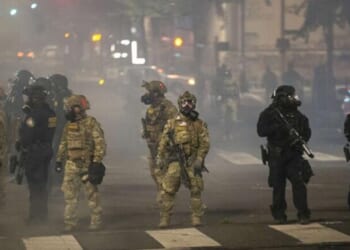
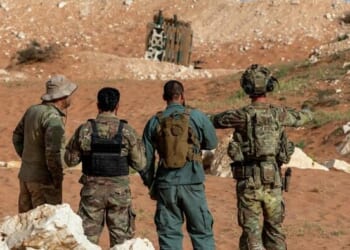
Consider his three options with infantry.
The first is sending troops to secure Iran’s enriched uranium, which would be a tricky business. “Teams of U.S. forces would need to fly to the sites, likely under fire from Iranian surface-to-air missiles and drones,” the Wall Street Journal noted. “Once on site, combat troops would need to secure perimeters so that engineers with excavating equipment could search through debris and check for mines and booby traps.”
The operation could take a week to complete, with no guarantee of success and American soldiers forced to dodge munitions the whole time. But even if it works, the strait will still be closed and the global economic crisis will deepen. One can only assume, in fact, that the regime will be less inclined to reopen it after its uranium gets pilfered. The more its other bargaining chips are snatched away by America, the more valuable its remaining Hormuz bargaining chip will become.
The next option is to send American infantry to occupy Kharg Island. “We need about a month to weaken the Iranians more with strikes, take the island and then get them by the balls and use it for negotiations,” a source close to the White House told Axios recently. Once Iran’s oil infrastructure is under U.S. control, the war’s endgame hypothetically becomes a simple prisoner exchange: They release their grip on the strait and in return we release our grip on their island.
It’s not as easy in reality, though. Iran is already “laying traps” on Kharg and fortifying it with troops and air defenses to prepare for an invasion, per CNN. After U.S. forces take it, they can expect anything from missile strikes to drone attacks to the Iranians opting to set their own oil facilities on fire to smoke out the American occupiers. Resupplying the troops by sea would be dangerous due to the threat to naval vessels in the Gulf; resupplying them by air would become impossible if the Iranians destroy the island’s runway to prevent the United States from using it.
The global energy shock would get worse if the mission succeeds, paradoxically, since now Iran’s exports would be offline. And the prisoner exchange that this operation is supposed to facilitate might not come together as easily as the White House hopes. Because he’s an idiot, the president has begun chattering about how much he’d love to take Iran’s oil; if you’re an Iranian leader listening to that, having been burned twice before by Trump’s negotiation tactics, you might reasonably conclude that he has no actual intention of giving back Kharg Island once it’s in his grasp.
In which case, not only will you have no reason to reopen the strait, you might start firing missiles at oil facilities in U.S.-aligned Gulf nations to punish America for its theft.
The third alternative is to send troops to occupy the coast around the Strait of Hormuz, which would have the virtue of addressing the core problem directly. If American infantry can push Iranian forces inland far enough, they can move them out of range of targeting tankers navigating the strait. Oil would begin to flow again. The economic pain that the world is about to feel acutely would be mitigated.
But there are catches here too. One is logistical. “People totally underestimate just how vast the strait is. Logistically, it’s such a long shoreline, some 100 miles, that it’s difficult to do any one thing to effectively neuter the threat from Iran,” an intelligence official recently told CNN. “The Iranians can be set up anywhere along the shoreline.” U.S. troops would be left playing whack-a-mole, trying to intercept hostile elements along a coast about as long as the state of Georgia’s. How many would be needed to secure an area that large? How many casualties would they take to secure it?
Even if you clear that objection, you’re left with a more basic one: How long can this occupation feasibly go on? We’re not going to have a ground force numbering in five digits camped out indefinitely along Iran’s Hormuz shoreline. At some point those troops need to come home. How does the strait stay open once they do?
There were and are only two ways to end this standoff on terms favorable to America. The regime could fall and be replaced by one that’s willing to take dictation from the White House, as Trump hoped would happen after a day or two of bombing. Alas, the Venezuela option looks to be off the table.
The other is to bludgeon the regime until it agrees to reopen the strait. I’m not sure that’s on the table either.
Test of wills.
The president believes, as all postliberals do, that any enemy can be subdued with sufficient ruthlessness. If you fight ugly enough, even the most determined adversary will conclude in time that giving you what you want is less painful and humiliating than continuing to resist.
That’s surely Trump’s theory of how to win in Iran, per his latest war-crimes threat this morning. If the regime isn’t ready to reopen the strait after a month of us laying waste to their military infrastructure, let’s see how they feel when desalination plants start going up in flames and there’s no water to drink.
It’s also the logic motivating his designs on Iran’s oil industry. “White House officials believe that taking Kharg Island would ‘totally bankrupt’ Iran’s Revolutionary Guard, one official said, and could potentially lead to a swift end of the war,” CNN reported earlier this month. Maybe they’re right. If we turn off their money tap and the bad guys come begging for mercy, offering to relinquish their death grip on the strait, that could be a fast, cheap, and good-ish outcome to the conflict—depending on how many American casualties there are in seizing Kharg, of course.
I have a hard time imagining that happening, though, for this reason: The only way the regime can “win” this war is by not begging for mercy and giving in to U.S. demands. Defying America and surviving the ongoing bombardment is the only path to strategic victory for the Khomeinists against two powerful enemies that undertook to end their rule in Iran.
It’s a test of wills. And the powers that be in Iran have good reason to think they can win it.
For one thing, they surely know that the war is unpopular in America and will grow less popular if ground troops are deployed. It’s not just Trump’s short attention span that has him looking for a “speedy” end to the conflict; he’s risking a long-awaited revolt by Republicans on the Hill and a total collapse in non-MAGA public support if combat troops start dying. He’s got to find an exit, and soon. That can only encourage the Iranians to wait him out.
His attention span is a factor, though. “[Trump] is getting a little bored with Iran,” a White House official recently told MS NOW. “Not that he regrets it or something—he’s just bored and wants to move on.” The Wall Street Journal confirmed that, citing a source who spoke to the president recently and came away believing that he “appears ready to shift to his next big challenge.” That might mean Cuba or it might mean bearing down on addressing the cost of living—which will be a neat trick if the strait stays closed and oil hits $150 per barrel.
The fact that the White House seems more gung-ho for peace talks than Iran does is another tell about Trump’s eagerness to wrap this up. It’s anyone’s guess what the true state of negotiations is—per Axios, even most high-level administration officials don’t know—but from every account I’ve read, the pummeling Iran has taken hasn’t softened the regime’s demands. On the contrary, Iranian leaders reportedly believe they’re winning strategically by having shut down the strait and are insisting on compensation for the war and the expulsion of U.S. military forces from the region, among other things, to end the conflict.
If anything, the Iranians are keen for the world to know that they’re not negotiating. Practically every time the president hops onto Truth Social to tout how well peace talks are supposedly going, some Iranian mouthpiece somewhere pipes up to contradict him. Last night the speaker of the country’s parliament (one of the few top regime officials left alive) mocked Trump on Twitter by predicting that he would hype the state of negotiations this morning to try to manipulate markets before they opened. Which, right on cue, the president did.
I don’t know that the Iranian government could make a deal on terms favorable to the United States at this point even if it wanted to, frankly. If, say, the foreign minister agreed to the president’s many demands, what would stop him from being killed by members of the Revolutionary Guard who believe they’re close to winning their test of wills with America and refuse to let some traitor in their midst bargain away their leverage?
One more thing. If Trump does foolishly opt to dial up the ruthlessness, it’s easy to see how that could weaken America’s hand in negotiations. Cutting off Iran’s oil revenue or its water supply might make the regime blink—or it might devastate the civilian population, bringing global opprobrium onto the U.S. and driving the president’s approval into the toilet. It’s hard to see the Khomeinists throwing in the towel at the very moment public opinion tilts sharply against the United States over the suffering of innocent Iranians.
The people there have been hostages of their government since 1979. The White House is now effectively threatening to shoot those hostages in hopes that their captors will cry, “No, anything but that!” and surrender. I do not think they will.
Prudence.
If I’m right about all of this then America needs a deal more than Iran’s government does, and the Iranians know it. Which makes it hard to see how the terms of that deal don’t wind up requiring America to lose face.
We’ve lost some face already. Iran is firing twice as many missiles now as it was a week ago. We’ve had to lift sanctions on its oil to ease the supply crunch caused by the Hormuz standoff. Our Gulf allies, which counted on us to protect them from Iranian attack, have found out the hard way that they misjudged and are worried that Trump will make a bad deal to end the war that leaves them exposed.
It would take wise, prudent leadership to discern which is the least bad option at this point among the “fast, cheap, or good” trade-offs on the war that I described earlier. That is not the sort of leadership we have, to put it mildly. One needn’t suffer from, ahem, Trump Derangement Syndrome to think so, either: Sift through the White House’s many conflicting pronouncements about the war over the past month, sometimes calling the conflict as good as over, other times threatening to bomb Iran twice as hard to end it, and see how confident you feel that there’s a steady hand on the wheel.
At best, the president is clear-eyed about the reality on the ground but is lying as needed from moment to moment for nakedly political reasons—to calm investors, to placate anti-war postliberals, to intimidate Iran’s leaders or our reluctant European allies. At worst, his assessment of the state of the war is shaky and constantly being revised depending on whichever toady was last in his ear. One can glean only so much information from “gorilla channel” sizzle reels of bombs going off, you know.
My guess is that Trump is looking for an outcome at this point that merely clears the low bar of being just good enough that he can plausibly sell it to MAGA as the greatest victory ever. If he could get Iran to agree to reopen the strait, that would probably suffice to justify a TACO—even if it meant having to spin all of the initial grounds for war in some feeble way. Regime change? We did it! (Sort of.) Missile capabilities? Done and done. Nuclear program? Eh, we buried it under rubble last year and will do so again at some point if need be.
He’s waiting hour by hour for some big shot in Iran to pick up the phone and offer him the “TACO for Hormuz” deal that’ll end this war. But the call isn’t coming, and he can’t wait much longer before having to make a momentous decision. Fast, cheap, or good? Choose any two.