When the crimes of the Trump administration are called to account in some future reckoning, high on the list will be the ongoing boat strike campaign, which has killed at least 163 people in 47 strikes in the Caribbean and eastern Pacific, with a strike on March 25 killing four. Former Department of Homeland Security counsel Kevin Carroll wrote in these pages that the strikes, “especially [of] shipwrecked sailors hors de combat, will almost certainly be ruled unlawful homicides when eventually reviewed by courts.”
Those strikes committed the administration, as a signature foreign policy, to what is called extrajudicial violence—injury committed outside the lawful bounds of war on the one hand or law enforcement on the other, depending on how you might look at it. Which made me wonder: To what extent should the means by which the Trump administration has pursued its signature domestic policy, mass deportation, also be seen as extrajudicial violence? Among those who have already spotted the parallel is Dispatch columnist Kevin D. Williamson, who wrote, “it took only 127 days for the Trump administration to go from extrajudicial killings of non-U.S. citizens in the Caribbean to extrajudicial killings of U.S. citizens in Minneapolis.”
It’s worth stopping at this point for a few caveats. Police in general, including those on a deportation mission, can lawfully use force for various authorized purposes: to detain a legitimate target of arrest, to respond proportionally to reasonable fear of imminent attack, and to respond to genuine interference or obstruction (which does not include simply being filmed). What’s more, isolated instances of excessive force will not always amount to a pattern of tolerated misconduct.
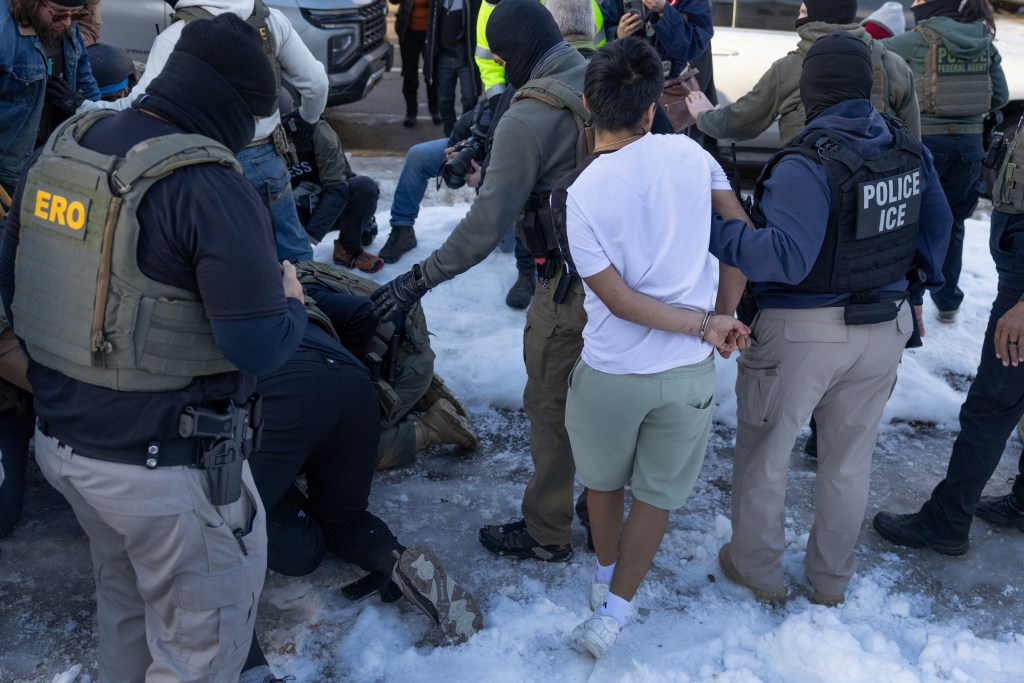
All that said, there is abundant evidence that Immigration and Customs Enforcement (ICE) and the Border Patrol have engaged in mind-boggling brutality against both noncitizens and citizens. After one target in Minneapolis was admitted to the hospital with his skull broken in eight places, ICE insisted to incredulous medical workers that he’d run into a brick wall trying to escape while handcuffed. Dozens have died in federal custody, often amid grotesque conditions, while the administration shipped 238 Venezuelan nationals to El Salvador’s CECOT prison, where they predictably were subject to torture and extrajudicial violence, for which the facility was notorious.
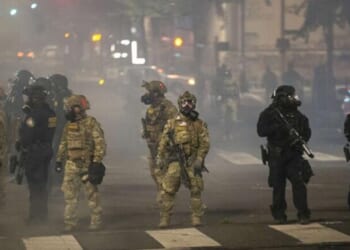
Americans who have showed up to film, observe, or protest ICE activities have been targeted for abuse. Even beyond the high-profile killings of Renee Good and Alex Pretti by federal agents in Minneapolis, citizens have been physically tackled and pushed to the ground, attacked with fists and batons, bear-sprayed, and pepper-balled. Orderly demonstrators posing no risk of trespass or interference have been tear-gassed in large numbers, as have thousands of bystander schoolchildren, shoppers, and local residents who found themselves in the wrong place at the wrong time in cities like Chicago and Minneapolis.
Defining the phenomenon.
Definitions of extrajudicial violence vary in practice, but the core is recurrent violence taking place outside the legal system that is condoned, connived at, or encouraged by the legally constituted authorities. The ones dealing out the injury might be agents of the government exercising freelance or informal authority, with or without orders from higher-ups, or they might be private gangs or toughs operating in concert with the government or tolerated by it. Across all these cases, a key element is impunity: The perpetrators one way or another have reason to expect that they will not be punished according to regular law, or even perhaps investigated when identified as perpetrators.
Extrajudicial violence is often regarded as a keystone indicator of whether the rule of law is in healthy shape in a country. One reason is that it tends to be contagious: While it may begin with a loathed or officially disfavored target, such as a suspect roughed up in the police station, it can often spread to others, such as political opponents or unpopular minorities. Impunity gets to be a heady thing.
At the same time, it’s important to recognize that extrajudicial violence can take deep root in genuinely democratic societies, the kind where elections are conducted fairly and parties succeed each other in office. One reason is that such violence can be quite popular with many voters, above all if they think it will help deter crime against the general public. As Dispatch columnist Nick Catoggio has pointed out, plenty of populist opinion here in the United States sees the roughing up of suspects and prisoners as a sort of corrective to the supposed softness of the regular legal system. Abroad, some of the modern strongman leaders most associated with extrajudicial violence have enjoyed solid popularity with voters, including El Salvador’s Nayib Bukele and ousted Philippines strongman Rodrigo Duterte (now on trial for human rights violations).
What’s changed under Trump.
No figure in American history has played to and exemplified this strain of public feeling like Donald Trump, from his suggestion that cops stop being so “nice” to people they arrest to his treatment of hecklers at rallies. Noting his suggestion before California Republican activists that shoplifters should be shot, the New York Times wrote that Trump had regularly “glorified violence.” But just as often his hints and more-than-hints of a taste for extrajudicial violence are winking and half-joking, as when he mused during the 2024 presidential campaign about how all it took to solve the retail theft problem was “one really violent day”: “One rough hour—and I mean real rough.”
Along with singling out figures like Duterte and Bukele for praise, Trump has lauded what he claims is some countries’ practice of executing drug dealers the same day they are apprehended, a policy unlikely to accord with any very exacting ideas of due process. Near the height of a public outcry over his having deported Venezuelan nationals to the notorious El Salvador CECOT prison, Trump said he’d like to send “homegrown” offenders there too– that is, U.S.-born citizens. It was fully consistent for him to choose for his defense secretary a man such as Pete Hegseth (“no stupid rules of engagement,” “maximum lethality, not tepid legality”), who made his name defending war criminals.
Impunity was a theme of Trump’s second term from almost the day he took office, beginning with his mass pardon of January 6 rioters, some of whom had committed heinous physical violence against police defending the Capitol. The most conspicuous feature of the deportation campaign—agents’ use of masks and disguise—served both to promote and to proclaim impunity. When masked agents began committing acts of violence, the president and his subordinates immediately moved to a stance of fully backing them no matter what the circumstances, and claiming that they enjoy complete immunity (they don’t).
To be fair, Trump didn’t invent America’s long-term trend toward ever broader personal immunity for federal agents who violate constitutional rights. That trend had been going on for decades. Even so, there had remained at least some show of legal standards and accountability. Reports of misconduct could be investigated by relevant departments and weighed against policy handbooks, sometimes leading to firings and even prosecutions of errant officers.
Trump’s deportation campaign, however, added several new wrinkles. To begin with, the administration did not respond to evidence of possible misconduct with the usual gestures toward internal investigation, let alone prosecution. While it might be possible for some later presidential administration to go back and revisit Trump-era abuse with an eye to prosecution, it is widely assumed that Trump would treat a pending change of administration as occasion to issue blanket pardons of many or even most misbehaving underlings.
When federal agents shot Renee Good in the face through her car’s side window and Alex Pretti in the back on the streets of Minneapolis, one of the things that shocked the public was how instantly and completely the administration moved to rule out any prospect of investigation and accountability. Well before the facts had emerged in both cases, they rushed to exonerate the agent who shot Good and spread wild untruths about Pretti’s reasons for being on the scene. Inconsistent with standards of impartial investigation, they hastily scooped up the evidence from both scenes, which also served to frustrate the attempts of state and municipal police to lay the basis for an investigation under state law. It soon became clear that Good’s and Pretti’s survivors had virtually no hope of pursuing effective justice in any court. ICE was truly above the law.
The Department of Homeland Security also took to keeping private, rather than making public, its standards for how its officers should behave, notably on its switch to a practice of entering homes without a judicial warrant, something the department kept secret for months. As part of a push to hire 10,000 new employees, DHS also drastically pared down its training program for new agents, in part by removing instruction on such topics as “the Constitution, use of force, and lawful arrests.”
To sum up, then: Two key, interrelated elements in a system of extrajudicial violence—practical impunity for violent misconduct, and official condonation of or connivance at it—are very much in place, coming from the very top.
That still leaves, to complete the picture, the question of which acts of violence were in fact lawless and which might have been defended as having some legal justification. Ideally, this sorting out would take place by fair legal process before judges and juries. And that brings us back to a dead end for the moment, given the effective cloak of impunity the administration enjoys.
It might not enjoy that cloak indefinitely. Assuming (for example) that Democrats recapture one or both houses of Congress this fall, they could begin investigating with subpoena power. Aside from the highest-profile incidents like the killing of Good and Pretti, I have a few other suggestions for areas that could usefully bear investigation:
- violent treatment of people filming enforcement actions from their phones, something most courts have found to be constitutionally protected;
- gassings, pepper-ballings, and physical beatings of journalists and demonstrators who across a wide range of cases appear to be neither resisting, obstructing, or menacing;
- violent entry to homes, smashing of windshields, and flash-bang attacks, among other “shock and awe” tactics that sometimes cause injuries.
In each of these instances, the reports have been frequent and consistent enough to suggest that higher-ups are at least informally approving, if not actually ordering, the categories of abuse. DHS should be forced to supply testimony and documents on what policies and guidance it has issued on each of these practices, what legal justifications the department may be using, and whether reports of extreme abuse have been met internally with reprimands and write-ups, or with praise and promotions.
It’s also possible that some investigations will originate abroad—and not with the International Criminal Court, to which the U.S. is not a signatory. Many advanced democracies take an interest in whether allies or trading partners have been countries credibly accused of tolerating extrajudicial violence. Ironically, at least until quite recently, the United States was known as one such democracy. In November Rep. Jim Himes of Connecticut, ranking member on the House Intelligence Committee, was quoted recalling that the U.S. would often withhold full intelligence cooperation when it thought an ally had been credibly accused of it. “Very, very often we will shut down a partnership or shut down cooperation,” he told the New York Times.
Better for America to turn back from the path to international pariah status and set to work fixing our problem with extrajudicial violence. That should mean replacing impunity with full legal accountability, including criminal prosecutions of violent wrongdoers before independent judges and juries. Responsibility should also include real, usable pathways to recovering civil damages for unlawful injuries dealt out by police. Leaders under whom abusive practices have flourished should be separated from federal employ, at a bare minimum, and mistakes of recruitment and training should be walked back by retraining the cohorts of agents that came in under lower standards, if they are to stay at all.
If law enforcement agencies cannot credibly promise to investigate agent misconduct in an impartial way, credible outside investigative bodies should be empowered that are independent of agency culture. Transparency must extend not only to policy and training, but to agencies’ cooperation with formal or informal allies or consultants whose work relates to potential violence or excessive force. Last but not least, the Department of Homeland Security itself should be done away with, its legitimate functions reassigned to other government departments that have not been so utterly tainted by a culture of abuse.
When a turn in the political climate makes it feasible, let’s get to work.