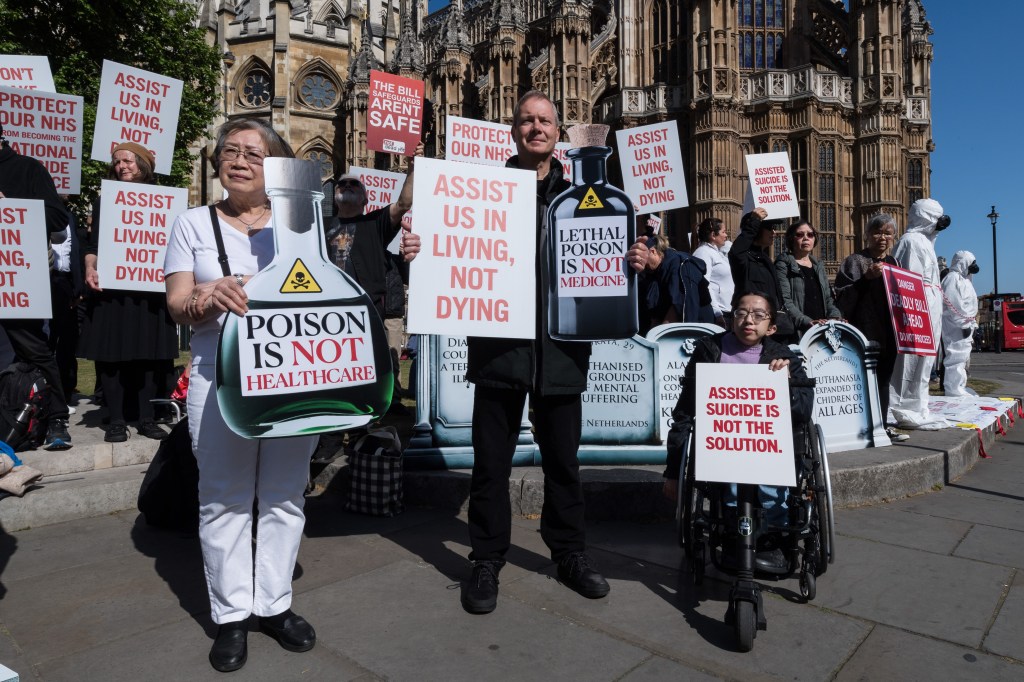
Sloppy, imprecise arguments are a feature of our age. With public discourse reduced to warring byte-size tweets or swipeable video clips, complex issues of our time—war, immigration, climate change, abortion—are represented in hasty fragments. But many merit deep consideration.
A new book by the British writer Kathleen Stock, Do Not Go Gentle: The Case Against Assisted Death, offers a timely antidote to slapdash, scroll-bait arguments. She handles a matter that is literally life or death: whether or not the United Kingdom and other countries should offer an institutionalized assisted-death service to terminally ill patients.
In clear and almost conversational prose, Stock carefully rebuts the arguments in favor of the Terminally Ill Adults (End of Life) Bill. The proposed law passed its second reading in the U.K. House of Commons in late 2024 and is now before the House of Lords.
A veteran at naming the pitfalls of progressive ideology, Stock came to public attention in 2021 after a high-profile conflict with her employer, the University of Sussex. She resigned from her professorship after students and staff protested against her, labeling her “transphobic” for her view that biological sex is immutable, and that women’s rights should be based on sex rather than gender identity.
In the assisted death debate as in the gender debate, Stock attends to the way that the language of a debate can misrepresent its reality. She sets out her opposition scrupulously: she is not “in principle” against assisted death, but against “organised death … formal structures dedicated to helping people to die with the aid of clinicians.” This argument takes direct aim at the U.K. legislation, itself influenced by established programs in other jurisdictions including Canada, Oregon, and the Netherlands.
A philosopher by training, Stock’s strength is to take the terms of the debate where its proponents rarely go: asking “whether each of us is owed the relief of terrible psychological suffering by right, in a way that imposes a moral obligation upon relevant state-backed institutions to provide such relief.”
Moving the question to more rigorous ground allows Stock to demonstrate the flimsiness and inconsistency of many of her opponents’ arguments. “Freedom Lovers,” as Stock characterizes them, argue that every individual has the freedom—and further, the right—to die how and when they choose. These are the “my body, my choice” brigade and Stock traces their lineage through the Enlightenment of John Locke and John Stuart Mill all the way back to Seneca.
Taking the priorities of freedom and autonomy in turn, Stock finds “a right to noninterference in your own private suicidal intentions” but nothing “to justify the idea that there is a right to assistance in death.” Having assistance from a doctor to die might be a good thing, she concedes, but “lots of things are good-to-haves without counting as rights or fundamental freedoms.”
Stock attempts a final blow to the “Freedom Lover” argument by pushing its logic: If this is about freedom, why limit assisted death to the terminally ill or to those above a certain age? Shouldn’t all people, regardless of sickness or health, have access to this freedom?
This fine-tooth comb approach—parsing out rights vs. goods, or pushing freedom to its extreme conclusion—may seem pedantic or unconnected to real-world cases of assisted death. But it’s this depth of consideration that casts the U.K.’s proposed End of Life Bill in shocking relief. The “freedom” argument has helped to remove basic safeguards in an attempt to give people ultimate, unquestioned individual choice. The bill’s committee phase determined that applicants for assisted death would not be required to meet with palliative care specialists to explore other options. They would not be required to speak to a mental health professional and would need to only meet the most minimal requirements to demonstrate mental and cognitive capacity. And the assessing panel would have no requirement to even ask the patient why they wish to die. As Stock quips, we’re in the new age of “Give me liberty and give me death.”
Stock implores us to imagine the moral repercussions on a society where the difference between dying and killing has been collapsed.
Others argue for assisted death in the name of mercy, and Stock characterizes this type of person as the “Merciful Helper.” But Stock allows no euphemism about the terms of this mercy: “When someone receives an assisted death, they don’t just die. They are being killed.” Stock implores us to imagine the moral repercussions on a society where the difference between dying and killing has been collapsed.
The impulse to mercifully relieve pain also has an uncomfortable endpoint. Though they are well-intentioned, advocates of so-called mercy in fact “believe that certain kinds of lives are so very terrible, their owners are better off dead.”
Among the book’s most disturbing—and therefore powerful—themes is the tendency of assisted death programs to devalue individuals who live with chronic disabilities or impairments. Stock points to Canada’s health system, which offers disabled people an assisted death without a terminal diagnosis. She cites a campaign group called “Not Dead Yet” who point out that the debate around assisted suicide “is tied to the value our society places on disabled people’s lives.” And she invokes the words of disability activist Harriet McBryde Johnson: “We are living the lives that others fear.”
Under the proposed U.K. bill, doctors would be free to raise the option of assisted death, even with vulnerable patients who may be susceptible to coercion or unable to advocate for themselves. Those who suffer from depression, anxiety, or other mental disorders are no exception. Stock uses the Canadian program as a cautionary tale, showing that among the 13,241 people who received an assisted death in Canada in 2022, the most commonly cited reason was a “lack of meaning, one of depression’s core features: namely, a ‘loss of ability to engage in meaningful activities.’” Why, asks Stock, have we decided to give depressed and/or suicidal people an encouraged off-ramp, where previously we would work to make them happier?
This course smooths the road for us to demean lives lived outside our limited notion of “dignity.” Once a word meaning “worth,” the Latin dignitas has been co-opted as the rallying call for assisted dying. Stock argues that 18th– and 19th-century liberal thinkers like Immanuel Kant would have never tied dignity to particular bodily conditions; to do so “detrimentally shift[s] social norms about the value of lives that lack those capacities.” Somewhere along the way, dignity became modernized: conditional on certain bodily or mental capacities, rather than intrinsic worth.
Stock seeks to dismantle the mercy- and freedom-based arguments by showing their inherent incoherence. Granting mercy and championing individual freedom “point in two different directions,” she argues. “The former is essentially an interventionist stance; the latter is an injunction to stay out of an individual’s private business.” The muddled discourse is riddled with unacknowledged contradictions, and advocates of assisted death use hasty appeals to one to paper over the gaps in the other.
But what makes Stock’s arguments persuasive is less this rhetorical “gotcha!” moment, and more her poignant discussion of the value of life. She reminds her readers time and again of the messy yet meaningful reality of aging and death. Even those who are terminally ill are still, until the moment of death, alive.
Accordingly, she asks why a refocus on hospice and palliative care options is not understood as a morally and logically superior next step. Within the medical profession, the specialists who work most closely with the dying, aging, and disabled show the least support for assisted death services. Stock maintains that the allure of assisted death stems from our own anxieties and fantasies about what death really is.
Stock asks us to put those anxieties aside and to consider what state-backed assisted death would mean in the cold light of the real world: “in realistic bureaucratic scenarios, not utopian ones … alongside the economy and welfare states we have; with the overstretched, under-resourced health and social care sectors we know; with our own foibles and ideological blind spots, rather than fantasies about optimal levels of human reason and empathy.”
After Stock’s careful philosophical and practical arguments, it’s a statement from Dame Cicely Saunders, the founder of the hospice movement, that lingers most powerfully. “You matter because you are you, and you matter to the last moment of your life. We will do all that we can not only to help you die peacefully, but also to live until you die.”