More education leads to higher earnings—or so many people think. Over the past quarter-century, the share of the adult population with a graduate degree has risen from nine percent to 15 percent, a rise of two-thirds. Starting in 2006, Congress supported Americans’ aspirations to attend graduate school with effectively unlimited federal student loans through the Grad PLUS program.
Two new reports from the Postsecondary Education and Economics Research Center (PEER Center) cast doubt on the idea that graduate school is always a sound economic decision. The payoff of a graduate degree is low, or even negative, for many popular fields of study. And graduate students complete their degrees at alarmingly low rates.
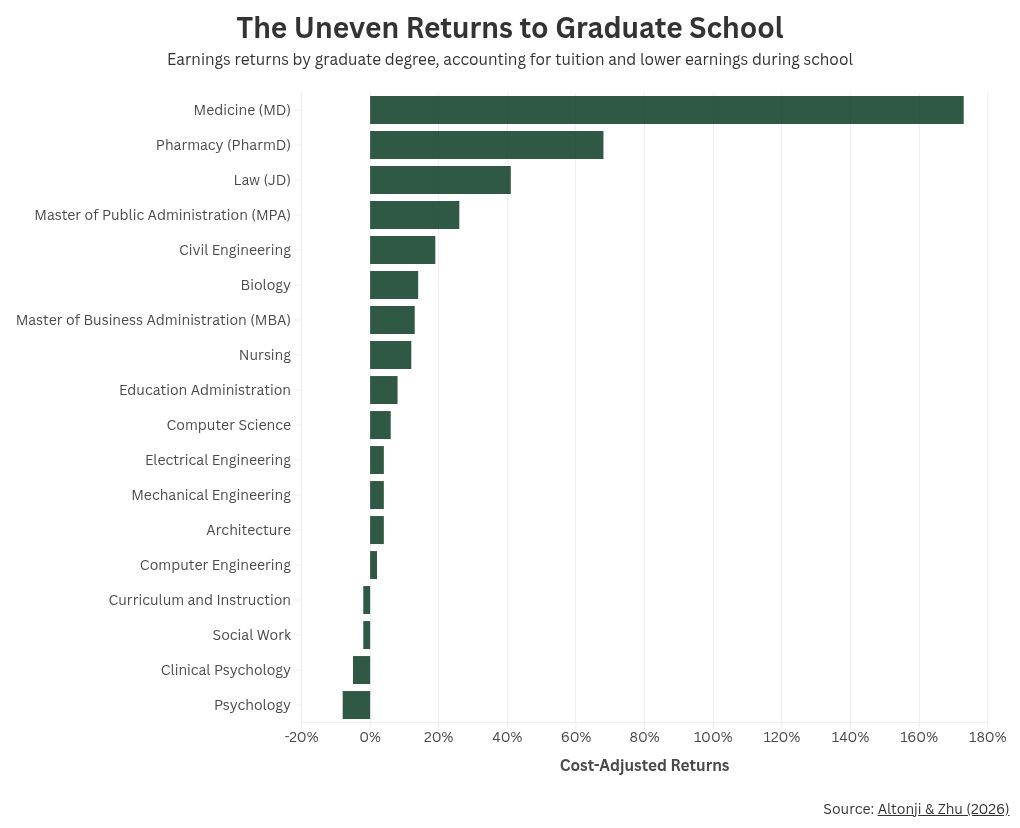
The first report, by Joseph Altonji and Zhengren Zhu, examines the impact of earning a graduate degree on students’ incomes. Critically, Altonji and Zhu account for students’ earnings before they enroll, lower earnings during graduate school, and the cost of tuition. These adjustments are important—while a student who earns a master’s degree in computer engineering or business administration may realize high earnings in an absolute sense, that student probably would have earned a high salary even without the graduate degree. The actual return on investment is lower than it appears—especially after you account for time and money spent chasing the degree.
Altonji and Zhu find that most professional degrees yield a high payoff, including medicine, pharmacy, and law. But the returns for most master’s degrees are significantly lower. An MBA offers a return of 13 percent after considering tuition and opportunity cost. Returns for most engineering degrees are in the single digits, as their students possessed high preexisting earnings potential. Master’s degrees in education, psychology, and social work have negative returns after taking the cost of the degree into account.
Moreover, many students who pursue those degrees don’t even finish them. The second report, by Jeffrey Denning and Lesley Turner, examines completion rates for graduate programs. Historically, the federal government has not collected data on graduate school completion rates—perhaps because they were assumed to be high.
For some programs, including law and health care, graduate completion rates stand above 80 percent. But those programs are the exception: the average six-year completion rate among all the programs Denning and Turner analyze is just 62 percent. For some areas of study, including education, typical completion rates are closer to 50 percent. And those are just field-wide averages: Completion rates are as low as 10 percent for some individual programs.
Prospective graduate students should carefully consider these outcomes before deciding to go back to school (especially if they plan to take out loans). Fortunately, the federal government is becoming more careful with how it funds graduate school, by capping federal loans and cutting off loan eligibility entirely for the lowest-earning programs. Outside some highly compensated professional fields, including law and medicine, graduate school is a risky proposition. Modest rises in salary, high tuition, and large numbers of non-completers are not always a winning formula.
The post Graduate School Is Riskier Than You Think appeared first on American Enterprise Institute – AEI.