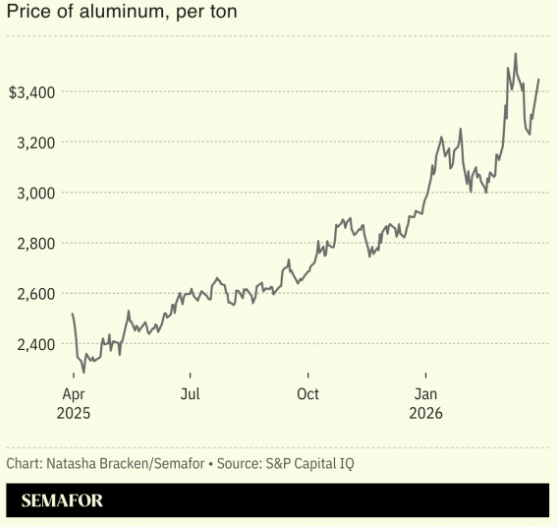
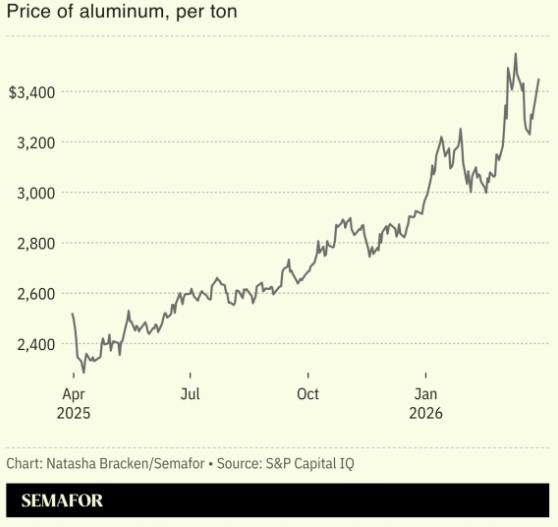
Questions about the availability of key industrial materials due to the conflict in Iran are driving up prices. The price of aluminum, a key component of auto parts, furniture, windows, and other products, has reached a four-year high, according to Reuters, following Iranian attacks on two aluminum production sites in the Middle East. Aluminum Bahrain (Alba), which runs the world’s largest single-site smelter, is assessing the damage from the Iranian strikes on its facilities, and Emirates Global Aluminum reports its plant sustained significant damage. Benchmark aluminum on the London Metal Exchange was up 4.7% to $3,453 a metric ton after the attacks.
According to Reuters, the effective closure of the Strait of Hormuz has restricted shipments of aluminum to export markets in the United States and Europe. Semafor reports that the Middle East accounts for 9% of the world’s aluminum production, which is essential to a wide range of industries, including transportation, construction, and packaging, as well as the manufacture of solar panels, electrical transmission systems, wind turbines, and electric vehicles.
According to Reuters, Alba shut down three aluminum smelting lines accounting for 19% of its capacity. The company issued a force majeure on March 4th as it was unable to ship metal to customers due to the effective closure of the Strait of Hormuz. The closure of the strait has also left Middle East smelters unable to bring in vessels carrying their key raw material, alumina.
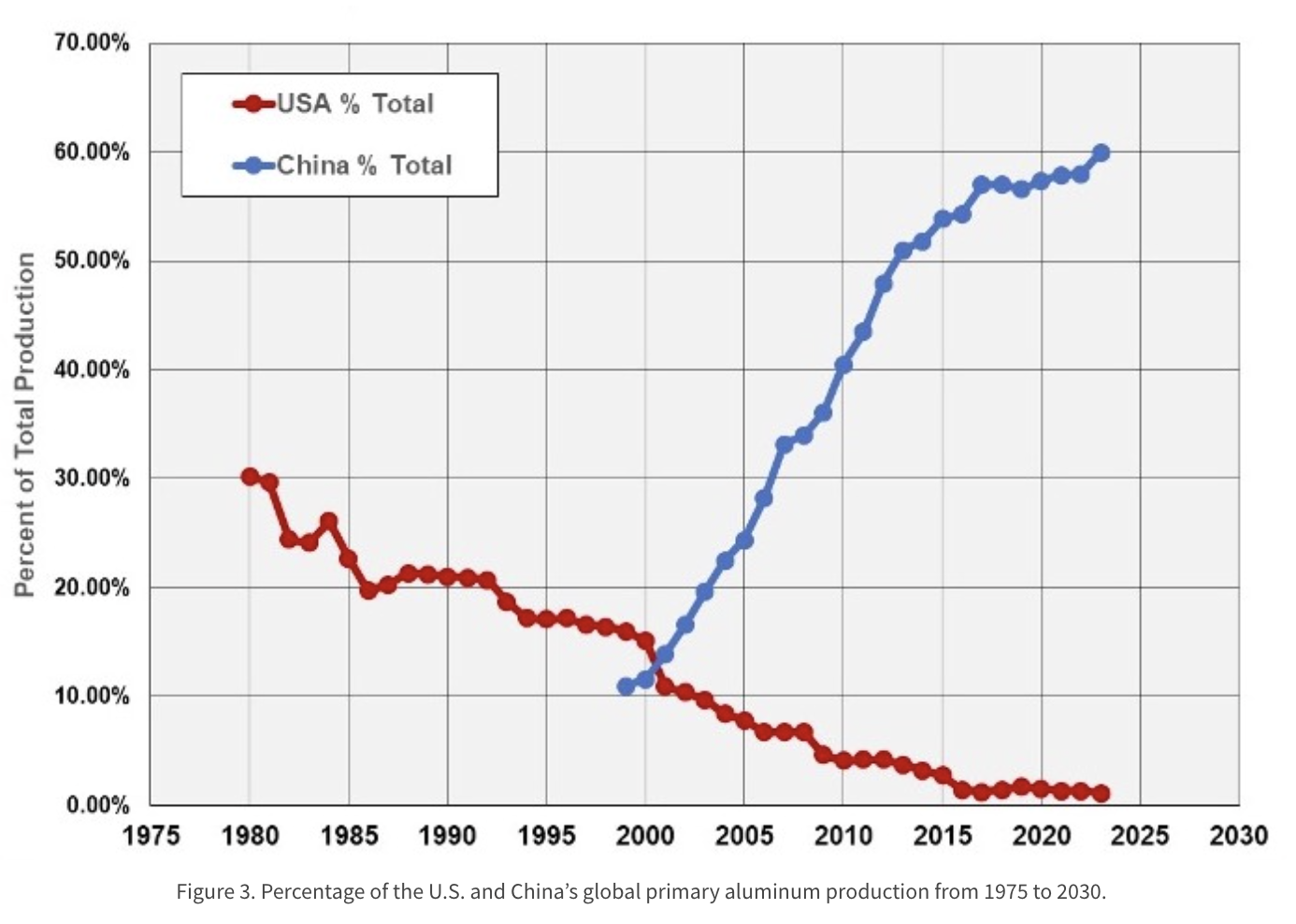
Russia ranks third in world aluminum production and the world’s largest producer is China, with about 60% of the world’s total production. The United States was once ranked among the top primary aluminum-producing countries in the world, a position it held through the 1900s. The country started closing smelters after 2000. By 2020, 15 primary facilities shut down, and two others remained idle. By 2021, after production dropped by 28% in a single year, the United States was the ninth-largest primary aluminum producer and held less than 2% of the global market share. In 2023, the U.S. share of global production was 1.1%. As U.S. aluminum production declined, China’s grew, as depicted below.
Helium Exports Affected by the Iranian Conflict
Manufacturers are also worried about supplies of helium, the coldest liquid on Earth, which is used in chip-making and MRI machines. When Iran struck Qatar’s largest liquefied natural gas facility, it damaged helium production lines that could take years to rebuild, according to the New York Times. Qatar produces roughly a third of the world’s helium supply, and that output is now offline, spiking prices. About 200 specialized containers used to transport helium were stranded in the Strait of Hormuz when the war began, and repositioning them could take months.
Chip makers, the largest consumers of helium, including TSMC, Samsung, and SK Hynix, need helium to cool superconducting magnets and clean chip wafers. Helium cools the superconducting magnets during chip manufacturing and flushes toxic residue after wafers are washed. The gas is irreplaceable for making chips that power cell phones and artificial intelligence servers.
The United States is the largest producer of helium worldwide, producing 81 million cubic meters — more than 40% of global supplies. Despite this production, North American consumers also depend on imported helium from the Persian Gulf. Via Al Jazeera, Airgas, a subsidiary of French industrial gases group Air Liquide and among the largest U.S. distributors of helium, recently declared force majeure, announcing it was cutting its helium shipments by half. Air Liquide announced plans to reallocate its helium supply chain to obtain the gas from other regions.
Russia, the third-largest helium producer, has faced significant operational challenges at its Amur facility due to fires, explosions, and sanctions. Last year, Russia was estimated to have produced almost 10% of the world’s helium. The Gazprom Amur facility was to increase Russia’s helium exports to 30%, but it is still not fully operational.
Analysis
The conflict with Iran is affecting supplies of aluminum, which are essential to a wide range of industries, from transportation, construction, and packaging, to “green” technologies. While the U.S. was once the top aluminum producer, rising energy costs and strict emissions standards for aluminum reduction plants have shrunk its lead. If the U.S. wants to reclaim its former aluminum-producing glory, it needs to reduce the regulatory burdens that raise electricity prices. As AEA’s Michael McKenna explains, “Aluminium is connected to energy, it’s the most important input… That’s the same argument that Jensen Huang over at Nvidia makes about chips. He’s said this multiple times, ‘the only thing that’s going to limit our ability to make money on AI is how much energy can we get to it.’”
For inquiries, please contact [email protected].