The immediate effects.
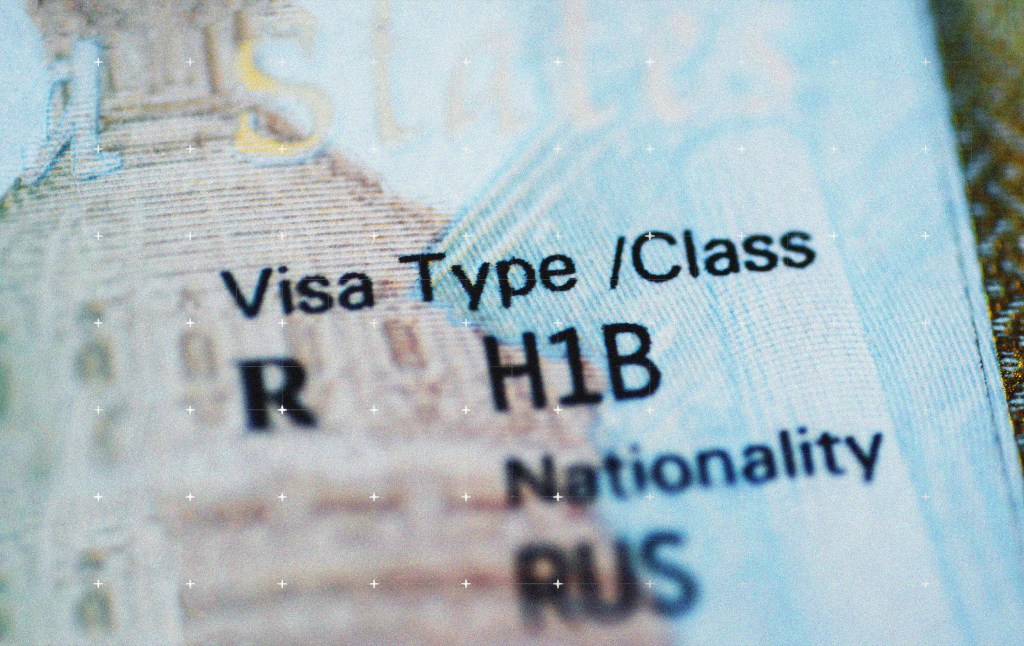
The most obvious issue is that, contrary to White House claims in September that “all big companies” were on board with the new fee and that it’d raise lots of money, almost no one has actually been willing to pay it. As Bloomberg Law reported in late February, in fact, only 70 U.S. employers have thus far paid the fee for just 85 workers—an 87 percent decline in these H-1B petitions versus the same period last year, representing thousands of workers not getting hired.
This didn’t mean, however, that U.S. employers stopped pursuing foreign skilled workers and started hiring Americans. Instead, these firms did what all rational economic actors do when faced with a large and poorly designed new tax: They evaded it. Bloomberg reports, for example, that staffing firms for large U.S. tech companies looking to sponsor first-time H-1B visa applicants are “prioritizing hiring recent graduates and other immigrants who are already in the US and therefore not subject to the $100,000 fee.” Jeans company True Religion, meanwhile, backed off hiring the “perfect” director of production and sourcing—a Guatemalan national living abroad—and, after exhausting other visa options, is now searching for a candidate that won’t come with the $100,000 fee. “It’s a lot of money,” their HR executive told the news agency. Yes, it is.
Given the limited uptake, the visa fee has already failed to achieve one of its stated goals—to raise funds for the government—and is, in fact, comically doing the opposite. Back in September, supporters of the fee claimed that it had been rigorously set at a “revenue maximizing” rate that would slow migrant inflows but still allow enough that, given the fee’s magnitude, would generate much more money than the government was taking in under the old system. This conclusion was based on research from George Borjas, who served as a senior economist on the White House’s Council of Economic Advisors and has advocated for an “optimal” fee based on “average employer wage savings.” Companies save so much by paying foreigners lower wages than native-born workers, so his theory goes, that they’d gladly pay a one-time $100,000 fee to hire the cheaper immigrant. The methodology for those “savings” came from new Borjas research that reportedly underpinned the White House’s $100,000 visa fee and showed that it would raise up to $22.4 billion in new visa fees.
As the Institute for Progress’ Connor O’Brien recently pointed out, however, recent U.S. government court filings show that the visa fee has thus far generated a mere $8.5 million in fees, and that—because the fee discouraged almost everyone abroad from applying—the government has actually lost $20 million overall. (The Laffer Curve is real, folks.) This outcome is hardly surprising. As the Economic Innovation Group’s Jiaxin He and Adam Ozimek documented, the Borjas paper contained significant methodological errors that dramatically overstated the wage gap between native workers and H-1B workers (and thus the amount employers would be willing to pay in visa fees). In fact, economist Michael Clemens separately corrected Borjas’ errors and found that H-1B workers are paid more than comparable native-born workers—thus collapsing the visa fee’s revenue justifications (as well as related claims that H-1Bs undercut American workers).
The current $20 million in losses would seem to support the critics’ conclusions.
The real-world costs.
Just because companies are avoiding the fee doesn’t mean it’s without costs (beyond the revenue hit, I mean). In fact, numerous reports show that the fees have already imposed significant harms by restricting the pool of available workers in specialized or constrained U.S. markets. Here are a few examples:
Academia and nonprofit research organizations. Under U.S. law, nonprofit research organizations in higher education, the private sector, and the government are exempt from the 85,000 annual cap and lottery for H-1B visas. As Bloomberg reported last year, this exception has allowed various U.S. institutions to hire thousands of faculty, researchers, and staff each year to help run their medical, scientific, and other specialized programs—programs for which there are typically few, if any, native-born alternatives to the super-smart foreigners being hired. (For example: “As of 2023, about 58 percent of all postdoctoral staff in science, engineering and health fields were on a temporary visa like the H-1B, according to the National Center for Science and Engineering Statistics.”) Overall, this system has been a boon for U.S. research organizations, their foreign hires, and the U.S. innovation ecosystem and economy more broadly.
Now it’s at risk. For many of the United States’ top research institutions, the new visa fee would result in tens of millions of dollars in new costs—or, more likely, simply block these institutions from hiring the people they need. For smaller nonprofits, the choice is simpler: “The international talent pool for researchers and faculty—that’s turned off.” Should the fee remain in place, these entities’ international hiring, enrollment, and related courses and programs are expected to decline, and it could have a broader “chilling effect” on their efforts to recruit the best and brightest minds in the world. A lawsuit filed in October cited early evidence of research institutions putting their hiring plans on indefinite hold. Other examples of foreign specialists being blocked by the fee have trickled out since then. Some scientists already here, meanwhile, are deciding to leave.
Rural health care. The H-1B program has long been a lifeline for small hospitals and clinics in less populated areas that struggle to compete for domestic physicians and nurses. Research shows that health systems in rural areas are twice as likely as their urban counterparts to use H-1B workers—doctors, nurses, assistants, etc.—and about 64 percent of foreign physicians practice in medically underserved areas. The visa fees, experts have warned, will cripple these areas because local providers simply can’t afford them and because workarounds, including other visa options, are themselves costly.
The effects on rural health systems are already becoming evident. In November, for example, a U.S. agency that annually provided hundreds of foreign nurses for systems in rural and low-income Midwestern communities said its hiring this year was at a “standstill” because of the fee. A Shelby, North Carolina, nephrology practice, meanwhile, was blocked from hiring an Indian kidney specialist that the growing community desperately needed. A rural Maryland hospital—the only emergency room in a 650-square-mile county—stopped recruiting 29 overseas nurses. A Ukrainian doctor who’d applied to several programs in underserved areas now can’t find a sponsor—even after spending “thousands of dollars on qualifying exams, including textbooks, credential verification and application fees.”
Given that many immigrant-dependent rural hospitals operate on razor-thin margins and that current national shortfalls for physicians are expected to persist for years, “just hire American” simply isn’t an option—especially in specialty fields like oncology with high shares of foreign-born doctors. The American Hospital Association has thus called for an exemption from the fee—and bipartisan legislation has been offered in this regard. So far, they’ve gotten nothing.
Startups and entrepreneurs. It’s a similar story for tech startups and entrepreneurs that don’t have the deep pockets of their Big Tech rivals—either to pay the visa fee or spend money searching around for alternatives. As TechCrunch reported, startup founders have taken to calling the visa a “talent tariff” that smaller players can’t afford. Immigration lawyers working with early-stage companies have paused their clients’ many H-1B petitions—a pause that will have real harms, given that the H-1B program has been disproportionately valuable to small and young firms. If U.S. startups can’t access global talent pools, they grow slower, innovate less, or simply don’t launch at all—and the U.S. economy eventually suffers.
Large firms moving work abroad. Big companies, meanwhile, have more options than the little guys do, and that includes moving work offshore. As we’ve discussed here, research consistently finds that large firms respond to U.S. restrictions on H-1B visas not by hiring more Americans but instead by expanding their operations in India, Canada, and elsewhere. History appears to be repeating, with news of large U.S. firms in tech/AI, retail, finance, pharmaceuticals, and other R&D-heavy industries responding to the new visa fee by freezing or restructuring U.S.-based hiring and by increasing headcounts in India, Canada, and elsewhere. Increasing the cost of foreign hiring doesn’t automatically increase demand for domestic hiring, and it appears we’re relearning this lesson again.
Skilled immigrants looking elsewhere. The fee also may have convinced many skilled immigrants to look elsewhere for work. Bloomberg reported in January, for example, that there was initial evidence of Indian startup founders and tech workers already in the United States looking to return to India after the visa fee was announced. Many foreign governments, meanwhile, are eager to attract these workers. When the visa fee started, Canadian Prime Minister Mark Carney said that his country would work to attract foreign workers blocked from the U.S. by the visa fee, and then the Canadian government announced a $1.2 billion initiative to recruit more than 1,000 foreign doctors, scientists, and researchers. In October, China launched a new K visa to attract foreign STEM professionals with no employer sponsorship requirement—a clear effort to hoover up the talent the U.S. is pushing away. European and Middle Eastern talent hubs have been similarly mobilizing.
Summing it all up.
Given options for avoiding the visa fee and that demand for skilled foreign workers far exceeds the annual 85,000 cap on initial approvals, Trump’s new “talent tariff” won’t totally collapse the number of new H-1B visa-holders in the United States, but it will still have significant costs. Like any tariff, the fee will limit the supply and variety of skilled workers in the United States, pushing employers to pursue costly workarounds and less-optimal alternatives. It’ll also have disproportionate harms on U.S. companies and industries—in research, health care, tech, and other industries—that don’t have as many choices and need overseas talent to succeed, if not survive. The hit to academia and nonprofit research organizations could be most severe, given their previous exemption from the annual cap on H-1B visas.
The fee also must be considered as part of a broader attack by the Trump administration and various states on skilled immigration in the United States. Enhanced federal vetting and screening of all H-1B applications, for example, has caused long delays in visa processing. The administration also has suspended H-1B processing for 39 countries and employer-sponsored immigrant visas for immigrants abroad for 92 countries (defrauding fee-payers in the process and thus amplifying the risk of paying the visa fee upfront). Serious ethical concerns aside, these restrictions are sure to harm the U.S. economy in myriad ways.
Research shows that skilled immigrants—many of whom enter the United States through the H-1B program—substantially boost U.S. innovation, entrepreneurship, wages, and government finances (at the federal, state, and local level). These and related benefits thus explain why an October report from the Richmond Federal Reserve estimated the visa fee and related restrictions would deliver large costs and few benefits, and that a permanent 10 percent reduction in college-educated immigrants would reduce native-born Americans’ welfare by almost $3 billion each year. There is, of course, some competition between skilled immigrants and native-born workers on the margins, but their overall effect is unambiguously positive for the vast majority of Americans (and, of course, for tens of thousands of smart foreigners now living abroad).
None of this is to say the H-1B program is perfect. As Bier documented in 2023, it most definitely isn’t: The annual 85,000 visa cap is way too low, and backlogs are way too long; the lottery system is arbitrary and inefficient and encourages gaming; and tying the visa to an employer creates dependency that can be exploited (though this is often overblown). A serious reform agenda would address these shortcomings. A $100,000 “talent tariff” just makes things worse.
Several lawsuits have been filed against the new H-1B visa fee that might stop it in its tracks—perhaps, ironically, based on the Supreme Court decision that stopped Trump’s “emergency” tariffs in February. Let’s hope they succeed.
Chart(s) of the Week