The Supreme Court convened on Wednesday to hear oral arguments in Trump v. Barbara, a case weighing whether the 14th Amendment makes automatic citizens of children born to parents who are temporarily or unlawfully present in the United States. The court’s answer to that question should be no. In adopting the 14th Amendment to repudiate Dred Scott v. Sandford, which held that free descendants of Africans imported as slaves were not citizens, the people of this nation did not confer birthright citizenship on children born with only an ephemeral connection to the United States. To do so would have been contrary to the republican principles animating the constitutional amendment. The challengers pressed the high court to adopt a contrary rule, but their arguments cannot square with the text and history of the citizenship clause.
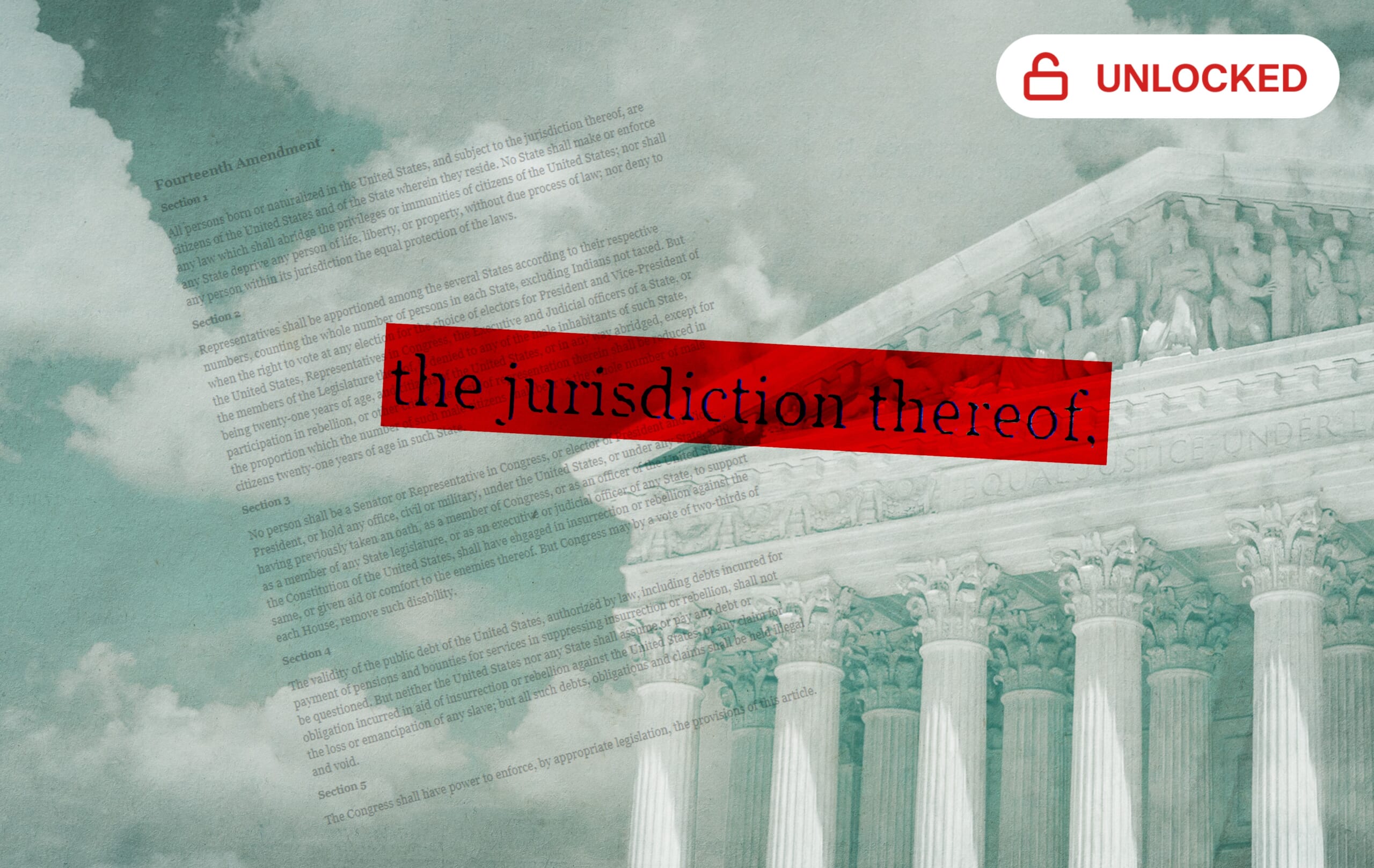
The citizenship clause of the 14th Amendment provides, “All persons born or naturalized in the United States, and subject to the jurisdiction thereof, are citizens of the United States and of the State wherein they reside.” The standard for automatic birthright citizenship, therefore, is a conjunctive one: A person must both be born in the United States and subject to its jurisdiction. Trump v. Barbara turns on what it means to be born subject to the jurisdiction of the United States.
The unqualified nature of the phrase “subject to the jurisdiction” means that a person must be subject to the full and complete jurisdiction of the United States, not subject to that jurisdiction to some degree. To hold otherwise would contravene standard interpretive principles. For example, Article II of the Constitution vests the president with “the executive Power … of the United States.” That means all of the executive power is vested in the president, not just part of it. By the same reasoning, to be subject to the jurisdiction of the United States is to be subject to that jurisdiction to a full and complete degree.
And this is precisely what the authors of the citizenship clause said. For example, Republican Sen. Jacob Howard, the clause’s champion in the upper chamber, explained that “the word ‘jurisdiction,’ as here employed, ought to be construed so as to imply a full and complete jurisdiction on the part of the United States, coextensive in all respects with the constitutional power of the United States … that is to say, the same jurisdiction in extent and quality as applies to every citizen of the United States now.”
The question then becomes, are those with no permanent home in the United States subject to the full and complete jurisdiction of the United States? The answer is no. Such individuals are subject to a temporary and local jurisdiction that evaporates when they leave the country. They are not, in other words, subject to the jurisdiction of the United States to the same extent and quality as are citizens.
This conclusion is confirmed by the widespread understanding that the children of members of Native American tribes were not automatic birthright citizens under the citizenship clause. Native Americans were subject to the jurisdiction of the United States to some degree, but they were primarily subject to their tribes, which were viewed as quasi-sovereign entities. As a prominent 19th-century treatise put it, if tribal Native Americans were not “citizens of the United States because they are not, in a full sense, ‘subject to the jurisdiction’ of the United States, it is considered that a fortiori the children of foreigners in transient residence are not citizens.”
“In declaring independence from Great Britain, the founders of this nation rejected the English common law of subjectship in favor of an American law of citizenship.”
Pete Patterson
“On birthright citizenship, the law has always led to the same place: To be born in the United States is to be born American.”
John Yoo
Typical arguments against this view fail to persuade.
First, under the English common law of subjectship, children born to parents only temporarily present were generally considered subjects of the king, based on principles derived from feudal notions about the monarch’s right over the soil, so, the argument goes, the same standard must apply here. The challengers at Wednesday’s oral arguments emphasized this English common-law understanding. But in declaring independence from Great Britain, the founders of this nation rejected the English common law of subjectship in favor of an American law of citizenship. A central element of English subjectship was that it was perpetually binding, and in declaring independence, the founders of the U.S. unilaterally proclaimed Americans to be “Absolved from all allegiance to the British Crown.” Congress reiterated this break with English principles in 1868, the same year that the 14th Amendment was ratified, by enacting a statute stating that expatriation—the right to renounce one’s citizenship—was “a natural and inherent right of all people.” Against this backdrop, it is untenable to uncritically read the English common law of subjectship into the citizenship clause.
Second, some claim that denying automatic birthright citizenship to the children of those temporarily or unlawfully present demeans or punishes those children. On the contrary, the citizenship clause’s conditions protect both the integrity of the citizenship of the United States and the autonomy of persons born without a permanent connection to this nation. If a child is born to parents temporarily present in the United States, the expectation is that the child will not have a permanent bond to this country but rather will be raised in the parents’ home country. It would not be befitting of a constitutional republic based on consent of the governed to place upon that child the duties of citizenship, such as being conscripted into our military. Indeed, Sen. Lyman Trumbull, the architect of the citizenship clause’s precursor in the Civil Rights Act of 1866, explained that the act was designed to avoid making citizens of “persons temporarily resident in [the U.S.] whom we would have no right to make citizens.”
Third, some argue that the exception for Native Americans was based on birth on tribal land, not birth as tribe members. But this argument is contradicted by history. Sen. Howard, for example, explained that the citizenship clause would not make automatic citizens of Native Americans who “maintain[ed] their tribal relations.” And in the 1884 case of Elk v. Wilkins, the Supreme Court similarly held that the citizenship clause did not make automatic citizens of those who were “members of and owing immediate allegiance to one of the Indian tribes.” What is more, accepting this argument logically would entail that non-Native Americans born on tribal lands would not be automatic birthright citizens under the citizenship clause. There is no historical warrant for that radical conclusion.
Justice Amy Coney Barrett asked about this issue during Wednesday’s oral arguments, and it is a key one: If the child of members of a quasi-sovereign Native American tribe born while the child’s parents are visiting an American city off of tribal land is not covered by the citizenship clause, it follows that the child of citizens of a fully sovereign foreign nation born while the child’s parents are visiting the same American city likewise is not covered.
Fourth, the Supreme Court’s 1898 decision in United States v. Wong Kim Ark held only that a child of Chinese nationals domiciled—i.e., permanently residing—in the United States was an automatic birthright citizen. It does not follow that the child of parents temporarily or unlawfully present in the United States is an automatic birthright citizen. Indeed, unlike such a child, the child of noncitizen parents who have chosen to make the United States their permanent, lawful home can also be expected to make the United States his or her own permanent, lawful home. It is not anomalous to make such a person a citizen of a constitutional republic.
Writing in 1834, the great legal scholar and Supreme Court Associate Justice Joseph Story reasoned that the general rule that individuals were subjects or citizens of the country in which they were born “should not apply to the children of parents, who were in itinere in the country, or abiding there for temporary purposes.” In Trump v. Barbara, the Supreme Court should confirm that the framers and ratifiers of the 14th Amendment adopted Story’s recommendation by conditioning automatic birthright citizenship on being “subject to the jurisdiction of” the United States.