Following S&P Global’s Manufacturing PMI’s better than expected print higher (signaling resilience in the face of March’s war in Iran), the data released this morning showed the US Services Sector experienced a contraction of activity at the end of the first quarter of 2026.
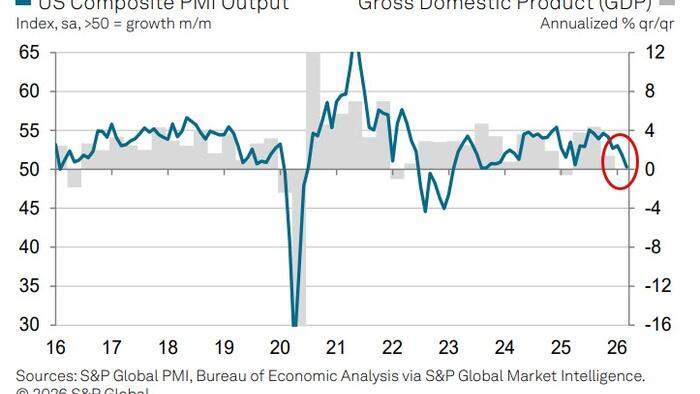
The headline S&P Global US Services PMI Business Activity Index recorded 49.8 in March, down from February’s 51.7 and lower than the earlier ‘flash’ estimate of 51.1.

It was the first decline recorded in over three years amid the weakest rise in new work since April 2024.
“The PMI survey data show the US economy buckling under the strain of rising prices and intensifying uncertainty, as the war in the Middle East exacerbates existing concerns regarding other policy decisions in recent months, notably with respect to tariffs,” said Chris Williamson, Chief Business Economist at S&P Global Market Intelligence
The service sector has slipped into contraction for the first time since January 2023, dragging the overall economy down to a near-stalled 0.5% annualized rate of growth in March…

Worst hit is consumer-facing service sectors where, barring the pandemic lockdowns, the downturn reported in March was among the steepest recorded since data were first available in 2009.
However, financial services and tech, both of which performed strongly last year, have shown some signs of weaker performance amid financial market volatility and concerns over higher interest rates, which have deterred investment.
“Key to the deteriorating growth trend is a pull-back in spending amid worsening affordability, with costs and selling prices surging higher in March amid spiking energy prices.
The survey data are broadly consistent with consumer price inflation accelerating close to 4% as firms increasingly seek to push through higher costs onto customers in the coming months. “
The stagflationary environment of stalled growth and surging price pressures pictured by the PMI presents a major challenge to policymakers, especially with the March survey also indicating falling employment.
“Clearly much depends on the duration of the conflict. The fact that business confidence has merely dipped and not slumped is a sign that businesses are hopeful of a swift resolution to the war,” added Williamson.
“However, a concern is that the energy disruption unleashed by the war in the Middle East may well have an impact that lasts far longer than any actual conflict and may test the resilience of business and households over the coming months.”
Ironic that this occurred during a month that saw the economy add a surprising 178k jobs.