from the fact-checking-is-still-not-censorship dept
Fact-checking is not censorship. Asking a publication to correct factual errors is not censorship. Pointing out that someone’s book contains demonstrably false claims is not censorship. None of this should require explanation. And yet here we are, because author Jacob Siegel has decided that Renee DiResta requesting corrections to false statements he made about her — in his book and in reviews of his book — constitutes some kind of sinister suppression campaign. He’s gone as far as writing an article at The Free Press (which I have no intention of linking to and giving more traffic) publicly accusing her of plotting to censor a review of his book published in The Baffler. He spent a morning on Twitter calling her “a figure connected to the US government” (she’s not) who “pressure[d] a publication to remove its review of my book” (she didn’t).
This is all, to put it plainly, absolute nonsense. But it’s a specific strain of “free speech absolutist” nonsense that we keep seeing over and over again. And I say that as someone who has spent decades fighting for free speech, but is pretty damn sick of these free speech tourists, pretending to support free speech when they’re really just trying to protect themselves and their friends from social consequences for saying something stupid, or just something blatantly false.
We’ve seen this playbook before. Six years ago, a group of prominent intellectuals published what became known as the “Harper’s Letter,” ostensibly warning of a rising tide of censorship and illiberalism supposedly threatening free expression. But when you actually looked at the cases they cited, what you mostly found was… people criticizing them (or their friends). Sometimes sharply. Sometimes even unfairly. But the “intolerance” they described was just other people exercising their own free speech to push back on ideas they disagreed with. As we noted at the time, the whole thing amounted to famous people with massive platforms, and little self-awareness, using those very platforms to complain about being silenced.
But the Harper’s Letter crowd, for all their hand-wringing, were at least mostly operating in the realm of opinion and social consequences. They didn’t like that people disagreed with them loudly. Fair enough. It was thin-skinned and cringey, but mostly harmless. Siegel is doing something worse, because he made demonstrable factual errors in his book. Rather than owning them, he’s accusing the person he published false information about of censorship for having the temerity to ask for corrections.
If asking for a correction to a false factual claim counts as censorship, the word has been stretched so far that it no longer means anything. Which is probably the point. The more the term gets diluted, the easier it is to weaponize against anyone who challenges you on the facts.
Some background: Siegel published a book called The Information State, which is basically a book-length expansion of his 2023 Tablet essay about what he and a small group of MAGA-leaning grifters call the “censorship industrial complex.” One of his main arguments centers on the Election Integrity Partnership, an academic research project DiResta worked on during the 2020 election. Siegel’s book says the EIP “classified 21,897,364 tweets” as “misinformation incidents,” and he places this number in a context carefully designed to make readers believe the project flagged 22 million tweets to platforms for removal. As DiResta explains:
A couple of pages before the number appears, Siegel spends a some time on a character sketch establishing me as dishonest. Then he describes me as leading “the Election Integrity Partnership, at the time perhaps the largest public-private social media monitoring and censorship initiative in existence.” He then writes that “over a hundred employees in the EIP network maintained nearly round-the-clock coverage of social media” and sent “alerts and takedown requests” that platforms responded to in under an hour. Immediately after that operational framing — the censorious leader, round-the-clock monitoring, the takedown requests, the rapid platform response — he drops the 22 million number: the EIP “reported collecting more than 859 million tweets for analysis and classifying 21,897,364 tweets on ‘tickets’ as unique ‘misinformation incidents’ just between August 15 and December 12, 2020.”
Read in sequence, the clear implication is that this was the scale of the “censorship operation”: a hundred people working around the clock flagged 22 million tweets to platforms, which obediently took them down within the hour. That is how people on Twitter are reading it, too.
That is not what happened.
What actually happened, as we’ve covered in detail before, is that the 22 million figure comes from a post-election academic analysis of how viral election narratives spread across social media — a research dataset, not a list of items flagged for removal. During the actual election, EIP flagged roughly 4,800 URLs total, including 2,890 tweets, to platforms for possible policy violations like impersonating poll workers. As DiResta notes:
Of those, approximately 65 percent received no platform action whatsoever, about 25 percent were labeled, and ~10 percent were removed — by the platforms, under their own policies. No government agency directed or funded any of it. Those are the real numbers. A few hundred tweets came down. This is in the public record, in our publications, in amicus briefs, in legal filings, and in congressional testimony. Every flagging ‘ticket’ we sent to a platform was turned over to Jim Jordan’s Weaponization Subcommittee under subpoena. Even Jordan’s deeply partisan report does not attempt to substantiate the “22 million” framing — because it can’t be substantiated, because it isn’t true.
Because this point apparently can’t be stated enough: the EIP flagged fewer than 3,000 total tweets, essentially asking Twitter: “hey, does this violate your rules?” Many of those reports actually came from local election officials worried about disinformation — things like false information about where and when to vote — who figured that a coordinated flag from a research partnership might get more attention than a single complaint.
But what EIP did was really no different than what ANYONE could do by seeing a piece of content on social media and clicking the ever-available “report” button. I’ll note (because I just checked) even X (the supposed, but not really, free speech platform) still lets anyone report any content, and among the categories you can report content for is… “civic integrity.”
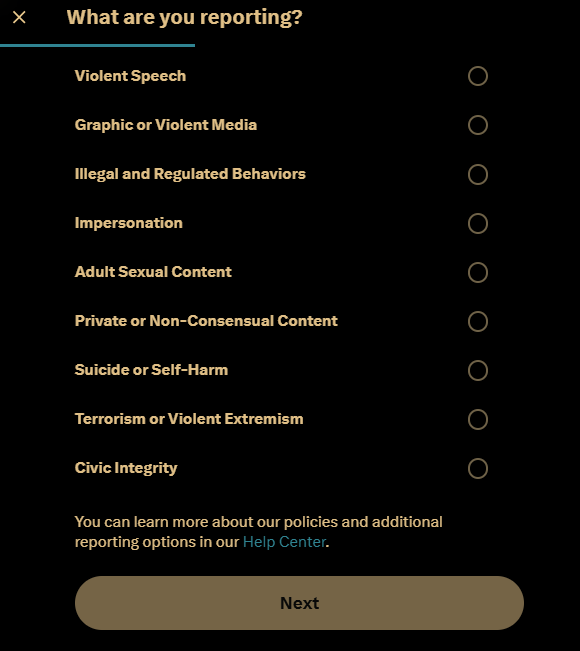
In the case of EIP, it submitted fewer than 5,000 such URLs across multiple platforms and the platforms DID NOTHING in response to the majority of them, finding that they did not, in fact, violate any policies. While they took action on 35%, most of those were “labeling” (i.e., providing more speech) and only 10% involved removals (and most of the ones that were removed involved blatant election disinformation, such as telling people to vote in places that had no polling place).
That’s just a few hundred tweets removed, decided by the private companies based on their own decisions.
The 22 million number, which Matt Taibbi and others pushed for many months was what EIP wrote about months later, when they wrote a report about how misinformation spread. It was not content they asked to be removed. It was not content they alerted platforms to. It was just what their (months later) after report reviewed on the platform, trying to show how misinformation spread.
Siegel, apparently, knows all of this. DiResta claims she told him in person before he published. He published the misleading framing anyway. That’s on him. If that leads others to repeat that false information and later being asked for a correction, that is 100% on Siegel for failing to do his own homework and choosing to publish information he was told, point blank, was false.
So when reviews of his book repeated the 22 million number as if it described the scale of active censorship — because Siegel’s book is designed to make readers draw exactly that conclusion — DiResta contacted three separate publications and asked for corrections. This is the most normal thing a person can do when they’ve been written about inaccurately. It happens every day across every type of journalism. It is, in the most basic sense, counterspeech. “Hey, you published this thing, it got some important facts wrong, here’s what they are, and why they’re wrong. Can you issue a correction?”
In no definition of “censorship” is that censorship.
Of the three publications DiResta alerted that they were repeating false statements, there were three very different responses: The Brownstone Institute did nothing. The Free Beacon issued a correction. The Baffler pulled their review entirely. As DiResta makes clear:
To be unambiguously clear, I did not ask The Baffler to pull their review. I asked for a correction. The fact that they pulled it, though, made Siegel lose his mind.
That last part is key. DiResta asked for a correction. The Baffler, after reviewing the evidence, independently decided to pull the review — presumably because the errors were significant enough that a simple correction wouldn’t suffice. That was the publication’s editorial decision. But Siegel treated it as proof that DiResta was running a censorship operation against him. He falsely accused her of pressuring a publication to remove its review in his Free Press article. On X, he went even further and dropped the “pressuring” qualifier and just flatly accused her of being behind the decision.
Siegel was wrong about the supposed “censorship operation” DiResta supposedly ran during the 2020 election. And now he’s wrong about the “censorship operation” he thinks she’s running against his book now.
Is he ever right about anything?
And the Free Press ran this without anything resembling proper fact-checking. When DiResta asked Bari Weiss’s (and now CBS’s) the Free Press how Siegel’s blatantly false claims made it through editorial review, the answer was remarkable:
When I asked The Free Press how Siegel’s theory made it through fact-checking, they told me that Siegel emailing me to demand my correspondence with The Baffler, The Free Beacon, and The Brownstone Institute was the factcheck.
So to be clear: the “fact-check” on an article accusing someone of orchestrating censorship consisted of the accuser sending his target a hostile email demanding she turn over her correspondence. I know that fact checking is a dead art, but that’s not how fact checking works. For a publication that built its brand on being a corrective to mainstream media sloppiness, it’s embarrassing.
DiResta describes the trap Siegel has constructed:
Siegel’s article is designed so that every possible response feeds his narrative. If I stay quiet, the lies ossify. If I ask for corrections, that’s “suppression.” As I push back publicly here, watch, I’ll become an ‘unhinged woman.’ If a publication independently decides his claims don’t hold up, that’s my fault too.
This is the core of the problem, and it extends well beyond Siegel. This specific rhetorical move has been gaining traction for years: the redefinition of “censorship” to include any form of factual challenge, correction, or even disagreement. We saw it when the NY Post declared that fact-checking was censorship. We’ve seen it when people accused social media of “censorship” for merely adding more speech to a discussion.
And the accusation does double duty as marketing. Every correction request becomes a news hook. Every pushback becomes evidence of the conspiracy described in the book. The victimhood is the product. It drives sales, generates sympathetic coverage in friendly outlets, and turns the factual question — was the book accurate? — into a secondary concern.
DiResta puts it well:
The allegations that I’m debunking here are load-bearing walls in Siegel’s book. If 22 million tweets weren’t flagged — and they weren’t — then “perhaps the largest public-private social media monitoring and censorship initiative in existence” shrinks to an academic project in which researchers tagged a few thousand URLs to private platforms, most of which they ignored. That’s why Siegel is so angry. It’s not that I’m “censoring” him. It’s that I was never a government-puppet “censor” at all.
Pull out the load-bearing claims and the whole structure collapses. When the structure is a sweeping conspiracy theory about a “censorship industrial complex,” the author has every incentive to make sure nobody pulls those claims out. Reframing factual corrections as censorship is how you protect a weak foundation — it turns your biggest vulnerability into your biggest rhetorical asset.
Free speech means Siegel can publish his book. He did! It’s out there, for sale, being reviewed, being discussed. Free speech means DiResta can point out that the book contains factually false claims about her. She did that too. Free speech means publications can decide whether to correct, retract, or stand by reviews based on their own editorial judgment. The Baffler made its call. The Free Beacon made a different one.
None of this is censorship. It is the system working as intended. The proverbial “marketplace of ideas” that free speech advocates claim to champion depends on people being able to challenge false claims without being accused of suppression. If “censorship” means “someone publicly disagreed with me and a publication decided my claims didn’t hold up,” then the concept has been gutted.
Siegel published a book making grand claims about a censorship machine. The subject of those claims had the receipts proving those claims false. She asked for corrections through entirely normal channels. One publication issued a correction, one did nothing, and one pulled its review entirely. Siegel’s response was to accuse her of censorship — from his perch at a well-funded publication, with a book on the market and an audience on X hanging on his every word.
Rather than being gagged, he’s simply being corrected. The fact that he can’t tell the difference — or, more likely, that he can tell the difference and has decided that pretending otherwise is more profitable — tells you everything you need to know about how seriously to take his claims.
Filed Under: censorship industrial complex, fact checking, jacob siegel, renee diresta