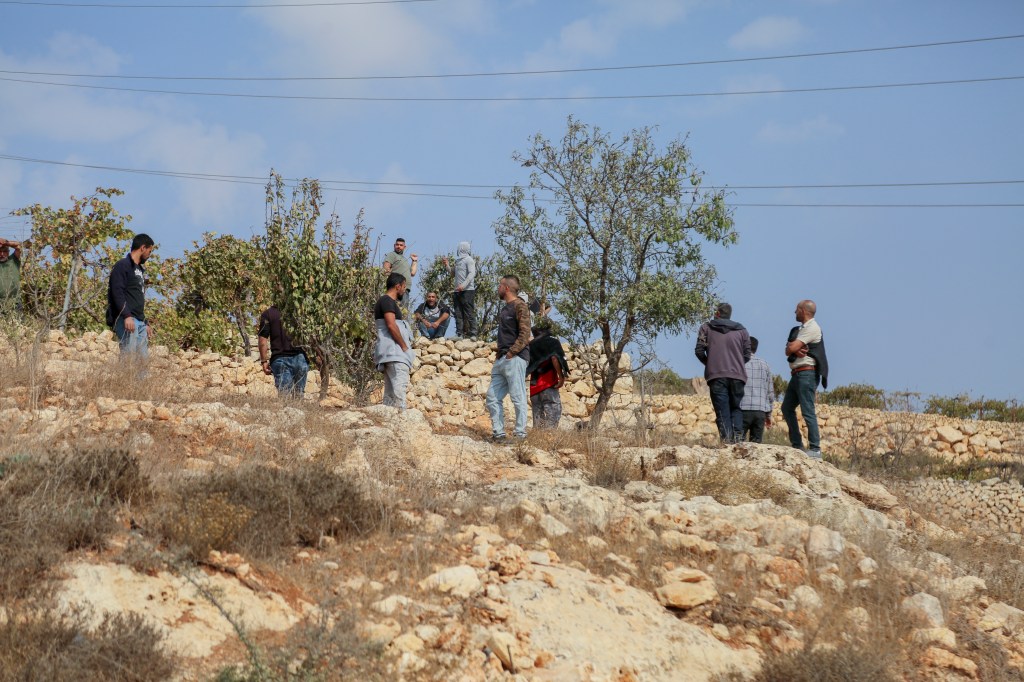
On November 20 alone, settlers are accused of committing six attacks across the West Bank: beating Palestinians with clubs in Markaz, setting fire to residential buildings between the Palestinian villages of Al-Lubban ash-Sharqiya and Ammuriya, torching an agricultural building in Khirbet Abu Falah, and raiding the village of Beit Furik, despite part of its boundaries falling within Area B—established under the Oslo II Accord—where unauthorized civilians are prohibited from entering by the Israeli government. Settlers even allegedly attacked an 85-year-old Palestinian man and his donkey while he was en route to a nearby mosque, sending him to the hospital.
During a rock-throwing fight between settlers and Palestinians near Bethlehem over the weekend, masked settlers fired on Palestinian villages. Nobody was killed, but Israeli police have opened an investigation into the attack and the Israel Defense Forces (IDF) are controlling the area.
The West Bank, a landlocked territory of about 2,200 square miles on the western bank of the Jordan River, is bordered by Israel to the west and Jordan to the east. Israel captured the territory from Jordan in the 1967 Six-Day War, but under the Oslo Accords brokered in the 1990s, the Israeli government transferred day-to-day civil administration in some areas to the Palestinian Authority. Roughly 3.5 million Palestinians live in towns and cities throughout the territory—which is governed by a patchwork of Palestinian civil authority and Israeli military law—as do many Israelis. According to a March 2025 report from the United Nations Human Rights Office of the High Commissioner, approximately 500,000 Israeli settlers now live in the territory, with an additional 230,000 in East Jerusalem—counted separately because Israel formally annexed the eastern half of the city in 1980, though this is disputed internationally.
The vast majority of these settlers are not violent. Nimrod Goren, the founder and president of Mitvim (The Israeli Institute for Regional Foreign Policies), told TMD that the three most prominent types of Israelis who move to the West Bank are:
- Those seeking financial opportunities and economic development;
- Orthodox Jews moving there for religious reasons; and
- Radical political extremists.
The third group is where the problems arise.
“The extremists will usually go and settle into all kinds of unrecognized hilltops, places around the West Bank, and they will feel as if they can take the law into their own hands,” he said. Though they also target Israeli soldiers and those providing aid to Palestinian villages in the West Bank, Goren said the settlers seem like they just “want to look for where they can hurt Palestinians or Palestinian property.”
Many of the violent settlers—primarily young men—come from backgrounds of “juvenile delinquency, unsupervised activity, [and] family collapse,” explained Sara Yael Hirschhorn, an American Jewish Studies professor and senior researcher at the University of Haifa. She told TMD that they’re “looking for a kind of social outlet. And sometimes that overlays nicely with radical politics.”
Yohanan Tzoreff—a senior researcher at Tel Aviv University and former head of the Palestinian-Arab Division in Israel’s Ministry of Intelligence and Strategy—told TMD that many of the young violent settlers “feel that if they will attack the properties of [Palestinians] or try to prevent them from doing the work of agriculture, as farmers, nobody will hurt them.” They attack Israeli soldiers as well, because, according to Hirschhorn, they “feel that the IDF is an impediment to their ability to build outposts and wreak mayhem.”
Tzoreff added that these settlers feel empowered, in part, by Hamas’ October 7, 2023, massacre and the belief that Palestinian property in the West Bank “belongs to them.” Mairav Zonszein, an Israeli-American journalist and senior analyst at the International Crisis Group, affirmed this point: October 7 “definitely gave a lot more trauma, anger, and kind of energy to this, to settler violence specifically, and to the idea that Israel needs to act very forcefully in every place that it exists.” Continued attacks by Palestinian terrorists from the West Bank—including the September shooting that killed six Israelis at the Ramot Junction in Jerusalem—only add to the tension.
And yet many violent perpetrators have, to date, escaped criminal charges. “There are almost never arrests, and when there are arrests, there’s almost never indictments,” Zonszein told TMD. “They know that even if they might get arrested, they’ll probably be freed.”
On November 11, for example, Israeli police arrested four settlers suspected of taking part in what authorities described as “acts of extremist violence” in an industrial zone in the northern West Bank, near the Palestinian villages of Beit Lid and Deir Sharaf, setting fire to vehicles and attacking a factory and agricultural land. But only one of the four—a teenage minor—has thus far been charged. He faces terrorism-related criminal offenses.
Israeli President Isaac Herzog quickly condemned the attacks, as did IDF Central Command chief Maj. Gen. Avi Bluth. “The reality in which anarchist fringe youth act violently against innocents and against security forces is an intolerable and extremely serious situation that must be dealt with firmly,” Bluth said. On November 21, IDF Chief of Staff Lt. Gen. Eyal Zamir reportedly warned that the continued attacks risk further violence and destabilization in the West Bank. At a certain point, he continued, the situation would require military resources to control, and those would have to be “immediately diverted from the Gaza and Lebanon borders,” despite both areas needing those troops.
But Prime Minister Benjamin Netanyahu took several days to publicly criticize the early November attacks, and Israeli media reported on November 26 that the country’s defense minister, Israel Katz, said during a private parliament committee meeting that the recent string of settler attacks in the West Bank were not acts of “terrorism,” but rather “a disturbance of public order.”
In a Facebook post about her father’s attack, Ella Yedaya addressed Netanyahu directly:
You’ve allowed nationalist terrorism to run wild for years without restraint. You brought the people who incite the burning of villages into your coalition, gave them control over everything happening in the West Bank, in the army, and in the police. You give them backing—to shoot, beat, wound, kill, and burn without interference. And you have the power to stop all of it.
Prosecuting settlers who engage in such attacks is procedurally difficult. Yuval Shany, a public international law professor at the Hebrew University of Jerusalem and former chair of the U.N. Human Rights Committee, told TMD that “prosecuting them in court is often difficult, because they wear masks, [and] they do not rat on one another.”
But these are not insurmountable obstacles. “It takes resources, it takes some effort, but, I mean, it certainly can be done,” Shany continued, suggesting the implementation of more efficient intelligence-gathering operations in West Bank settlements and the development of better processes for interrogating Israeli hilltop youths following incidents.
The violent settlers act with a “sense of impunity,” Shany explained. But he added that “there is a threshold that may have been crossed that will force the legal system to react in more assertive ways than we have seen in the last year.”
On Thursday, Israeli prosecutors indicted a 24-year-old Israeli settler, Ariel Dahari, for attacking Palestinians harvesting olives near the central West Bank village of Turmus Ayya in October. Prosecutors allege that Dahari also physically forced a Palestinian driver out of his car, and that, when the victim attempted to escape on foot, Dahari chased him, pelting him with stones. When he reached the olive pickers, Dahari is alleged to have beaten them with clubs, including a 52-year-old woman, Afaf Abu ‘Olia. She was hospitalized due to her injuries, including skull fractures.