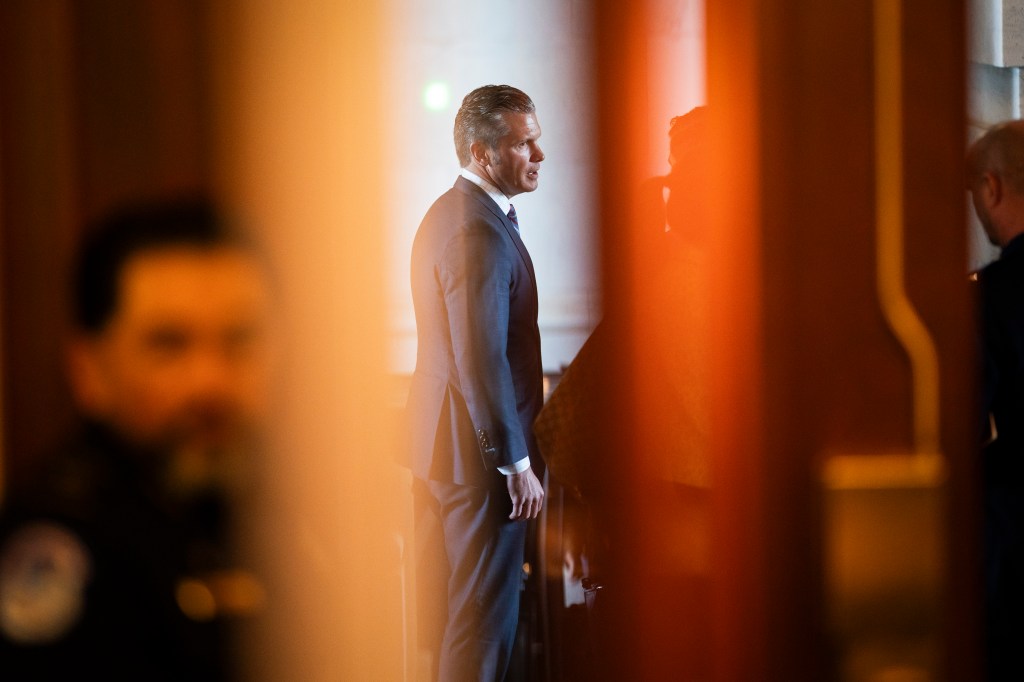
Precisely what happened on September 2 is still murky, and Congressional investigations are likely forthcoming. But multiple legal experts and former military lawyers who spoke to TMD said if the Post’s reporting is accurate, even in part, both Hegseth and military personnel could be at serious risk of criminal prosecution.
“It is absolutely not a war crime,” maintained Michael Schmitt, a professor emeritus at the Naval War College and a former lawyer in the U.S. Air Force’s Judge Advocate General’s Corps (JAG). “To have a war crime … you have to have an armed conflict.” But since there has been no congressional authorization for the use of military force against drug smugglers, simply a presidential “determination” that the U.S. is engaged in armed conflict with drug cartels, a broad range of experts don’t believe the U.S. is actually at war by legal definition, he said.
If the category of war crimes doesn’t apply in this case, Hegseth and the military personnel in the chain of command may instead be liable for homicide. “If it’s not in a war,” said Geoffrey Corn, the director of Texas Tech University’s Center for Military Law and Policy and former chief law of war adviser to the U.S. Army, “it’s a legally unjustified killing from inception, and a killing without legal justification, when it’s done intentionally, is criminal homicide.”
The administration contends that the U.S. is indeed at war. If true, then it’s worse. If the military operations of the past few months have been legal, an order to leave no survivors, or a second strike targeting them, would be both murder and a war crime. As Schmitt explained, the second strike on the ship would be “both a war crime [committed] by those going through the chain of command, and it would be a violation of the law of armed conflict by the United States.”
The administration has steadfastly maintained that its actions are legal. “Our current operations in the Caribbean are lawful under both U.S. and international law,” wrote Hegseth on X on Friday. But top administration officials also have tried to shift responsibility from Hegseth to Adm. Frank M. “Mitch” Bradley, commander of U.S. Special Operations Command and SEAL Team 6.
The Post story revealed Bradley oversaw that first strike and ordered the second strike in light of Hegseth’s orders. The newspaper reported that Bradley said—on a secure conference call—that the survivors clinging to the burning boat were still legitimate targets because they could theoretically contact other drug smugglers to rescue them and their cargo. On Monday night, the New York Times, citing five anonymous administration officials, reported that Hegseth’s orders came before the initial strike and did not specify what to do if there were survivors, and that it was Bradley who likely ordered a follow-up strike.
White House press secretary Karoline Leavitt told reporters yesterday, “Admiral Bradley worked well within his authority and the law, directing the engagement to ensure that the boat was destroyed.” A few hours later, Hegseth also confirmed Bradley had ordered the strike, writing on X that he stood by Bradley “and the combat decisions he has made.”
Leavitt’s specific choice of words was also important, noted Corn, especially the emphasis on the destruction of the boat itself. “It does suggest that the commander interpreted the order to focus on the ship after the first strike,” he said. At present, it’s unclear whether that second strike specifically targeted the boat or the survivors, but methods used—such as whether the missiles were for targeting personnel, rather than vehicles or structures—could provide some answers.
If evidence indicated the second strike was targeting the survivors, “the secretary of defense has some sort of defense in that he could say that they did not interpret this order correctly,” Mark Nevitt told TMD, a professor at Emory University School of Law and a former lawyer in the Navy’s JAG Corps.
But in that case, U.S. military personnel would still have an obligation not to carry out illegal orders, either from Hegseth or Bradley. Eugene R. Fidell—a senior research scholar at Yale Law School who worked on maritime law enforcement matters as a Coast Guard JAG officer—told TMD, “Under the Uniform Code of Military Justice, which governs the armed forces, orders are presumed to be lawful. Servicemembers should make every effort to interpret orders in a legal way, and, if they cannot be carried out legally, decline to follow them.”
But “some orders are so clearly unlawful that they don’t require interpretation,” he said. “Like blowing up people who are doing the backstroke in the middle of the ocean because their boat has been sunk.” Page 1,075 of the Department of Defense’s Law of War Manual gives firing on shipwrecked personnel as its example of a “clearly illegal” order. The manual also states that it is “prohibited to conduct hostilities on the basis that there shall be no survivors.”
Fidell said that if Hegseth did give explicit orders to kill everyone, or Bradley “took his statements to mean that survivors should be killed, that could legally implicate servicemembers who were directly involved, down to the person who fired the missile.”
In the past, the U.S. has taken a dim view of those who target the survivors of sinking ships. After the Imperial Japanese Navy adopted a policy of targeting the survivors of torpedoed vessels during World War II, the State Department called the practice an “inhuman form of warfare.” In 1945, during the trial in a British military court of German sailors who fired on survivors of a sunk merchant vessel, their commander claimed that shooting at survivors was an “operational necessity.” The German commander’s arguments were markedly similar to those reported in the Post story, noted Nevitt. It “took the [court] 40 minutes to convict,” he said.
Congressional Republicans, who have mostly declined to try to stop the military campaign against suspected drug boats, are now promising investigations. On Friday, the chair of the Senate Armed Services Committee, Sen. Roger Wicker, a Republican from Mississippi, said in a joint statement with ranking Democrat Jack Reed that their committee would “ be conducting vigorous oversight” over the reports. Wicker also said he would obtain all audio and video from the attacks, which would presumably include footage of the follow-up strikes. This had not been included in the video of the September attack that Trump posted to social media.
Rep. Mike Rogers, a Republican from Alabama who chairs the House Armed Services Committee, issued a joint statement with ranking Democrat Adam Smith on Saturday, stating that they were “taking bipartisan action to gather a full accounting of the operation in question.”
Other lawmakers have said that they are deeply concerned. “You have a situation like this where you’ve got survivors evidently in the water, and we pulled a second strike off? It’s just not acceptable,” Sen. Jim Justice, a Republican from West Virginia, told reporters Monday night.
But civilian leadership and military personnel aren’t just in potential legal danger. The U.S. may have also violated the trust of its service members who are asked to kill in the defense of their country, argued Corn. “The people who do that business are entitled to know that they’re only going to be asked to do that if it’s legally and morally justified,” he said. “No American should ever be ordered to kill someone who is shipwrecked.”