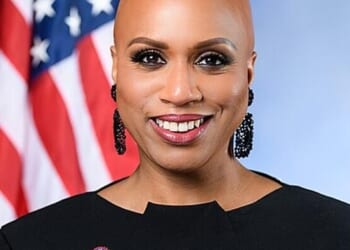
Only in the world of DEI can a black woman make nearly $600,000 annually while serving a destitute city, dress up in a William Shakespeare costume for a promotion while proclaiming, “I am a genius” and decrying the hardships she endures due to her race.
That’s our introduction to Angelique Power, the president of the $568 million nonprofit Skillman Foundation. With its deep pockets ($21.9 million in revenue reported for 2023 and $394.9 million in net assets) Skillman has emerged as a power broker in the diversity, equity, and inclusion/social justice movement with Power leading the charge.
In September, Power was promoting her participation in a campaign called “Shakespeare in Detroit.”
“Black women proclaiming our genius,” Power stated in a social media post of the photo of her dressed up in a Shakespearean wardrobe. “It was both hard to do and necessary to remember in spite of our own doubts – in the face of the rhetoric we face daily.”
Part of that “rhetoric” she faces was the Detroit News naming her as the Michiganian of the Year in June. Or in 2021 the Chicago Tribune article calling Power “a rock star” when announcing she was leaving for the Skillman Foundation. Or in June when Crain’s Detroit Business named her as one of the “Notable Leaders In Philanthropy In 2025.”
In a YouTube video, Power says, “Well, first of all, I want to say that asking a black woman about her genius still seems radical in 2025.”
It should be noted that Power is the third black CEO of the Skillman Foundation. The first was Carol Goss, who took over 21 years ago. Yet, one of Power’s first acts was to implement a “racial equity audit” on the Skillman Foundation.
Funding the status quo
***
These groups, with these people, are not offering new ideas, nor are they ignored voices. They are the status-quo that steered Michigan’s K-12 system into crisis.
***
Skillman’s calling card in 2025 is molding education with the DEI initiatives it funds to shape an “equitable education system.” On its website, Skillman claims, “It’s time to reimagine how decisions are made — expanding the table to ensure those who know our schools best are truly heard and included.”
To this end, Power paraded three Detroit area schoolchildren onto a September 8 podcast on WJR, calling them “truthtellers.” The ruse was that those teenagers would really have a say in spending the $20 billion Michigan government now spends on K-12 instruction.
There’s an old joke that “status quo” is Latin for “the mess we’re in.” This should be the motto for Skillman’s grantmaking. Follow the Skillman money, and you find that it is going to the same cast of characters that have steered Michigan’s public education system generally, and Detroit specifically, into the mess Skillman claims to be fixing. As an example: nearly 9 out of 10 third graders in Detroit Public Schools are not proficient in reading.
One grantee, 482Forward, received $1 million from Skillman in 2024. The nonprofit is run by Jamila Martin, a former SEIU organizer, and Molly Sweeney, who worked for Excellent Schools Detroit, an education group that advocated for more public-school funding.
(Note: Unless stipulated otherwise, all grants referenced are from January 2024 or later.)
Skillman granted Launch Michigan $200,000 in 2024. The Skillman website claims Launch Michigan “members are committed to working across political and ideological lines to uphold a common agenda aimed at building a strong, thriving public education system for all Michigan students.”
Launch Michigan’s president and CEO is Venessa Keesler, who spent 10 years as a top administrator with the Michigan Department of Education. The vice chair of the board is Chandra Madaffari, president of the Michigan Education Association—the state’s largest teachers union.
These groups, with these people, are not offering new ideas, nor are they ignored voices. They are the status-quo that steered Michigan’s K-12 system into crisis.
In a February 2022 interview with Crain’s, Power was asked about the “system change” she was trying to enact.
“We have been working closely with Launch Michigan, and they have been doing some really thoughtful work around the teacher shortage,” Power said. “So that’s like a direct line of trying to listen, but also try to sit in coalition with others that are putting points, really bold ideas, around fellowships. How do we bring new people into the teaching pipeline? How do we incentivize teachers to stay?”
But Power has been listening to and funding the people whose agenda for decades has been to cry over teacher shortages . . . even when they do not exist.
In 2024-25, Michigan had more full-time teaching positions than at any point since 2010. The Detroit Public Schools Community District had 3,021 full-time teaching positions in 2016-17. In 2024-25, the district had 3,533 full-time teachers.
Where’s the shortage?
Losing the race
***
A cynic might observe that shipping five-figure blank checks to the upper management of K-12 systems is a nifty way to get your agenda adopted.
***
While education is the main Skillman focus, race is the umbrella that many grants fall under.
Prior to joining Skillman, Power was president of the Field Foundation. The Chicago Tribune reported in 2021 that Power was “noted” for transforming the Field’s funding structure to focus on racial equity. The Field Foundation currently describes itself as a “private, independent foundation that supports community power building.”
Power wrote in April that the “Skillman Foundation is race explicit—not race exclusive.” In practice, this means Skillman funds groups that blame racism or injustice for the failures of nearly any social institution.
482Forward, one of the biggest recipients of Skillman funding, has an “anti-oppression” platform that makes this claim:
We know that in the U.S. many individuals and classes of people have been denied quality education based on their identity. In particular, we recognize the significant impact of racism on our society and schools. Racist and oppressive policies have played and continue to play a substantial role in shaping our education systems.
Economic Justice Alliance of Michigan received $50,000 from Skillman in 2024. EJAM claims that issues such as paid sick leave, voting rights, and climate justice are all under the economic justice umbrella.
We the People of Detroit received $50,000 from Skillman in 2024. The nongovernmental organization claims that shutting off water to Detroit citizens who don’t pay their water bills illustrates “the racial inequities” of city policies that are “systematic and structural forms of racism.”
The Detroit People’s Platform received $50,000 from Skillman in 2024. It claims racism “has historically plagued our transit policy.” It defends that claim by saying the city has not properly funded its transit system.
Doling out this money makes Skillman the grandest of puppeteers, pulling all the strings trying to influence more taxpayer spending on Detroit’s education. The blueprint for success is simple, yet costly. Skillman funds the research, and the media to publicize the research, and the educators to carry it out.
Here are some examples:
Finance the research: In 2024, Skillman granted $150,000 to the Citizens Research Council of Michigan’s Detroit bureau. In 2025, the Citizens Research Council released a report that discussed the benefits of the city implementing an entertainment tax, e.g. taxing patrons who come to town for professional sporting events by increasing the price of their tickets.
In Detroit, policymakers may want to allocate revenue to specific city services, including infrastructure, transportation, public safety, and potentially education services (e.g., arts and recreation). For example, in Columbus, Portland and Seattle, the revenue has historically been utilized to support arts education and recreation programs in public school systems and non-profit organizations.
Sarah Winchell Lenhoff, a Wayne State University professor, received $50,000 from Skillman. She is the former director of policy and research at The Education Trust-Midwest, a nonprofit that publishes research promoting funding increases for traditional public schools. As such, Lenhoff’s work parrots the talking points of the K-12 status quo that constantly advocates for more money.
Wayne State University, where Lenhoff is now a professor, also received a $245,552 research grant from Skillman in 2024.
Skillman also gave $100,000 to the Education Trust and $350,000 to the Michigan League for Public Policy. Both are left-leaning organizations that have a long history advocating for more taxpayer spending on public schools.
Finance the media: The impact of mainstream newspapers is eroding, but Skillman is far more modern with its journalism philanthropy.
Skillman has funded with $75,000 The Center for Michigan, operator of Bridge, a news website designed to replace the Detroit Free Press and MLive as the go-to source for liberal news. (The name is a reference to the Mackinac Bridge that separates Michigan’s upper and lower peninsulas.)
Civic News Company received $100,000 from Skillman in 2024. Civic News funds Chalkbeat, a chain of progressive news sites that promote the school districts they cover. Skillman designated its money for Chalkbeat’s Detroit bureau.
Skillman has also tapped into the radio market. Skillman president Angelique Power has a monthly radio show on WJR-760, Detroit’s major 50,000-watt AM radio station. Sponsored by Skillman, the program is called “Our State of Education.”
Finance the educators: The Skillman Foundation Visionary Award is a “no strings attached” $50,000 grant to individuals. A cynic might observe that shipping five-figure blank checks to the upper management of K-12 systems is a nifty way to get your agenda adopted. Examples of past “Visionary Award” recipients have included Nikolai Vitti, the superintendent of the Detroit Public Schools Community District (the state’s largest K-12 system), and Juan Jose Martinez, president of the Cesar Chavez Academy charter school, the largest charter school in the city of Detroit.
Dead-enders for DEI
***
Can this vacuous public relations blather get any worse? Yes, yes it can.
***
After he became president for the second time, Donald Trump began dismantling federal support for the diversity, equity, and inclusion movement that Skillman had embraced.
But Skillman’s president is a DEI dead-ender who won’t give it up.
“This administration is mandating we remove language many of us have held dear,” Power wrote in April 2025. “It has set off such alarm bells and internal debates – what do we do, what do we sacrifice in doing so, what do we keep, what do we risk in keeping it?”
The language she refers to—the descriptions used to identify DEI initiatives—is often incomprehensible jargon. A careful reader wading through it will be left without a clear idea of what the program is meant to accomplish.
For example, Power has talked about the concept of “centering youth” … “especially black and brown youth in terms of lifting their voice and centering their power.”
Problems in education aren’t due to a lack of good ideas, Power said in her podcast on WJR. “Often it is because they don’t work together and don’t break down conversations into real talk,” Power said.
Centering power? Real talk? Can this vacuous public relations blather get any worse?
Yes, yes it can.
One of Power’s guests on the Skillman-sponsored WJR radio program was john a. powell, director of the Othering and Belonging Institute at the University of California, Berkeley. powell prefers that his name be spelled in lowercase letters – spellcheck be damned – “in the belief that we should be part of the universe, not over it, as capitals signify.”
Maybe Skillman should fund “grammar justice.”
Some Skillman grantees use talking points that sound as if they came right out of the Democratic National Committee.
In 2023, Skillman granted $130,000 to Mothering Justice, a nonprofit “dedicated to advancing policies that center the needs of mothers, particularly Black and Brown moms, to ensure families thrive.”
The same year, Mothering Justice was one of the plaintiffs in the lawsuit filed against the Michigan Attorney General. That lawsuit led eventually to the Michigan Supreme Court imposing mandatory paid sick leave for all workers on private companies as well as hiking minimum wage.
Skillman also gave to well established progressive organizations in 2025: $56,000 to the Tides Foundation and $50,000 to the ACLU-Michigan.
But not all Skillman grants are saturated in race and corporate PR babble.
In 1962, one of the first donations from the Skillman Foundation went to Torch Drive, a precursor to the United Way. In 1963, Rose Skillman, founder of the eponymous foundation, gave $600,000 through her three-year-old nonprofit to help construct a new “Children’s Hospital of Michigan” in Detroit (that’s $6.3 million in 2025 dollars).
Today, Skillman still has truly philanthropic moments, albeit now overshadowed by the obsession with racial politics.
Skillman’s 2024 grantees included the Boys & Girls Clubs of Southeastern Michigan, the Detroit Police Athletic League, Special Olympics Michigan, YMCA of Metropolitan Detroit, and the United Way for Southeastern Michigan.
K-12 in Detroit
***
Skillman has the resources to help bust up the status quo, yet it is forever “listening to the people” that made the mess in the first place.
***
And the Skillman Foundation has had its fingerprints all over the Detroit Public Schools Community District. In 2016, the state of Michigan approved a $760 million plan to bail out the Detroit Public Schools. The end result of the process was a reorganization and rebrand of the district, which has since become the Detroit Public Schools Community District.
That same year, a group of Detroit public school students filed a lawsuit against Michigan Gov. Gretchen Whitmer and the Michigan Department of Education, claiming the state had failed to provide a basic level of education. The settlement brought $94.4 million in 2025 to the Detroit Public Schools Community District.
And then in 2021 the Detroit Public Schools Community District received $1.3 billion in federal pandemic aid.
Does this sound like a school district that is flush with money?
Not according to Detroit superintendent Nikolai Vitti.
Skillman president Angelique Power wrote this of her first meeting with Vitti in March 2022:
I asked him what he would put forth as critical pieces of education systems change. Equitable funding, hands down, number one, he said. Vitti spoke of how Michigan isn’t even in the realm of equal funding, much less equitable funding where students who require the most support receive the most resources. He spoke of issues with the local millage required to get to state funding and how the wealthier suburbs generate so much more to support their schools. He said DPSCD can’t invest in buildings the way they need to, nor can they pay the much higher salaries needed, and the trauma that children come into classrooms with due to living in poverty is not being addressed. Wraparound services are needed desperately.
Vitti is a skilled, competent administrator who has stopped the exodus of students from his district, balanced the budget (an inconceivable notion to his predecessors, although Vitti has done it with unprecedented state and federal funding) and his tenure has been absent the corruption that preceded him. He has managed slight improvements in reading, math, and student attendance.
Still, in 2024-25, 61 percent of Detroit students were labeled as “chronically absent,” meaning they missed a minimum of 18 days of class days in a school year.
And Vitti’s district is still the worst public school district in the country when it comes to standardized test results, according to the National Assessment of Educational Progress bi-annual The Nation’s Report Card. Detroit has been last among the largest public schools in education performance since it first entered that rating system in 2009.
With that pandemic funding raining down in 2021, the Skillman Foundation predicted big things for Detroit students:
The stimulus funds create real opportunities to address students’ and schools’ immediate needs AND to redefine and rebuild how children and families are supported. They lay the ground for an equitable recovery. A way up for all Americans, and in particular, our children.
Now that most of that money has been vaporized (2026 is the last year federal pandemic money can be spent), what does the Detroit Public Schools Community District have to show for it?
According to state data, there was very little improvement. In 2018-19, a year before pandemic hit, 89.2 percent of the district’s black students in were not proficient in English Language Arts (i.e.: they were not learning to read). In 2024-25, that percentage dropped to 87.9 percent. Is that truly progress?
What did Skillman’s president have to say about this dismal outcome?
More vacuous gobbledygook.
In a September opinion piece for the Detroit News, Angelique Power wrote:
It’s about making Michigan’s education system strong, consistent and modern for the long haul. That requires listening to the people who know schools best and putting their solutions into practice.
In other words, Skillman is listening, yet again, to Michigan’s progressive educational complex: the teacher unions, school executives, administrators, and all the cottage industries that attach themselves to the state’s multi-billion-dollar education blob. Skillman has the resources to help bust up the status quo, yet it is forever “listening to the people” that made the mess in the first place.