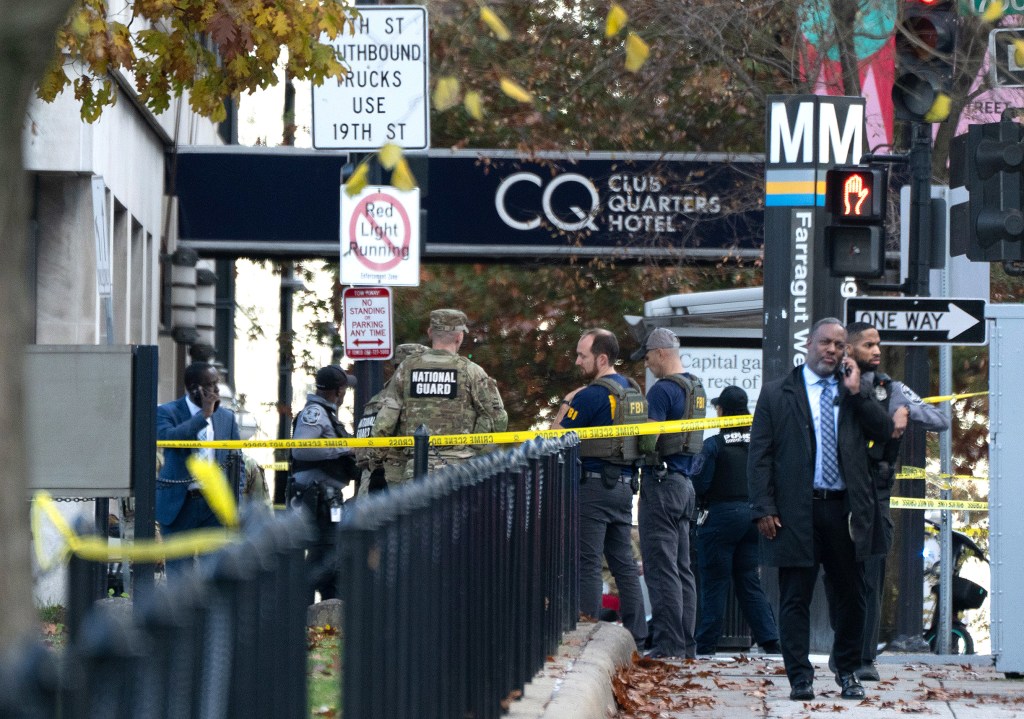
“We must take all necessary measures to ensure the removal of any alien from any country who does not belong here or add benefit to our country,” President Donald Trump said hours after the attack. “If they can’t love our country, we don’t want them.”
U.S. Citizenship and Immigration Services (USCIS)—the Homeland Security Department agency that administers immigration processes—announced the night of the shooting it would immediately pause processing for all immigration applications submitted by Afghan nationals, “pending further review of security and vetting protocols,” and, a day later, that there would be “additional national security measures” for vetting the identity and background of applicants from 19 countries labeled as “high-risk” under a June 4 proclamation by the administration. In a separate announcement, USCIS Director Joseph Edlow further stated that Trump had directed him to conduct a “full scale, rigorous reexamination” of all green card recipients from those 19 countries “of concern.”
By Friday of last week Secretary of State Marco Rubio directed the State Department to pause issuing visas for all Afghan nationals. Edlow said USCIS would halt “all asylum decisions until we can ensure that every alien is vetted and screened to the maximum degree possible.” And Trump vowed on Truth Social to “permanently pause migration from all Third World Countries to allow the U.S. system to fully recover.”
He also threatened to “denaturalize migrants who undermine domestic tranquility, and deport any Foreign National who is a public charge, security risk, or non-compatible with Western Civilization.” He added, “Only REVERSE MIGRATION can fully cure this situation.”
In Trump’s June 4 proclamation, the White House justified its decision to restrict travel from countries, including Taliban-governed Afghanistan, by noting that they “lack a competent or central authority for issuing passports and civil documents, among other concerns,” preventing the U.S. government from conducting proper vetting. Lakanwal’s official documents list his age as 29, which an unnamed U.S. intelligence official told the Washington Post is likely inaccurate. But David Bier, director of immigration studies at the Cato Institute, argued that applying restrictions to applicants based on their country of origin’s bookkeeping ability is an unnecessary extra step. “If there’s no information about the person, then they’re not going to be approved for a visa,” Bier told TMD. “That’s how the system operates.” Instead, he explained, “You just continue to evaluate each applicant, and if they don’t have information proving their eligibility, then they’re ineligible.”
On Thursday, DHS Assistant Secretary Tricia McLaughlin announced the agency plans to review every asylum application approved under the Biden administration, which she claimed “failed to vet these applicants on a massive scale.” On Saturday, an ICE official said agents there would be ensuring Afghans admitted to the country had been “properly vetted” and that they would be now prioritizing the 1,860 Afghan nationals who had been given final deportation orders by an immigration judge but were not yet detained.
But there is no glaring hole in the initial U.S. vetting process. As immigration policy analyst and Dispatch contributor Gil Guerra noted in a Tuesday piece:
The DHS’s IDENT system serves as the primary repository of biometric data, which includes fingerprints, photographs, iris scans, and facial images. IDENT alone holds more than 260 million unique identities and processes more than 350,000 daily transactions. The DOD’s ABIS (Automated Biometric Identification System) contains approximately 2.5 million records specifically from Afghanistan, including information about where, when, and why individuals were collected during combat operations. ABIS is especially crucial because it collects information about individuals ranging from detainees to people applying to work on U.S. military bases to recipients of microloans.
According to John Sandweg—the former acting director of ICE and current partner at Nixon Peabody, where he leads the law firm’s cross-border risks team—officials are checking that biometric information “across a wide array of U.S. databases from the intelligence community, the Department of Defense, law enforcement, or from your international partners.”
“The problem with all of this if the person did not have any terroristic inclinations or memberships or was not a member of any [terror] organization at the time of his admission, even if all the vetting was done properly and you checked all the various databases, you’re not going to find anything,” Sandweg told TMD.
Operation Allies Welcome did have vetting protocols—including biometric collection, such as fingerprints, facial recognition technology, and eye scanners—and the CIA would have vetted Lakanwal previously in Afghanistan. But such vetting procedures can’t weed out individuals who become radicalized after entering the country.
So, the government needs to “make sure that there’s recurrent vetting,” Sandweg said, noting that “DHS has made a lot of strides in this,” explaining that the federal government, local law enforcement, foreign government, and other entities continually update information in a shared database.
But the Trump administration’s immediate response doesn’t take into account those facts.
Daniel Di Martino, a Manhattan Institute fellow whose research focuses on immigration, told TMD that USCIS asylum officers are “still scheduling interviews” with those seeking affirmative asylum status but “they’re just not making decisions.” That applies for denials too, he added, so “you’re just delaying the deportation” of applicants who would otherwise be denied and currently residing in the U.S. Defensive asylum is sought in immigration court by people already in removal proceedings and facing deportation, whereas affirmative asylum is filed preemptively.
“There’s not a compelling security argument for pausing all of their cases,” Bier said. “It’s not as if this results in them being detained or somehow being eliminated as a threat.”
Hopeful Afghan migrants, who were on the verge of coming to America through asylum and other processes, will likely face setbacks as a result of the administration’s updated policy. Robyn Barnard, the senior director of refugee advocacy at the Human Rights First nonprofit, told TMD, “Afghans who’ve been waiting years abroad to be reunited with family here have had their visas torn up and flights canceled.”