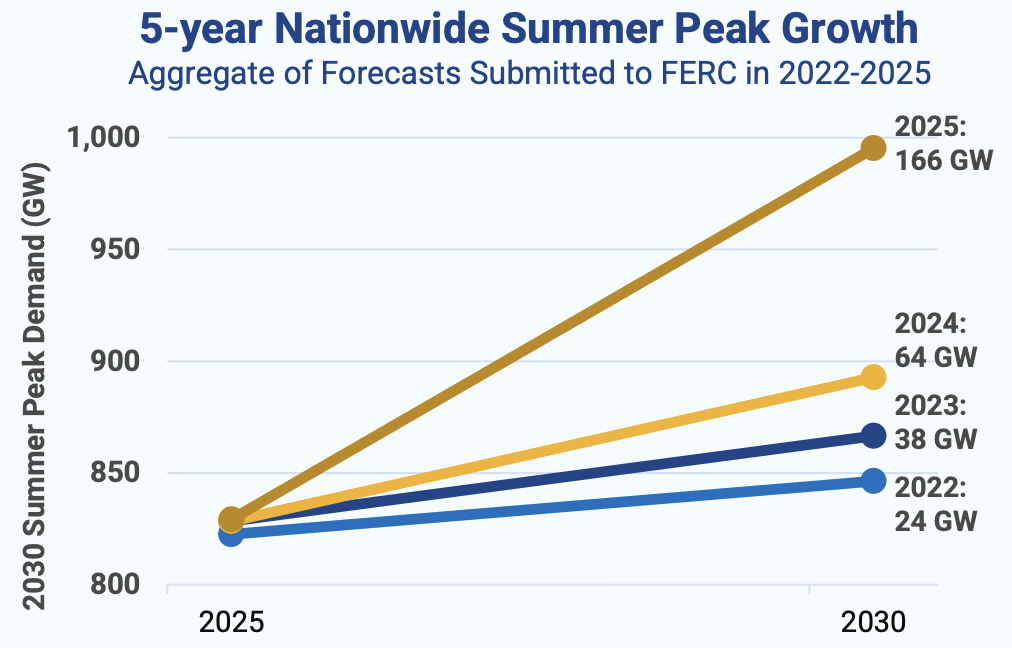
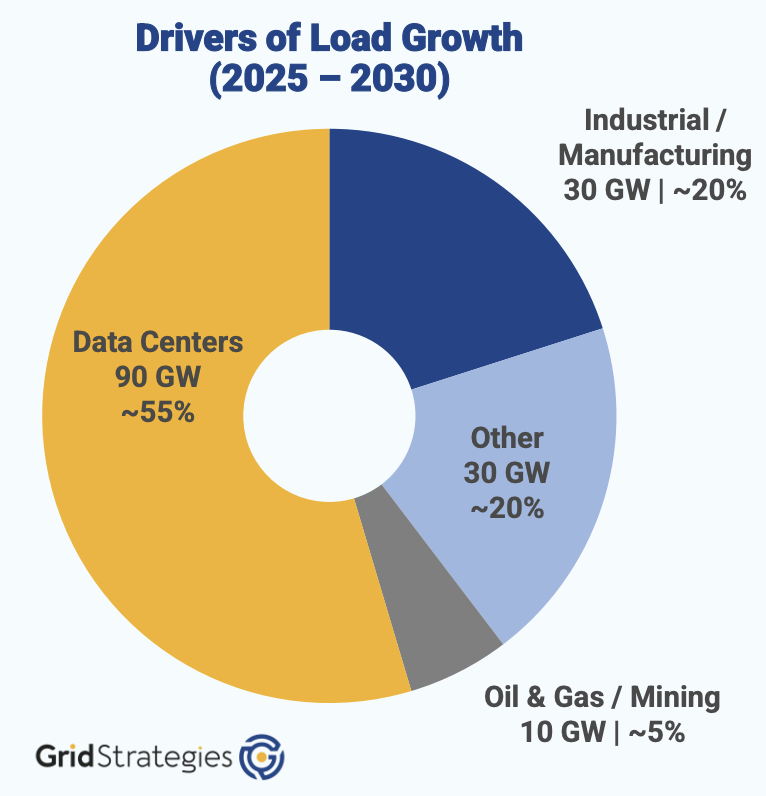
Peak load growth in the United States is expected to increase by 166 gigawatts over the next five years, according to Grid Strategies — over four times higher than the 2023 estimate of 38 gigawatts and over double the 2024 estimate of 64 gigawatts. Grid Strategies attributes much of the higher estimate in 2025 to data center development, which it expects to account for 90 gigawatts of the new peak demand growth. Manufacturing accounts for another 30 gigawatts, or about 20%, with the remainder coming from building and transportation electrification, plus mining and other loads.
Grid Strategies, however, warns that the peak load number could be too high as there is double-counting among data center developers, who look in multiple utility jurisdictions in search of the best deal for the same project. Furthermore, the data center boom is leading data center developers to make speculative proposals for projects that may not materialize. As Canary Media explains, comparing utility forecasts with alternative methods of projecting data center load growth, such as industry analysis of technological bottlenecks, Grid Strategies found that utilities may be overstating data center demand by as much as 40%. And, some external reports tracking data center load growth estimate between 60 and 65 gigawatts of data center load coming online by 2029-2030. Incorporating these lower estimates, however, still results in a higher estimate for peak load growth than the earlier five-year forecasts.
Utilities use the peak load forecasts to justify investments in power plants and grid infrastructure, which is driving up utility bills in some regions, including the PJM Interconnection, the country’s biggest energy market. Via Canary Media, higher load forecasts have driven up capacity costs — the prices paid to power plants and other grid resources to meet peak grid demand — from $2.2 billion in 2023 to $14.7 billion in 2024, and to $16.1 billion in the summer’s capacity auction.
State Activity
As reported by Canary Media, Dominion Energy is proposing new gas-fired power needed to maintain reliability due to data center growth in Virginia — the world’s largest data center hub. Georgia Power is seeking regulatory permission to build gas-fired power capacity to meet load forecasts due to proposed data centers in Georgia.
Canary Media explains that Texas, now the nation’s second-hottest data-center hub, is seeing unprecedented growth in power needs. Over the past year, “large-load” forecasts within the Electric Reliability Council of Texas (ERCOT) have nearly quadrupled, signaling a potential doubling of the grid’s peak demand. In response, state lawmakers approved a measure requiring new data centers to disconnect from the grid during periods of peak stress — a mandate whose specific rules are still being developed by ERCOT and state regulators. Other states are moving to impose laws and regulations that push data-center developers to shoulder more of the costs for new power plants and grid upgrades. In response, some operators are pledging to shift their electricity use to off-peak hours to ease grid pressures. PJM, the country’s largest grid operator, is meanwhile weighing new rules that would require incoming data centers to curb their impact on overall capacity costs.
Blackouts Are Another Potential Outcome
The North American Electric Reliability Corp. (NERC) indicated in its Winter Reliability Assessment that increased demand from data centers and increased electrification of transportation and heating could result in blackouts if severe weather were to hit. A polar vortex, for example, could trigger energy shortfalls from the Pacific Northwest to Texas to the Carolinas. This is because power consumption has grown by 20 gigawatts from the previous winter, without the supply keeping up. Data centers are a main contributor to load growth in those areas. Winter is an especially risky time because solar generation is available for fewer hours, and battery operations may be affected. According to NERC, all regions have adequate resources in normal conditions.
The Pacific Northwest, according to NERC, includes Oregon, Washington, and Montana, as well as parts of Northern California and northern Idaho. Last year, no areas west of the Rocky Mountains were listed at elevated risk in the NERC winter assessment. The “Basin” area in the West, comprising mainly Utah and southern Idaho, is also at elevated risk this winter. According to NERC, data centers, residential electrification, transportation electrification, and semiconductor manufacturing are the primary drivers of the 9.3% increase in winter peak demand in the Pacific Northwest, the second biggest increase among 23 areas assessed. The area also saw a 10.5% decline in “existing certain capacity” due to coal and hydro retirements.
OpenAI CEO Sam Altman, in a letter to the White House’s Office of Science and Technology Policy, recommended that the United States add 100 gigawatts of energy production capacity a year to stay competitive in the artificial intelligence (AI) race. Data centers alter the daily load shape due to their 24/7 operations, lengthening peak demand periods. The annual growth rate on peak load is estimated at 3.7%, but electricity use is projected to rise even faster, up 32% over the next five years — an average annual increase of 5.7%.
Analysis
Increased U.S. load growth from data centers and manufacturing is expected to put stress on grids across the country, which could lead to blackouts if severe weather hits. Maintaining grid reliability while achieving our AI potential requires building new and maintaining old reliable generation that can provide power 24/7 without burdening people with excess costs. Utilities are starting to recognize that achieving this reliability requires renouncing allegiances to net-zero goals and accepting “the inherent advantages of stock-versus-flow energies.”
For inquiries, please contact [email protected].