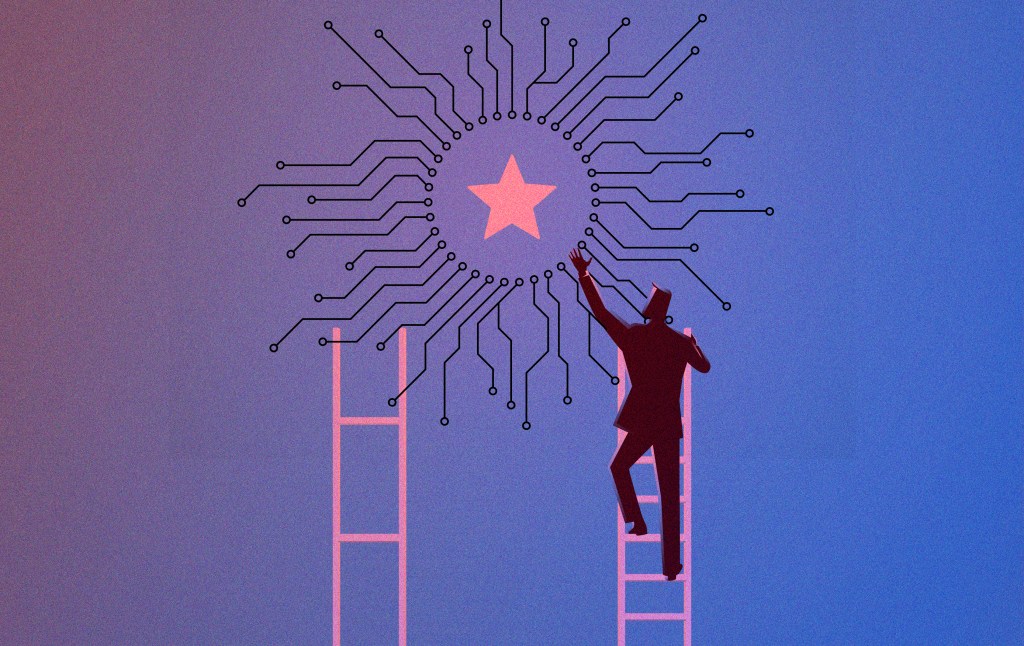
Calls to ban the development of superintelligence have gained traction among some technologists, pundits, and even a few policymakers. They argue that an artificial intelligence system so powerful that it could outthink humans would pose an existential threat to civilization. But this idea rests on unsubstantiated fears, not evidence. A government prohibition on advanced AI would not make the United States safer, but it would make it weaker. Such a ban would forfeit economic and technological leadership, undermine national security, and betray America’s founding commitment to liberty and progress.
The concept of “superintelligence” is a moving target. It usually describes a hypothetical AI system that could autonomously reason, plan, and create at a level far beyond any human. But these self-directed minds do not exist today, nor is their creation on the near horizon. What exists today are systems that perform specific cognitive tasks far better than people, such as analyzing medical scans or optimizing supply chains. They can generate code, write essays, and even design new materials, but they do not think, choose, or act independently. Imagining a conscious or sentient machine may make for compelling cinema or bestselling novels, but it is not an imminent policy challenge. The United States should not rush to outlaw something that does not yet exist—and that may never take the form its critics imagine.
Even if such superintelligent capabilities eventually emerge, banning them is the wrong approach. The real question is not whether machines can surpass humans in certain intellectual tasks—they already have—but whether society should halt the tools that enable such progress. When humans first built telescopes, we saw beyond the stars; when we invented microscopes, we saw the hidden world of cells and bacteria. AI is another instrument of perception and reasoning. To outlaw it because of what it might one day become would be like banning telescopes because they could one day reveal something unsettling. Risk arises from misuse of technology, not from its existence.
“AI is not a mystical force; it is knowledge applied through computation. It magnifies human creativity, insight, and compassion. Just as a microscope revealed life invisible to the naked eye, AI can reveal patterns and solutions that no person could find alone.”
Daniel Castro
“Any technology smarter than humans may be capable of breaking free of the control systems humans have designed, allowing it to pursue actions that are not fully aligned with the best interests of humans individually or humanity collectively.”
Jon B. Wolfsthal
This debate is really about freedom: the freedom to think, build, and reason. Throughout American history, that freedom has driven discovery. Thomas Edison did not wait for permission to electrify cities; the Wright brothers did not need a license to leave the ground; innovators from Silicon Valley to Houston have long thrived under the principle that knowledge should not be rationed. The “freedom to compute” is the liberty to use and build computational tools to advance knowledge—an essential extension of freedom of thought in the digital age. A ban on advanced AI would break from this tradition by outlawing not a dangerous weapon, but the very act of reasoning with more capable tools. Free inquiry has made the United States a scientific superpower and restricting this freedom would erode a key pillar of American innovation.
Critics counter that smarter machines could become uncontrollable or dangerous. But intelligence is not the same as autonomy. A Go-playing algorithm can outmatch the world’s best players, but it harbors no desire to win beyond its programming. Nor do these capabilities undermine human achievement. On the contrary, research shows that exposure to AI systems has improved the skills of top Go players, pushing them toward more creative strategies. Smart tools elevate human performance; they do not diminish it.
The same pattern appears across disciplines. AI now helps doctors detect cancer earlier, chemists identify new materials, and climatologists model extreme weather. In one striking example, researchers used AI to discover novel antibiotics to treat a deadly, drug-resistant bacteria—a breakthrough that could save millions of lives. The choice before policymakers is whether to continue building such tools or to stifle them out of fear.
A ban on advanced AI would impose steep economic and human costs. Smarter systems make workers more productive, drive technological growth, and create entirely new professions. Halting their development would stall progress and deny future generations the benefits of discovery. And because no one can draw a clear boundary between advanced AI and superintelligent AI, any prohibition on the latter would inevitably sweep in the former. History offers a clear warning: Societies that restrict knowledge fall behind.
It would also weaken the United States geopolitically. AI is the foundation of 21st-century power, and the nations that lead in AI will lead in economic and military strength. China understands its importance, and it is investing massively to dominate the field. If Washington forbids its own researchers and companies from pursuing the frontiers of AI, it would amount to unilateral disarmament in a global competition for superintelligent capabilities. Leadership requires moving forward, not standing still.
The danger lies not in artificial intelligence itself but in how humans apply it, a challenge best addressed through oversight, not prohibition. Effective oversight means monitoring significant incidents, auditing high-risk systems, and holding people accountable for misuse—not outlawing progress. Indeed, a ban would be unenforceable because superintelligent capability is not a discrete product or weapon, but an open-ended form of knowledge. And the United States cannot outlaw knowledge any more than it can outlaw mathematics. Nor can the U.S. government meaningfully define what constitutes “too much” intelligence or stop global researchers from pursuing it. Attempting to do so would drive innovation abroad while stagnating it at home, concentrating power in the hands of other nations.
Worse, the precedent would be perilous. Allowing the government to restrict the development of knowledge itself would invert the principle of a free society. The United States has historically trusted its citizens to use knowledge responsibly, from the printing press to the internet. A ban on advanced AI would mark the first time that Washington has declared certain forms of thinking too dangerous for the public to pursue. Americans would retain the right to bear arms—but not the right to build tools of thought. That is a contradiction unworthy of a free nation.
Some will argue that rights are not absolute: The government regulates weapons, pharmaceuticals, and financial instruments to prevent harm. But those restrictions apply to uses, not ideas. Banning the creation of intelligence is not like banning assault-style weapons; it is like banning the study of metalworking because metal can be forged into a sword. AI is not an inherently destructive technology. It is a general-purpose tool, as capable of curing disease as it is of generating disinformation. The rational response is not blanket prohibitions but prudent management—ensuring transparency, safety testing, and accountability for misuse.
That is where government has a legitimate and valuable role. National AI safety institutes, for example, can monitor incidents, assess risks, and share best practices across the industry. Public oversight ensures that businesses use powerful tools responsibly without smothering innovation. A dynamic framework for monitoring, reporting, and mitigating harm is both feasible and compatible with American values. What is not compatible is the idea of outlawing the advancement of intelligence itself.
Europe’s experience illustrates the dangers of excessive caution. The European Union’s “precautionary principle,” which treats innovation as guilty until proven safe, has led to stagnant productivity and a diminished technology sector. By contrast, America’s prosperity has always rested on the willingness to embrace uncertainty in pursuit of progress.
Much of the current anxiety around AI stems from the timeless fear of being outsmarted by machines or becoming obsolete. When mechanized looms appeared, artisans smashed them. When the printing press spread literacy, scribes decried it. When calculators entered classrooms, educators worried they would erode basic arithmetic. Each time, the tool expanded human capability rather than replacing it. AI will be no different.
Some, however, have let their fears curdle into extremism. Prominent critics have called for dystopian-sounding proposals such as shutting down data centers, tracking every GPU sold, or even using military force to destroy computing facilities. In California, one vetoed bill to regulate AI even sought to require “kill switches” for advanced AI systems in case they went rogue. Such ideas are not safeguards; they are symptoms of panic. Once people start believing that saving humanity might require bombing a data center or targeting those who build them, we have crossed from caution into zealotry—and that’s far more dangerous than any algorithm.
Fear is natural. But governing on that basis is misguided. Public policy should address tangible risks through clear rules and oversight, not by suppressing entire fields of inquiry. Knowledge has always carried dangers, yet progress depends on confronting them with courage and competence.
AI is not a mystical force; it is knowledge applied through computation. It magnifies human creativity, insight, and compassion. Just as a microscope revealed life invisible to the naked eye, AI can reveal patterns and solutions that no person could find alone. Greater intelligence, whether human or artificial, does not diminish human worth. It enhances it.
The United States now faces a defining choice. One path leads toward fear, restriction, and decline—a future in which the government forbids the creation of minds more capable than today’s. The other leads toward discovery and leadership, where human and machine intelligence together expand what is possible. The nation that built the light bulb, the microchip, and the internet should not flinch at building something smarter.
If the future belongs to intelligence, it should be American intelligence—guided by human rights, supported by free institutions, and harnessed for the common good. The right to think, build, and reason should remain sacred. The choice is clear: lead, not limit. Build, not ban.