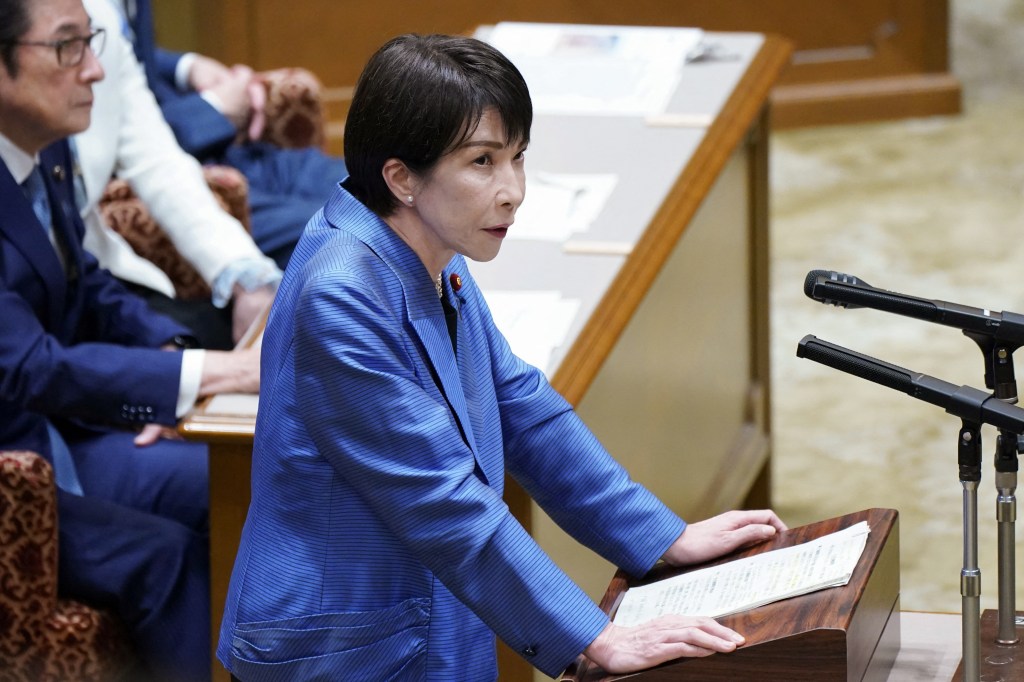
The Chinese Communist Party was not pleased with her comments. It has banned Japanese seafood imports and canceled around 1,900 flights from China to Japan, nearly 40 percent of all such air traffic. It has also attempted to reduce cultural links between the two countries, canceling concerts by Japanese performers in China and issuing travel advisories to discourage Chinese tour companies from leading trips to Japan.
Chinese Coast Guard boats also conducted patrols near the Senkaku Islands, a set of uninhabited islands administered by Japan, but claimed by China. The provocation was part of a longstanding Chinese “gray zone” strategy, using dangerous actions that fall just short of war, said Ray Powell, the director of the SeaLight Foundation, which monitors Chinese maritime activities.
The goal, he told TMD, is to intimidate. “There’s a Chinese proverb, ‘kill the chicken to scare the monkey,’” he noted. China wants to send a message that Takaichi “crossed this red line. Don’t anybody else think you’re going to be dumb enough to do this, too.”
Chinese officials are also attempting to isolate Japan diplomatically, appealing to foreign nations and the U.N. to condemn Takaichi’s statement and arguing that Japan is trying to resurrect its early-20th-century empire. “The international community must remain highly vigilant against Japan’s ambitions to expand its military capabilities and revive militarism,” wrote Fu Cong, China’s U.N. ambassador, in a letter sent to Secretary-General António Guterres on Monday.
In a call with President Donald Trump, Chinese President Xi Jinping referenced the U.S. alliance with China in fighting “fascism and militarism” during World War II, according to a Chinese press release (conveniently ignoring that the U.S. was allied with the Republic of China, not the Chinese Communist Party). And in calls with his counterparts in Britain and France ahead of a three-day trip by French President Emmanuel Macron to China, top Chinese diplomat Wang Yi asked both European countries to “safeguard the outcomes” of World War II.
Chinese anger at Japan’s numerous atrocities committed during the war is real, Stanford University foreign policy researcher Daniel C. Sneider told TMD. But it also reflects recent efforts to create a patriotic narrative centered on the Communist Party’s supposed victory over imperial Japan. “Since Tiananmen, the Chinese Communist Party has had to re-legitimize themselves” in the eyes of the Chinese populace, he said.
At the center of these efforts is the “Patriotic Education” initiative, a massive reorganization of school curricula and propaganda programs that emphasizes China’s overcoming the “century of humiliation,” the period spanning roughly from the mid-19th century to the end of the Chinese Civil War in 1949, when the country was unduly influenced by outside powers, including Japan. “The battle with Japan is central to that narrative,” said Sneider. “Central to it is the claim that the Chinese Communist Party wants to make, that we Chinese, and we the Chinese Communist Party, were the victors in World War II.”
Recent Chinese blockbuster films have reinforced this narrative of Japanese villainy, including this year’s Evil Unbound, which tells the story of Japanese biological experiments on Chinese prisoners during World War II. The Eight Hundred, released in 2020, depicts soldiers for the anti-Communist Nationalists fighting the Japanese as national heroes.
But if China has sought to revive memories of World War II, Japan has moved on. Its constitution, drafted in the years following the destruction of the Japanese empire in World War II, officially “renounces war as a sovereign right,” and vows to never maintain forces with “war potential.”
Over the years, successive Japanese governments have (somewhat creatively) interpreted these clauses to mean that Japan renounces offensive war but permits national self-defense, including maintaining the “minimum” level of military forces required to do so. Additionally, in 2014, Japan extended its definition of self-defense to “collective self-defense,” meaning that Japan would defend an ally if the conflict represented an existential threat.
Those revisions have generally been accepted in Japanese politics, at least by the right and center, said Guibourg Delamotte, a professor of political science at the French Institute of Oriental Studies. In many ways, Takaichi’s statement was simply an articulation of a generally accepted principle, albeit one that a sitting prime minister had never made. “Really, she was just stating the law, but getting grilled by the opposition,” Delamotte argued. “It’s very much about internal politics.”
And the opposition’s gambit to galvanize the more pacifistic parts of the Japanese electorate appears not to have worked. A Nikkei Asia public opinion poll, released on Monday, showed that Takaichi had a 75 percent approval rating, with 55 percent of respondents finding her statements on Taiwan appropriate and only 30 percent disapproving. Many ordinary Japanese people may see the slowdown in Chinese tourism as a silver lining, Sneider remarked, as exasperation with hordes of foreign visitors was a key talking point in the last election.
Japan has also made more substantial commitments to defense in recent years, beyond simply amending its laws. This week, the Cabinet approved a plan to spend an additional $7 billion on defense in fiscal year 2025 (ending March 31, 2026), putting its defense spending at over 2 percent of GDP. The increase includes longer-range defensive weapons, such as surface-to-air missiles, deployed on islands near China and Taiwan.
Chinese aggression in the Indo-Pacific is not the sole driver of Japan’s spending increase, and Russia’s invasion of Ukraine “had a huge impact in Japan,” Sneider said. The second page of Japan’s 2022 National Security Strategy, for example, cites the invasion as having “breached the very foundation of the rules that shape the international order,” six pages before any mention of China. Since the end of World War II, Russia has controlled the four southernmost Kuril Islands—known in Japan as the Northern Territories—which have become the subject of a Japanese government awareness campaign featuring Erika-chan, a tufted puffin mascot.
The Japanese public and leaders are also deeply concerned about the U.S.’s recent shift away from its traditional alliances. “Before Trump met with Xi Jinping in Korea, the discussion in Japanese media was all about whether or not Trump was going to sell out the Taiwanese for the sake of having a deal with Xi Jinping,” Sneider told TMD.
But the U.S. doesn’t appear inclined to back down on Taiwan. In his recounting of a call with Trump late last month, Xi stressed that he had told the U.S. president that Taiwan’s “return” to China was an “integral part of the postwar international order.” Trump did not mention Taiwan in his Truth Social post recounting the call, and held a call with Takaichi the next day. On Wednesday, he signed the Taiwan Assurance Implementation Act into law, which will functionally require U.S. officials to have regular contact with their Taiwanese counterparts. Chinese officials, as they had with Japan, called the move a “red line.”
How this dispute ends is unclear. “The challenge for Japan is that China is going to be offering off-ramps to them, which will require something of Japan,” Powell said. China tends to see diplomatic crises as opportunities, rather than necessarily problems to be solved. He cited the 2012 Scarborough Shoals incident, in which the U.S. mediated a dispute between China and the Philippines in the South China Sea. The Philippines agreed to withdraw from the disputed region, but China remains there to this day.
Takaichi can’t easily back down. Last week, Takaichi implied her remarks were off-the-cuff, saying that she merely sought to “respond faithfully” to a request for specific examples of when Japan would invoke collective self-defense. “Going forward, it is my responsibility to build a more comprehensive and positive relationship (with China) through dialogue,” she said.
But China’s demands may be steeper than that: “They want there to be an admission of wrongness, and she’s not going to do that,” Powell said. Delamotte agreed: “There’s no way she can take it back, because that would considerably weaken deterrence, and plus, the law is what it is.” On Tuesday, Taiwanese Foreign Minister Lin Chia-lung warned that the “situation may take a year to stabilize.”
Both Xi and Takaichi are locked in a staring match. “Once people have gotten themselves locked into these postures, it’s pretty hard to back off without appearing weak,” said Sneider. “And I don’t think either of these people wants to appear weak.”