We queued for nearly half a block, crawling from the corner of Lexington Avenue along East 24th Street toward the Asylum Theater. Something there was drawing theatergoers of every ilk—people from every corner of New York City, pressed shoulder to shoulder in the same line.
When we reached the entrance, we saw the source of the delay: a lone security guard meticulously wand-ing and bag-checking each person, one by one. I was caught off guard. Just a few months ago, Slam Frank had been nothing more than an Instagram page, where musician Andrew Fox uploaded raw, unpolished (and gloriously incendiary) clips of himself rapping over scratch tracks. Could an off-Broadway show that so many doubted was even a real musical truly need security?
Yes, it turns out, and one guard wasn’t enough. In years past, critics labeled shows like 1984, Spring Awakening, and Equus as dangerous, but only because they’d never seen Slam Frank. In its 100-minute runtime, no sacred cow goes un-tipped, from Lin-Manuel Miranda to trans ideology—a movement whose followers have shown themselves capable of actual violence.
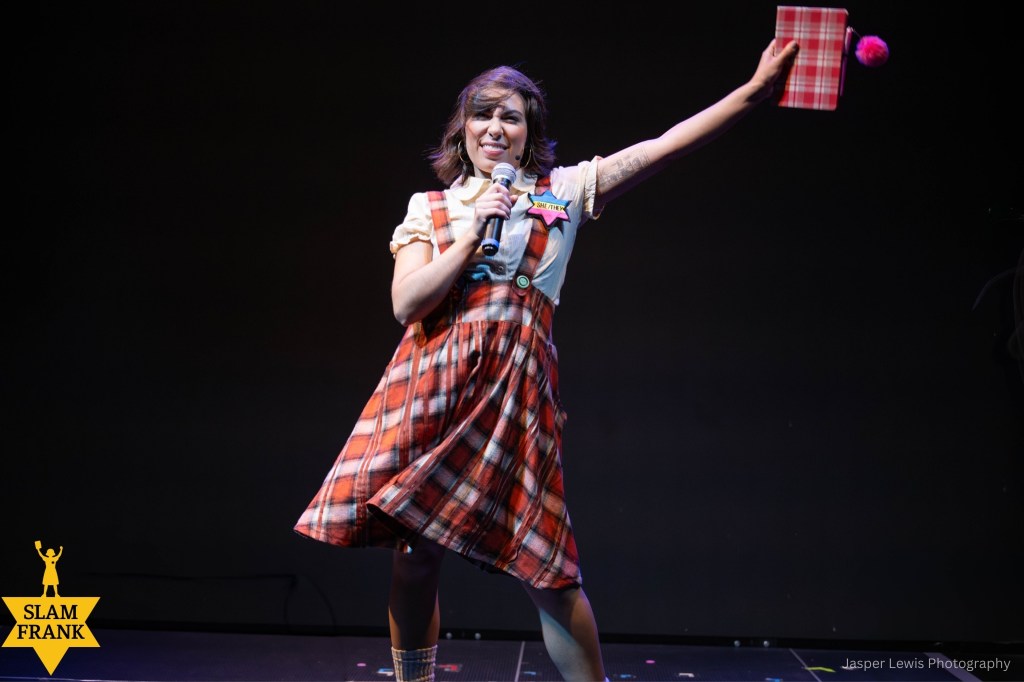
Inspired by a viral Twitter thread that asked, “Did Anne Frank ever acknowledge her white privilege?” Slam Frank follows a progressive community theater troupe determined to de-center “privileged, straight, white Europeans (who also happened to be hiding from the Nazis).” From there, the showrunners “decolonize” her diary, twisting Frank’s true story into a “gender-queer, multi-ethnic, intersectionally feminist, Afro-Latin hip-hop musical.” Anne Frank becomes Anita Franco, a Latina woman with a “hip-hop diary flow.” Her beloved Peter van Daan—historically, Frank’s first love interest Peter van Pels, though Frank changed his name in her diary—blossoms here into a dancer grappling with his nonbinary identity. Mr. van Daan (Hermann van Pels, Peter’s father) is “literally worse than the Nazis.”
“Sometimes,” Anne says, “when you can’t easily explain your identity, it actually means it’s even better than all the others.”
The Franks and their supporting characters are in no way the targets of the writers’ ire. Ironically, the show highlights the historically marginalized Jewish community’s ability to bear cultural pressures with grace and good humor—using satire to confront taboos and ignite necessary debate, stretching back to “Springtime for Hitler,” the seminal song from The Producers, and before.
Those who have accused the show of punching down at minority groups (some even started a petition to stop the production altogether) misunderstand the mechanics of satire. In fact, Slam Frank punches up at tribalism taken to its logical extreme and the absurdities of identity-driven thinking—ideas that have long infected and de-fanged American theater.
The writer Clayton Fox called this neutering “toxic gentleness” in a September 2023 piece for Tablet Magazine, in which he lamented the “young millennial bolsheviks” destroying a once-great art form from within. The pandemic shut our theater doors, he said, but the ideological illness metastasized in 2020:
…the principles of the Black Lives Matter movement—including the idea that “show must go on” culture is “driven by fear” and disproportionately harms nonwhite artists—became the new religion. If theaters couldn’t put on shows, they could certainly change their mission statements, promise to cull white staff and creatives to achieve diversity quotas, and scare off any wrong thinkers who might still be lingering in the wings, including unvaccinated artists.
Through examples too numerous to count, theater has since “committed suicide by a thousand cuts,” to use Fox’s words. Ask the unvaccinated Laura Osnes, the “transphobic” cast of Tootsie, the star of Jagged Little Pill who committed non-binary “erasure,” or the “privileged” creatives behind the casting of Maybe Happy Ending. Ask the producers reviving great Golden Age musicals. Hell, ask Lin–Manuel Miranda.
Audiences don’t seem to be buying all of this self-flagellation. In September, a New York Times piece titled “The Broadway Musical Is in Trouble” laid out the grim financial reality: Since the pandemic, only three new musicals have recouped their initial investments. Since September, & Juliet joined the list, bringing the total to four. That figure is far below Broadway’s historical norms—for decades before COVID, industry analyses estimate that roughly 20 to 30 percent of new musicals recouped. Today, the rate has plunged to barely 10 percent.
So, what becomes of a once life-giving industry driven more by progressive activism and empty ideology than by devotion to the craft? We seem to be watching the fallout in real time—writing flattened by fear and moral confusion, and audiences dwindling rather than paying premium prices to performers who seem to resent them.
It’s the slow theme-park-ification of an art form that no longer honors its deep roots. From the ancient Greeks and Romans through medieval Englishmen, theater has always been an aggressive dialogue between men, kings, and God—an epic tug-of-war over threads of truth. It was the innovative American artists of the 20th century, like Rodgers and Hammerstein, who wove those threads into something new: the modern musical, a sporting event for the heart.
This lineage, from William Shakespeare to Stephen Sondheim, held up a mirror to society, tangling masterfully with our deepest fears and questions. They left for us an intellectual inheritance and an empty arena, inviting the next generation to take up the game.
Enter Slam Frank. The show has built a bona fide cult following, racking up 93,400 Instagram followers, and has now been extended for a third time, running through December 28. Nightly lines stretch around the block. Turns out, audiences and critics alike are starved for theater with teeth—Ben Brantley, former theater critic of the New York Times, said that it “may be the most important new show around.”
One of the most shocking things about Slam Frank is that it’s genuinely good. The musical is helmed by industry pros—directors Sam LaFrage and Emily Abrams, musicians Andrew Fox and Joel Sinensky, and set designer C.J. Howard—who have built a veritable playground for their capable cast. Olivia Bernábe (who really does have a killer flow) anchors the production as Anita, but the entire ensemble is talented, exuberant, and perfectly matched to their roles, leaving audiences laughing and gasping in equal measure.
The final 20 minutes, under a media embargo for good reason, left my husband and me staring at each other with our mouths agape. Slam Frank is genuinely dangerous theater. And that’s just what we need.