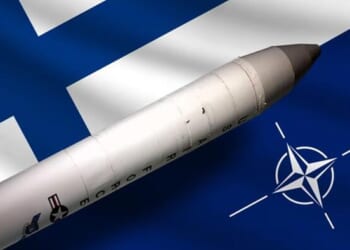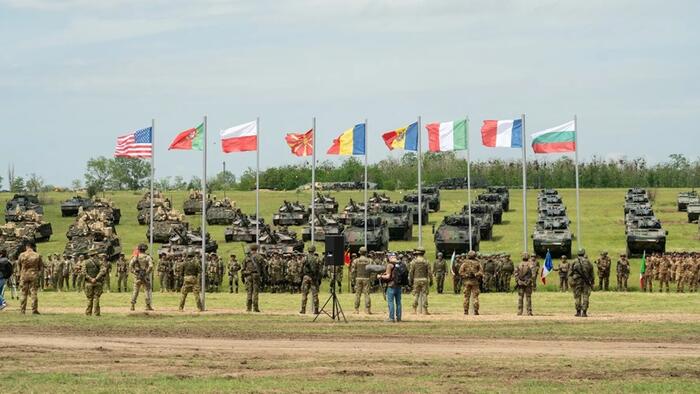
European members of NATO have been warned by Washington that they must assume greater responsibility for the alliance’s intelligence operations and missile production – which will require significantly more defense spending by 2027, Reuters has reported.
Reuters in its exclusive Friday report said that the United States “wants Europe to take over the majority of NATO’s conventional defense capabilities, from intelligence to missiles, by 2027, Pentagon officials told diplomats in Washington this week, a tight deadline that struck some European officials as unrealistic.”
“The message, recounted by five sources familiar with the discussion, including a U.S. official, was conveyed at a meeting in Washington this week of Pentagon staff overseeing NATO policy and several European delegations,” the report continued.
The directive was coupled with a warning behind the scenes, reportedly involving Pentagon officials cautioning representatives from several European nations that the US may scale back its role in certain NATO defense efforts if this target and deadline is not met.

It was noted in the report that some European officials consider the 2027 goal unrealistic, saying that rapidly substituting American military support would demand far greater investment than current plans and NATO member approved defense budgets allow.
This generally reflects the Trump administration’s long verbalized dissatisfaction with with Europe’s progress on shouldering more of NATO’s collective defense burden.
But the Reuters report also underscored that European officials were not offered tangible metrics whereby failure or success would be assessed:
Conventional defense capabilities include non-nuclear assets from troops to weapons and the officials did not explain how the U.S. would measure Europe’s progress toward shouldering most of the burden.
It was also not clear if the 2027 deadline represented the Trump administration position or only the views of some Pentagon officials. There are significant disagreements in Washington over the military role the U.S. should play in Europe.
One NATO official was cited as saying “Allies have recognized the need to invest more in defense and shift the burden on conventional defense” from the US to Europe.
As we described previously the Trump administration’s new National Security Strategy really hits out hard at Europe, stating saying “it is far from obvious whether certain European countries will have economies and militaries strong enough to remain reliable allies” to the United States.
The document further highlights that this current reality of European weakness could have certain negative implications for potential for heightened Western escalation with Russia:
“Managing European relations with Russia will require significant U.S. diplomatic engagement, both to reestablish conditions of strategic stability across the Eurasian landmass, and to mitigate the risk of conflict between Russia and European states,” the document reads.
Most analysts see the language in the document as opening the door for greater Washington meddling in European affairs.

“Washington is no longer pretending it won’t meddle in Europe’s internal affairs” Pawel Zerka, a senior policy fellow at the European Council on Foreign Relations, observed.
“It now frames such interference as an act of benevolence (‘we want Europe to remain European’) and a matter of US strategic necessity. The priority? ‘Cultivating resistance to Europe’s current trajectory within European nations‘,” he concludes.
Loading recommendations…