Earlier this year, vicious protests broke out against ICE agents in Seattle. According to local reporting, protesters blocked the Seattle federal building before pulling down its American flags and lighting them on fire. It was not the first time that recent anti-Trump administration protests have culminated in flag burning, of course: Protesters did the same thing in Los Angeles and D.C. The sight of a burning flag has grown so common, in fact, that President Donald Trump recently signed an executive order aimed at encouraging the prosecution of flag desecration-related crimes.
The order is basically toothless and legally questionable. But it nonetheless provoked the obvious debate: Should the law tolerate desecrating the flag? Two-thirds of Americans believe it should be illegal to burn the flag in protest. But civil libertarians disagree, contending that flag burning is First Amendment-protected speech.
Descriptively that’s true: Under current legal precedents, the First Amendment protects flag desecration. But the majority of Americans who oppose that conclusion are closer to understanding free speech than are those who disagree. Desecrating the flag is not free speech; it is an act of violence against the liberties that make free speech possible. Prohibiting it through a constitutional amendment would increase our freedom, not diminish it.
“Flag burning goes beyond speech merely critical of the government, which is and ought to be protected. It is speech targeted at, and actively hostile to, the system of liberties that makes it possible.”
Charles Fain Lehman
“America, with its robust constitutional protections for speech of all varieties, stands apart. And it should continue to do so, even when its own symbols are under attack.”
Matthew Cavedon
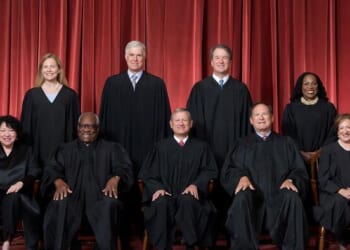
The question of whether flag burning is protected by the First Amendment was, as a legal matter, resolved in 1989’s Texas v. Johnson. A five-justice majority overturned the conviction of Gregory Lee Johnson for burning a flag in protest at the 1984 Republican National Convention. The majority concluded that Texas’ prohibition on flag desecration violated Johnson’s rights under the First Amendment, thereby enshrining flag burning as protected speech.
Yet to say that the court resolved the issue does not mean that its conclusion is beyond reproach. Johnson was narrowly decided, with four justices in dissent. Nor was their dissent unprecedented. In the decades leading up to Johnson, Justices Earl Warren, Hugo Black, Abe Fortas, and Byron White had all said they would not protect flag burning as speech; Black and Warren were both famous First Amendment advocates.
For that matter, Johnson upset earlier cases from the colonial and Civil War period that upheld bans on flag desecration. And it overturned the considered judgment of 48 state legislatures, none of which had thought flag desecration laws to produce any constitutional issue whatsoever.
Critics of the Johnson majority made several arguments. They pointed out that burning a flag was not necessarily an expressive act in itself, but a “manner” of speech, meaning laws restricting it should be subject to less stringent scrutiny. And they noted that flag burning is not obviously speech—written or spoken communication—but conduct. Other kinds of “expressive conduct” have received the imprimatur of First Amendment protection. But the line is often fuzzy: When is proscribing conduct necessarily treading on expression?
Lastly, and most importantly, Justice William Rehnquist (and others) argued that even if flag burning is speech, it should be counted among other kinds of “low-value” speech that are proscribable because they can generate disorder and do not contribute to discussion of matters of public concern. As Rehnquist put it in paraphrase of 1942’s Chaplinsky v. New Hampshire—which first delimited which kinds of speech were unprotected by the First Amendment—“the public burning of the American flag by Johnson was no essential part of any exposition of ideas, and at the same time it had a tendency to incite a breach of the peace.”
That these views did not carry the day in Johnson does not mean that they were wrong. But it does mean that a ban on flag desecration would require either overturning Johnson or a constitutional amendment. Which makes the question not just a legal but a normative one: As a social and political matter, should flag burning be protected?
Free speech in the American tradition is extraordinarily (and beneficially) broad, but it is not without limits, because it is not without purpose. At the founding, the First Amendment’s prohibition on “abridging the freedom of speech” was understood to both prohibit pre-publication censorship of any kind and to offer absolute protection to “well-intentioned statements of one’s views.” That is an essential feature of a democracy, which requires the people to engage in robust debate to settle disputes on matters of public concern.
Importantly, even today’s court recognizes that broad swaths of speech, non-political in character, are not covered by the First Amendment at all. For example, two CEOs conspiring to price fix can do so exclusively through speech. Yet almost no one believes that antitrust law violates the First Amendment. Similarly, workplace sexual harassment prohibitions can result in punishment for speech, but are thought by only a few to implicate the First Amendment.
Other kinds of speech are not only not “well-intentioned statements of one’s views,” but actively hostile in a way that is not only unpleasant, but harmful to the social order that makes speech possible. It is not that these kinds of speech merely hurt people’s feelings or express impolite ideas. Rather, the American tradition has long recognized that some speech—like some actions—poses a threat to the institutions of society that, among other things, make free speech possible.
For an extreme example, take incitement: speech which is, by the modern definition, “directed at inciting or producing imminent lawless action” and likely to accomplish that goal. Inciting speech, though narrowly defined, is unprotected by the First Amendment. That is because incitement is speech that directly yields socially destructive action. If the government did not have the power to stop it, then the civil peace necessary for a flourishing democratic republic would be at risk.
Until the late 1960s, inciting speech was construed more broadly to include speech that advocated for the overthrow of the constitutional order. As late as 1951, for example, the Supreme Court had no problem saying that advocating for communist revolution represented a “clear and present danger” that government could legitimately punish. That was consistent with the laws on the books in some 20 states that banned advocating for crime or violence to obtain political change. While these have fallen out of Supreme Court favor, they represent the same basic insight—certain speech can be proscribed because it threatens the underpinnings of constitutional liberty, in that case by encouraging anti-liberty revolution.
Or consider obscenity, which is also outside of the First Amendment’s coverage. The modern definition of obscenity depends on an abstruse test that makes “prurient” speech proscribable if it offends “contemporary community standards.” But the historical test—that obscenity is that which tends to “deprave and corrupt those whose minds are open to such immoral influences”—could be justified by the idea that certain speech tended to harm the character of a free people, and that that character was necessary for self-governance. A people pushed by obscenity into lascivious passions, many believed, is a people less able to engage in the act of self-government.
Modern free-speech absolutists—including those who advocate for the protection of flag burning—tend to depend on a paper-thin theory of why speech should be protected. In this account, the greatest—often only—threat to discourse is government action, and the process of truth seeking (Justice Oliver Wendell Holmes’ “marketplace of ideas”) can only function if no expression—no matter how vicious, vile, or potentially destructive—is excluded.
A thicker account of free speech, however, recognizes that robust public debate can be restrained by actions and words other than those of the state. Free-speech absolutists often recognize this (paradoxically) in their criticism of the “heckler’s veto,” which is private speech that itself silences speech. The general principle of the aforementioned categories is that some speech can be objectionable, and even in some cases proscribable, because it threatens the system that makes free speech possible.
This, in fact, is also the case for banning flag desecration.
What is the expressive content of burning the flag? It is a rejection of everything the flag stands for. And what does it stand for? As Rehnquist explained in Johnson:
The American flag, then, throughout more than 200 years of our history, has come to be the visible symbol embodying our Nation. It does not represent the views of any particular political party, and it does not represent any particular political philosophy. The flag is not simply another “idea” or “point of view” competing for recognition in the marketplace of ideas. Millions and millions of Americans regard it with an almost mystical reverence regardless of what sort of social, political, or philosophical beliefs they may have.
The flag does not stand, in other words, merely for the government. It stands for the American nation, and for the specific system of liberties that define that nation—including the freedom of speech. Flag burning, therefore, goes beyond speech merely critical of the government, which is and ought to be protected. It is speech targeted at, and actively hostile to, the system of liberties that makes it possible. It incites by destructive means a desire for destruction of our constitutional order, which is to say of free speech. In that way, “flag burning is free speech” is an oxymoron.
Defenders of flag burning often argue that it is the highest form of free speech, demonstrating the strength of our commitment to that principle. In fact, the opposite is true. The person who burns the flag spits in the face of free speech, because he opposes explicitly and with destructive action the institutions that undergird it.
It is no accident that those who burn the flag do not share with their defenders a principled commitment to free speech. The masked thugs who burned the flag in Seattle and Los Angeles do not believe in free speech for “fascists”—they believe in silencing them. And they understand that the flag represents the anti-silencing viewpoint. That is why they light it on fire.
There is little reason, therefore, to tolerate the act. Returning to the pre-Johnson status quo would not involve a great deal of prosecution. But it would once again permit the states to clearly send a message: We live in a nation of laws that preserve our liberty, and destroying the symbol of those laws and that liberty is unacceptable.