This week, Congress tackled one of its most important defense policy bills of the year: the National Defense Authorization Act (NDAA), annual legislation that authorizes the Department of Defense to spend the money the legislature has appropriated for it. As usual, the bill is massive, not only in importance but also in length. Weighing in at about 3,000 pages, this year’s NDAA tackles a myriad of issues, including a small yet long-awaited reining in of the president’s war powers.
Inside the text of the NDAA is a repeal of the Authorizations for Use of Military Force (AUMF) that greenlit operations in Iraq during the 1991 Gulf War and Operation Iraqi Freedom in 2002. (The United States deposed Saddam Hussein in 2003, but Congress gave the president the authority to do so the previous year.) The House passed the massive bill Wednesday by a vote of 312-112, and the Senate advanced it Thursday in a procedural vote with 75 senators voting “yes,” setting up final passage likely next week. President Donald Trump has said he will sign it into law. Some analysts argue the repeal is unlikely to have any consequential impact on current U.S. foreign policy, saying the two AUMFs are widely considered obsolete, but the action represents Congress marking a formal legislative end to the Gulf and Iraq wars and constitutes an incremental step in the legislative branch reclaiming its warmaking power from the executive.
The move comes at a time when the Trump administration’s justification for deadly strikes on boats allegedly ferrying drugs in the Caribbean and the East Pacific is coming under increasing bipartisan scrutiny. Although two resolutions designed to limit the strikes failed to pass this fall, a bipartisan group of senators is trying again.
Although the repeal of the decades-old war authorizations appears to be right in front of the finish line, getting it there wasn’t easy.
“Even with both houses agreeing to this, it was difficult to keep this in the NDAA,” Democratic Sen. Tim Kaine of Virginia, one of the leaders of the repeal effort in the Senate, told The Dispatch.
The difficulty in repealing the resolutions comes despite the fact that both chambers in previous Congresses have passed bills to do so since 2019, when Kaine and GOP Sen. Todd Young of Indiana first introduced the repeal effort. They’ve just never passed such legislation in tandem that they could send to the president’s desk, even though there has been bipartisan support for the efforts.
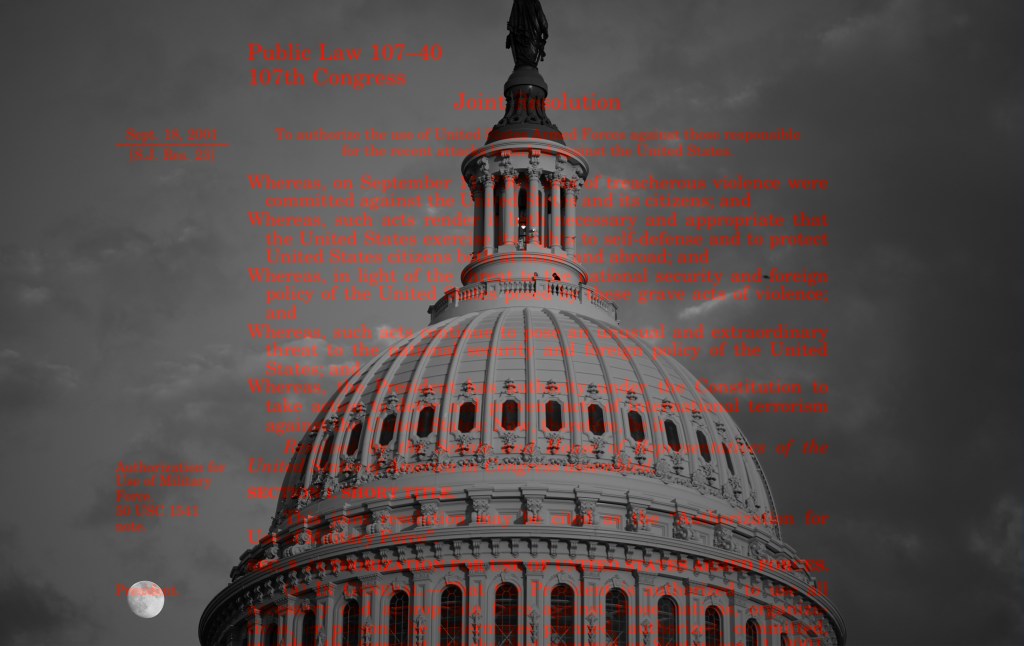
Young, a hawkish Republican who was similarly the GOP lead on this year’s repeal, noted two reasons for the slow progress of taking the 1991 and 2002 AUMFs off the books. “It’s been perceived incorrectly as applying to the War on Terror. As you know, that’s the 2001 AUMF,” Young told The Dispatch, referring to legislation Congress passed in the wake of the September 11 attacks that gave the president broad authority to fight the terrorist groups responsible—and that this year’s NDAA leaves in place. “And despite a lot of time spent on member education, it’s been difficult to persuade colleagues that repealing the 2002 AUMF would not impact the authorities provided [by the] 2001 AUMF.”
Young added, “There is among some an evident desire to look tough, to look muscular, and never be associated with anything that suggests a concern about warmaking.”
Democrats have usually voted in near unanimity for the repeal of the 2002 and 1991 resolutions, while most Republicans have opposed it, though with a significant number voting with Democrats on the issue. Opponents argued that repeal would constrain the president’s ability to respond to terror threats. An amendment to add the repeal provision to the NDAA passed in the House of Representatives 261-167, with 49 Republicans joining 212 Democrats in favor. A similar amendment passed in the Senate by a voice vote.
“Article II, Section 2 of the Constitution is crystal clear that the president of the United States is not just the chief executive. He’s the commander in chief of the military, and he needs to have enough room to maneuver,” GOP Rep. Derrick Van Orden of Wisconsin, who voted against adding the repeal provision to the NDAA, told The Dispatch. “Otherwise, we tie the president’s hands, and it emboldens our enemies.”
During an effort in 2021 to repeal the 2002 resolution, then-Senate Minority Leader Mitch McConnell argued that the law was necessary for operations targeting the Islamic State in Iraq and Syria (ISIS) terror group even with the much broader AUMF from 2001 in place. “Because ISIS and al Qaeda have sometimes diverged, legal analysts have suggested the 2001 AUMF alone may be insufficient to authorize operations against ISIS,” he said in a floor speech at the time.
But Gary Schmitt, a senior fellow at the American Enterprise Institute, said the repeal of the two resolutions in 2025 is basically inconsequential. “It doesn’t matter at all. … Practically speaking, it doesn’t make any difference,” he told The Dispatch.
President Barack Obama’s White House used the 2002 AUMF as “an alternative statutory authority basis” for its campaign against ISIS in 2014, though its primary justification was the 2001 resolution. Likewise, Trump cited the president’s Article II authority for his 2020 strike in Iraq that killed Qassem Suleimani, a top commander in Iran’s Islamic Revolutionary Guard Corps, but he also argued that the 2002 AUMF gave him the green light for the operation. President Joe Biden also invoked the 2002 AUMF, along with his Article II authority and the 2001 AUMF, for his strikes on Iranian-backed militias in Iraq.
Though this year’s NDAA does not touch the 2001 AUMF, lawmakers have tried to update it. Young and Kaine worked on one such effort during Trump’s first term in 2018, but it never got a vote. The legislation would have given the president the authority to conduct military operations against ISIS, al-Qaeda, and the Taliban, as well as groups the president designated “associated forces,” with actions taken against those new designees subject to congressional review.
Since its passage in 2001, presidents of both parties have used that resolution to justify a host of military operations not only in Iraq and Afghanistan, but also in countries such as Pakistan, Libya, Yemen, and Somalia. “You could justify anything under the 2001 AUMF, if we’re being honest,” former Rep. Peter Meijer, an Army veteran who was deployed to Iraq and served one term representing Michigan in the House, told The Dispatch.
With the administration designating certain transnational gangs and drug cartels as foreign terrorist organizations, there has been speculation that the Trump administration is using the 2001 AUMF as a legal basis for its strikes on boats suspected of carrying drugs in the Caribbean, but Kaine, who has received briefings on the matter, told The Dispatch that, while the legal rationale is classified, he could reveal that Trump was not using the law as justification. “I can tell you what’s not in it,” he said. “And the answer is, no, they’re not trying to justify it under the 2001 authorization.”
Though presidents have utilized an expansive interpretation of the 2001 AUMF, Schmitt argued that it would not make much of a difference if Congress were to repeal it, pointing to a record of presidents arguing over the past few decades that they have authority to conduct limited hostilities without congressional approval. Even without the 2001 law, “they’d still be making an argument that they had the constitutional authority to strike terrorist organizations that were a threat to the U.S.,” he said.
The question of AUMF reform brings together not just Democrats and Republicans, but also different factions of the GOP. Both hawks and doves are on record as supporting various repeals and alterations of existing AUMFs.
A bill to repeal the 2002 Iraq authorization that passed the House in 2021 garnered the support of Meijer and then-Rep. Mike Gallagher of Wisconsin—both hawks—as well as several members of the populist House Freedom Caucus. Legislation to repeal both the 1991 and 2002 AUMFs made it through the Senate in 2023 with votes from Young and then-Sen. J.D. Vance, the latter of whom has been critical of America having a large footprint on the world stage.
However, most GOP hawks generally aren’t in favor of making changes to the authorizations on the books. “To me, the risk of a repeat of 9/11 could occur any day, anytime, anywhere, and we need to be ever vigilant,” Rep. Joe Wilson of South Carolina, who voted against adding the AUMF repeal to the NDAA, told The Dispatch.
Nevertheless, the 1991 and 2002 authorizations are set to be repealed. Plus, Kaine and Young both called for revisiting the 2001 authorization. Populist Republican Sen. Josh Hawley of Missouri also expressed a willingness to take another look at it. “I’d be open to that,” Hawley told The Dispatch.
For Young, AUMF reform reflects a shared interest among hawks and doves in ensuring Congress exercises its constitutional authority, so that presidents do not engage the country in conflict without the support of its voters.
“I think people can support responsible governance for different reasons,” he told The Dispatch. “I think if you’re a ‘peace through strength’ selective interventionist, you want to make sure that you’re choosing your military engagements wisely and prudently. Obviously, if you’re a restrainer or a noninterventionist, then you’re maybe appealing to a different group.
“But I think all of us believe in the Constitution and that there’s a fundamental role for Congress, not just to declare war, but to unwind conflicts as well, and to make sure through oversight that no administration has the ability to make war without bringing the American people along with them.”