Authored by Allan Stein via The Epoch Times (emphasis ours),
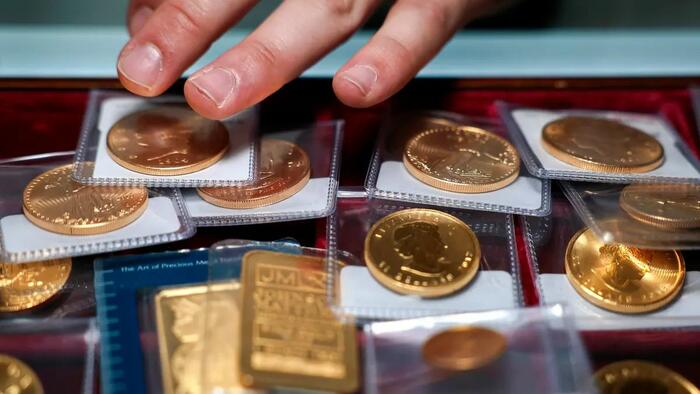
SHOW LOW, Ariz.—The coin shop owner had seen his share of hefty deals, but this call caught him off guard. An elderly man from nearby Snowflake, Arizona, wanted to purchase gold coins valued in the tens of thousands.

The next day, when the man walked into the shop in Show Low, his nervousness was obvious. The man was clutching his phone, hanging onto every word from a woman’s voice that seemed to be directing him.
“Before we sat down and talked about price or product or anything, he had a $180,000 cashier’s check already made out,” the shop owner, who requested to remain anonymous, told The Epoch Times. “I thought it was kind of strange.”
The man stumbled over basic questions, anxious to speed through the sale.
The shop owner’s unease grew—was this elderly customer being manipulated by a scammer?
Taking care not to alert the woman on the line, he discreetly slipped the man a note asking if he needed help. Certain now that something was amiss, he reached out to the police.
The FBI and other agencies quickly took on the case. Two weeks later, they arrested a suspect and uncovered a complex scheme that had already stolen $100,000 in gold coins from the 79-year-old man.
This was far from an isolated case. Since May 2023, the FBI Internet Crime Complaint Center has reported a surge in these scams. In September, an FBI warning estimated that losses from the scams now total more than $186 million.
Known as the “Gold Bar” government impersonation scam, the scheme draws in unsuspecting elderly, retirement age, and vulnerable people.
The scam often begins with people pretending to be U.S. government workers or law enforcement officers, according to the Ohio Department of Commerce. In January, local media said an 89-year-old woman from Sylvania, Ohio, lost more than $1 million in a similar scheme.
A letter in the mail, an email, or a phone call informs the victim their identity has been stolen and their bank or investment accounts are in danger.
Then, the victim may be told the agency can protect their money for a short time if they act fast.
The scammers then convince the person to buy gold, silver, or other valuable metals and arrange for a courier to pick them up, claiming it will keep them safe from theft.
Scammers warn victims not to talk to their bank or anyone else about what is happening and are threatened with legal trouble if they do.
A single scheme might utilize several scammers to manipulate a victim; each playing a different role, such as an employee at a tech company,a bank representative, or a government worker.
In some cases, such as that involving the man from Snowflake, victims may be asked for funds to avoid criminal charges or prove good faith.
“Basically, this is a very common scam,” as cunning as it is cruel, Snowflake-Taylor Police Detective Amity Toth, a lead investigator in the case, told The Epoch Times.
Toth said victims often go along with the scam out of fear of arrest on a false accusation or because they lack knowledge of the law.

‘Significant National Problem’
In this case, the man from Snowflake told investigators a woman with a foreign accent called him in October, identifying herself as Holly O’Brien, a U.S. Marshal.
She told him that someone had stolen his identity and used it to rent a car, which was later left in El Paso, Texas.
The caller then claimed police had found illegal drugs and blood in the driver’s seat of the car. She warned the man that he would be charged with a crime unless he could prove his identity by sharing details about his possessions.
He did as she asked. He then agreed to hand over $100,000 in gold coins from his private collection to a courier on Oct. 27.
But the scammer wasn’t yet satisfied, Toth said.
The man was instructed to withdraw $180,000 from his bank and buy more gold coins, all to be picked up by a courier on Nov. 14.
“I think that they would have stopped at nothing. They would have ruined him,“ Toth said. ”They would have found some other way to continue” to extort money from the victim.
The scams are “a significant national problem,” said Toth, who has been investigating fraud cases for more than a decade.
Cash-for-gold scammers often choose their victims at random, she said.
“They cast a wide net. Basically, this is just a cold call situation,” Toth said. “They create a sense of urgency.”
“Most people hang up or don’t answer, but one out of a thousand people believes them,” she said.
Just as in the Show Low case, victims are told to turn their assets into cash or buy gold, silver, or other valuable metals for safe keeping.
“Unfortunately, victims never hear from the scammers again and end up losing all their money,” the Ohio Department of Commerce said.

Brought to Justice
At least four people have been convicted for similar crimes this year.
In June, an Indian national living in the United States on a student visa pleaded guilty in a case in which elderly victims lose hundreds of thousands of dollars in cash and gold, according to a release from the U.S. Attorney’s Office for the Western District of Texas.
Dhruv Rajeshbhai Mangukiya, 21, was sentenced in a federal court in Austin to more than eight years in prison, after pleading guilty to conspiracy to commit money laundering. He was ordered to pay more than $2.5 million in restitution.
Kishan Rajeshkumar Patel, 20, conspired with Mangukiya and others in the multi-million dollar 2024 scheme, according to the Department of Justice. He pleaded guilty and was sentenced to more than five years in prison.
The group sent fake online messages and impersonated U.S. government officials, while Patel collected cash and gold from victims, passed some to others in the group, and kept some for himself.
In November, two Southern California men pleaded guilty to scamming a Carlsbad, California, woman out of almost $1.5 million over a period of months.
The men, Xilin Sun, 35, and Alexander Charles James, 21, posed as government, bank, and tech support personnel, according to the U.S. Attorney’s Office for the Southern District of California.
The scheme started with a pop-up message warning the victim her computer had been hacked.
The men then convinced the victim that she could safeguard funds by sending them to a supposed U.S. Treasury locker. A sting operation cut short the final payment of $100,000 in gold bars, and led to the arrest of the fraudsters.
In their plea agreements, Sun and James admitted to participating in an organization that operated technical support, bank impersonation, and government impersonation scams targeting victims across the United States, according to the release. They will be sentenced in February 2026.

Capitalizing on Fear
Toth said that in the Show Low case, the scam caller, who identified herself as a U.S. Marshal, used an official tone and made the victim fearful and anxious.
She persuaded him to give her important details, including his name, date of birth, Social Security number, and a list of his financial assets.
“I sat with the victim multiple times when he was on the phone with her,” Toth said. “She would talk to him, and it was pretty noisy in the background. So, my assumption is that she works at a call center. The likelihood of the call center being in the United States is slim to none.”
Toth said the owner of the Show Low coin shop was able to delay the second installment of gold coins for two weeks. This gave authorities extra time to gather evidence and prepare to catch the courier who was expected to pick up the gold coins.
On Nov. 14, authorities in Navajo County arrested Ankit Sahoo, 27, of New Jersey, near the victim’s home in Snowflake, as he tried to leave in an SUV. Sahoo tried to flee the scene and was arrested before the victim could deliver the payment in 43 Australian one ounce gold coins.
Investigators found that Sahoo was in the country on an expired student visa from India and had been flown from St. Louis to Phoenix to collect the money.
“He flew in that night. He rented the car just after midnight that day and was supposed to return the vehicle that night. I’m sure he was going to be flying back to wherever it was” he was from, Toth said.
Sahoo is being held on $400,000 bond; he pleaded not guilty on Dec. 4. The Epoch Times contacted Sahoo’s attorney for comment but did not receive a response.
But the victim’s $100,000 in gold coins is gone for good, Toth said.
“They’re extorting people in different ways. They don’t use receipt numbers. These are hand-to-hand transactions, so it’s almost impossible to trace,” she said.
Read the rest here…
Loading recommendations…