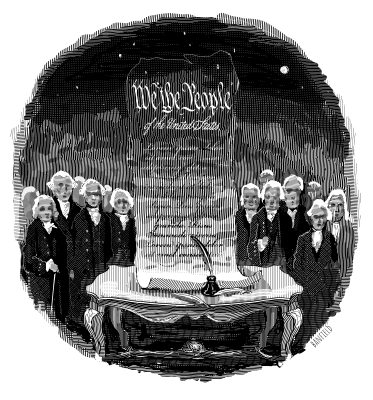
America’s battle over its history, what really happened and what it means, is the most important front in the culture wars that have raged since the 1960s. The central dispute is whether the nation is best understood as a mere artifact of oppression—including especially the original sin of slavery—or, in the words of historian Wilfred M. McClay, a land of hope, one of the great enterprises of human history.
Harvard historian Jill Lepore now joins the battle with We the People. Despite claims to be a history of the U.S. Constitution, its real purpose is to establish the centrality of what Lepore calls “the philosophy of amendment,” which is both “foundational to modern constitutionalism” and the “mechanism for the prevention of insurrection.” She asserts that “amendability” is American constitutionalism’s vital principle, and we the people have been derelict by failing to act on it.
***
Instead of using the formal procedure set out in Article V, we have been satisfied with workarounds. For example, both liberals and conservatives, she claims, seek constitutional change through the judiciary. Lepore argues that “informal amendment happens all the time, but formal amendment happens hardly ever.” The Constitution changes “by judicial decisions, by the enactment of new state and federal laws, by the application of new meanings to old laws, and by popular protest.” This formulation blurs the distinction between the Constitution and constitutional interpretation, a confusion that pervades the book.
Quoting the English jurist Matthew Hale, Lepore notes that laws “are subject to corruption and putrefaction, to diseases and rust.” And the U.S. Constitution, flawed from the beginning, is particularly putrid insofar as it maintains its legacy of exclusion by failing to incorporate a host of formal progressive amendments. Having made clear which side of the history battle she is on, Lepore brings to the fight a list of things that might have been—had we not lost our will to amend.
Adopting Woodrow Wilson’s caricature of the Constitution as Newtonian rather than Darwinian, Lepore says the framers “intended the Constitution as an orrery, a mechanical apparatus that modeled every motion, anticipated each force, and followed known rules.” But it was also a machine meant to be repaired on a regular basis, the amendment mechanism being “a lever to pull, to grind the machine to a halt.” On this peculiarly ahistorical account, mechanics are needed more than statesmen, and will more than deliberation.
***
The important thing Lepore gets right is that Americans once had a “commitment to amendment as both an idea and a practice.” This is evidenced not only by her accounts of the drafting and ratification debates, but by her detailed listing of the many state constitutional conventions in the 19th and 20th centuries, and even conventions held by “the Cherokee Nation, the Choctaw Nation, and the Seneca Nation.” In addition, she catalogs various social movements for constitutional change, spearheaded by women, blacks, Indians, and others. Successful formal amendments “produced a sense that the Constitution was ripe for still more changes, driving public interest in the possibility of constitutional revision.” The Progressive era culminated in four constitutional amendments: establishing the federal income tax, mandating the direct election of United States senators, prohibiting the manufacture and sale of alcoholic beverages, and guaranteeing women the right to vote.
Alas, by the late 20th century, the Constitution “was no longer amendable.” Instead, progressives made landmark legislative and judicial gains with respect to civil rights, women’s liberation, marriage equality, reproductive rights, and the environment. Lepore approves, while denouncing the reality that the importance of these gains “was matched only by their reversibility.” She concludes her long book with lamentations that the forests have disappeared, the seas have risen, wildlife habitats have diminished, the climate has changed…and yet our Constitution pays no mind. “[I]t is clear that no change to fundamental law about the relationship between humans and the natural world can happen without a restoration of the philosophy of amendment.”
Lepore’s central point about the importance of formal amendment frequently gets lost in a morass of historical detail entwined with progressive ideological commitments. We the People is largely a list of grievances paired with a dizzying catalog of petitions, proposals, and promises for amendment that went nowhere. She claims that the book “is a history of American constitutionalism as told through a collection of stories about constitutional change.” Unfortunately, her storytelling just doesn’t work. In some places, the book reads like a PBS documentary rather than a serious constitutional history. In others, it reads like a data dump from the Harvard-supported “Amendments Project,” which Lepore directs. Straightforward points are alternately belabored or muddled. The morass of detail appears calculated to suggest that everything about the Constitution has always been in flux—and always should be. This message follows naturally from Lepore’s premise—that the Constitution’s core principle is amendability, rather than natural rights or principled limits on national power.
***
Lepore deplores that none of the framers was female, and that “Sally Hemings did not consent to the U.S. Constitution; whether she consented to Jefferson is unknown.” Also unknown is whether there was in fact any sexual relationship between Miss Hemings and Mr. Jefferson—the kind of known unknown that a more careful historian would acknowledge. But Lepore is so intent on maintaining that the “rule of men over women is written into American constitutionalism” that she equates the framers with rapists. “Political consent was akin to sexual consent,” and the framers had no answer to what amounted to female slavery. “Women were no more than pigs and sheep, insects and beasts.” As Huck Finn might say, that’s a stretcher.
On the slavery question she maintains that the Constitution was stamped from the beginning with evils that only amendment could cure. Yet on her own account of the Constitutional Convention’s records, only South Carolina’s Charles Pinckney came close to arguing for slavery as a positive good. It might therefore be worth a historian’s time to consider whether the Constitution and its framers were opposed to slavery in principle, while being unable to eliminate it in practice. But she does not do so.
Even the Civil War gets shoehorned into her philosophy of amendment, being “fundamentally a war over the nature of constitutional change.” Why then did Abraham Lincoln think, at least prior to the Civil War, that the Constitution needed to be understood and followed rather than amended? Instead of considering such matters, Lepore quotes Thurgood Marshall: “While the Union survived the Civil War, the Constitution did not.” And she claims, rather extravagantly, that the 14th Amendment “founded the United States anew.”
Lepore thinks one of the things that has sapped our will to amend is constitutional originalism. She denies that originalism can be an honest attempt to arrive at constitutional meaning, which is eternally evanescent. Instead, she insists “originalism is a method of constitutional change; it provides a path to change by way of a new method of constitutional interpretation. That method is not original.” Originalists would demur—but their arguments are never considered on their own terms. For example, she dismisses Justice Antonin Scalia’s originalism as “born out of his frustration over social conservatives’ inability to amend the Constitution by Article V, and liberals’ success at doing so by judicial interpretation.” Her sloppy reductionism leads her to insist that Scalia’s originalism “has everything to do with abortion, and everything else to do with guns.”
***
She simultaneously claims that originalism “defies the philosophy of amendment.” In reality, however, it only provides a barrier to informal amendment by the judiciary, and even then, informal amendment in a progressive direction. One might think that originalism therefore incentivizes formal amendment. Yet Lepore seems to deplore originalism at least as much as she favors Article V. Why so, in a book that claims to favor “we the people” flexing our amendment muscles once again? Her answer is that we should only flex them in a way that favors amendments that push progressive understandings of political inclusion. And if we can’t effectively flex our muscles that way, it’s better to leave existing informal progressive amendments alone, and not stand in the way of new ones. It turns out this “philosophy of amendment” is really a philosophy of history.
In arguing that originalism was unknown before 1980, and especially before Robert Bork’s nomination to the Supreme Court in 1987, Lepore makes a claim echoed by many progressive thinkers. Unfortunately, it’s categorically false. Originalism as a principle of legal interpretation has been known for centuries in the common-law world. For example, William Blackstone, in his 18th-century Commentaries on the Laws of England, notes that the “fairest and most rational method to interpret the will of the legislator is by exploring his intentions at the time when the law was made, by signs the most natural and probable. And these signs are either the words, the context, the subject matter, the effects and consequence, or the spirit and reason of the law.” Blackstone did not feel the need to name this mode of interpretation. He simply described what proper legal interpretation was, i.e., what judges do when reading legal documents. And he presciently warned against considering “all cases in an equitable light…lest thereby we destroy all law…. And law, without equity, though hard and disagreeable, is much more desirable for the public good, than equity without law, which would make every judge a legislator.” This is common-law originalism, which the framers understood themselves to be importing from England.
***
Lepore seems bewildered by the fact that the right-to-life movement expressed concern about judicial overreach in the wake of Roe v. Wade (1973), and proposed formal amendments to overturn it, while expressing no such concern in the wake of Dobbs v. Jackson Women’s Health Organization (2022). “One’s commitment to Article V, it seems, depends on whether one agrees or disagrees with the Court’s decisions.” But there is no cause for bewilderment, much less the implicit attribution of hypocrisy, if one simply recognizes Roe was wrongly decided, and obviously so.
But very little is obvious to Lepore when it comes to constitutional meaning. There is either no original meaning to restore or, if there is, it should be deplored. Her real beef with originalism seems linked to the observation of Progressive-era historian Charles Beard, whom she quotes: “This crowned Constitution with its halo has been the bulwark of every great national sin.” Furthermore, the “cult of constitutional certitude” stands in the way of seeing the Constitution as a living document that demands continuous growth and change.
One thing for which Lepore does not criticize Jefferson is his remark that the earth belongs to the living, and a new constitutional convention is called for once every generation. Noting James Madison’s confidence that Article V was a sufficient answer to the problem of binding future generations, Lepore says the “weight of history has fallen on Jefferson’s side.” But has it? If Lepore’s wish list is our guide, we can be thankful for Madison’s relative caution. The trick, of course, is to balance the dangers of mutability against the necessary correction of faults that are revealed in time, as Madison himself noted in The Federalist.
But the formal amendments Lepore favors are so voluminous that, had they been ratified or even seriously pursued, they would have rendered written constitutionalism nugatory, for reasons already explained by Madison. He warned that frequent appeals to the people would “deprive the government of that veneration which time bestows on everything, and without which perhaps the wisest and freest governments would not possess the requisite stability.” Furthermore, notwithstanding “the success which has attended the revisions of our established forms of government…it must be confessed that the experiments are of too ticklish a nature to be unnecessarily multiplied.”
Madison’s sober realism compares favorably to another of Lepore’s assertions: “The Constitution of the United States rests on three eighteenth-century beliefs: that a constitution is a machine, that the human mind is driven by reason, and that history moves in the direction of progress.” There are far better candidates for the things on which the Constitution rests, starting with the laws of Nature and Nature’s God.
***
We might well be at the point at which formal constitutional amendment is again necessary. But if we are, it’s for none of the reasons Lepore suggests. Scholars of political science have long observed that all three branches of government have shifted from their constitutional foundations. Members of the legislative branch now behave more like ombudsmen than legislators, helping constituents navigate the perilous and perplexing waters of the administrative state. The executive branch has become largely rhetorical, divorced from a sense of constitutional obligation and limitation. The judiciary invents new rights as it countenances new government powers. Meanwhile, it is the headless fourth branch, the administrative state, that actually governs us without our consent as each of the constitutional branches appears feckless in the face of the administrative state’s scope and seeming permanence. A bold assertion of popular sovereignty through a convention of the states might be the only long-term remedy for the serious institutional corruption that has undermined the original principles and purposes of the framers’ Constitution. Whether such a course of action could work, or at least help us tone atrophied republican muscles, is an argument worth having. But it’s not the one Lepore desires or pursues.
This points to the largest problem with We the People’s analytical framework. Constitutional amendment is best understood not as a “philosophy” but a mechanism designed to effect the preservation of natural rights, including consent of the governed. If time and circumstance reveal deficiencies in institutional design, the people have recourse to a variety of mechanisms of correction, including, but not limited to, Article V. Aside from highlighting the abandonment of the practice of formal amendment, Jill Lepore’s book is mere sound and fury, signifying nothing but progressive preferences.