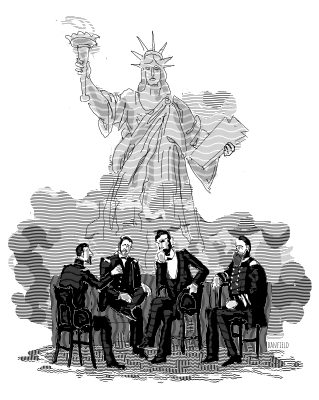
As fighting in the Civil War was winding down in March 1865, Abraham Lincoln sojourned in Virginia for two weeks, ostensibly to relax, but as Michael Vorenberg reveals in his highly readable, deeply researched new book, Lincoln’s Peace, the president’s real goal was to shape the peace settlement that would end the bloodshed. Lincoln met with his top military leaders: General Ulysses S. Grant, Admiral David D. Porter, and General William T. Sherman, with Porter, who served as host aboard the steamboat River Queen during those momentous days, later recalling that the president “had made up his mind that this fraternal strife should cease in one way or another.”
Two months earlier, Lincoln had sailed to nearby Hampton Roads, Virginia to discuss peace terms with Confederate officials, much to the consternation of some Republicans in Congress, who feared he might allow Confederate leaders to retain power and restore white supremacy even if chattel slavery were officially abolished. In response, Lincoln vowed to one lawmaker, “I shall never compromise the principles upon which I was elected.” Around that same time, he put