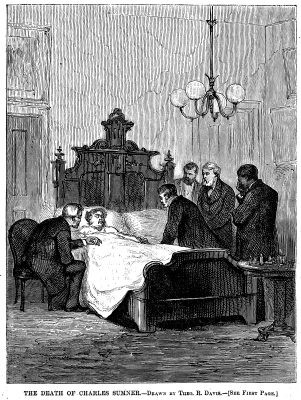
In the early hours of March 11, 1874, word spread around Washington that Charles Sumner was on the brink of death. The 63-year-old senator from Massachusetts had suffered a massive heart attack the previous evening. By 9 a.m., a crowd of several hundred had gathered in front of his home on Lafayette Square. “Colored men and women mingled with white in knots about his home,” wrote The New-York Tribune. Government workers, merchants, shopmen, waiters, and even “old colored women with baskets and bundles on their arms” stood together. Many were crying and begging to be let inside. They were stopped by one of Sumner’s friends and two policemen standing guard at the front door.
In his remarkable book, Charles Sumner: Conscience of a Nation, Zaakir Tameez, a scholar of antitrust and constitutional law, describes the events inside: “By 10 a.m., Sumner was awake but high on morphine and only half in his senses. He tried to pull himself together and get out of bed, insisting that he must get dressed and go to the Senate right away.” But he was unable. Plopping his head onto the arm of Arnold Johnson, his secretary, he gave up. “Don’t let the bill be lost,” Sumner whispered to Johnson. Johnson assured the senator that all the household bills were in order and paid in full. With his eyes a foggy glaze, Sumner exclaimed, “You mistake.” Turning to Congressman Ebenezer Hoar, who was standing nearby, Sumner said, “My bill!—don’t let it fail.” Then, to clarify, “The Civil Rights Bill. Don’t let it fail!”
Frederick Douglass soon arrived to visit his old friend. “Trembling with shock and heavy grief in the upstairs hallway,” Tameez narrates, “he could hear Sumner whimper, ‘the bill, the bill, the bill,’ over and over in his morphine-induced haze.” In the early afternoon, “the library was packed with members of Congress.” Sumner again implored Hoar: “Don’t let the Bill fail. I mean the Civil Rights Bill. Take care of the Civil Rights Bill.” Hoar “broke down as he listened to Sumner’s pleading, sobbing like a child while kissing Sumner’s hand.”
***
When Sumner’s final struggle began, somebody went to the library to announce that “the longest-serving senator in the United States at that time, was spending his final moments advocating for civil rights.” Arnold Johnson recalled that “there were no dry eyes in that room.” By 2:47 p.m., he was gone. His last words to Hoar were “tell Emerson that I love him and revere him.” Hoar remembered how the poet had described Sumner after he’d been brutally caned on the floor of the U.S. Senate by South Carolina Democratic representative Preston Brooks. Hoar replied to Sumner, “I will tell Emerson that you love him and revere him, for he said to me that you have the largest soul of any man alive.”
Two days after his death, the carriage carrying Sumner’s casket was escorted down Pennsylvania Avenue by a congressional delegation, along with Douglass and 300 other black men. There, his casket was laid in state in the Capitol Rotunda, as 10,000 people waited patiently to view it. “By some estimates,” Tameez writes,
nearly half the mourners were African American, and many were children. All colored schools in Washington had closed for the day to pay homage to Sumner. These thousands of Black mourners packed the corridors, stairwells, porticoes, and hallways of the Capitol to the very brim, as if to claim Sumner and America’s temple of democracy as their own.
Sumner’s coffin was taken to the Boston State House, where it again lay in state, guarded by black veterans of the Civil War. At his final resting place in Mount Auburn Cemetery in Cambridge, the “most impactful tribute, seen by thousands of mourners and featured in a famous drawing in Harper’s Weekly, was an immense floral shield laid near the casket.” On a background of white carnations was carefully placed a series of blue violets that spelled out:
DO NOT
LET THE
CIVIL RIGHTS
BILL FAIL
That civil rights bill had been drafted in 1870 by Sumner and John Mercer Langston. In 1868, Langston, a black attorney, had become the first dean of the Howard University Law School, then a new institution chartered by Congress. “Like Sumner,” Tameez relates, “Langston didn’t think the problems faced by Black Americans could be remedied solely by the passage of time, moral persuasion, and simple acts of charity. There had to be changes in law.”
Their four-page bill declared that “all citizens of the United States, without distinction of race, color, or previous condition of servitude,” were entitled to “the full and equal benefit of all laws and proceedings for the security of person and property as is enjoyed by white citizens.” In addition to the civil rights it identified, Tameez notes the enforcement measures it included:
The bill specified criminal and civil penalties for those denied equal access. Federal courts would have jurisdiction over civil rights cases; federal officers were made personally liable if they failed to prosecute cases; racial discrimination in jury selection was prohibited; any corporation convicted under the act would have its charter revoked; and any discriminatory law that used the word “white” was repealed.
***
Tameez relates in detail the several-year struggle by Sumner to have his bill enacted into law. Predictably, it met with resistance from racist Democrats, but it also was opposed by some Republicans who questioned its constitutionality. This was because the bill regulated “private” actors, rather than state governments. Was such a measure authorized by power delegated to Congress in section 5 of the 14th Amendment, which had been added to the Constitution in 1868? Some Republicans also had their doubts about the wisdom of the racial integration in public spaces that was mandated by the bill.
In tribute to Sumner, upon his death, the Senate voted its approval of the bill, but the House failed to act. Finally, in February 1875, the House passed a stripped-down version of Sumner’s bill that omitted key enforcement measures and some of its specified rights, in particular, removing schools from the list of public institutions that were barred from discrimination. This despite the fact that, during the five years of congressional debate and votes on the bill, the schools provision had consistently enjoyed majority support in both houses.
As the electorate’s enthusiasm for Reconstruction cooled, so too did that of Republicans who were ready to move on to other issues. In 1883, the Supreme Court, now composed entirely of justices nominated by Republican presidents, considered the constitutionality of the 1875 Act. In an opinion authored by Joseph Bradley, the Court held 8-1 that the Act was unconstitutional because it went beyond regulating “state action” to reach private actors. That decision is still considered good law today.
In our book, The Original Meaning of the Fourteenth Amendment: Its Letter and Spirit (2021), Evan Bernick and I explain why The Civil Rights Cases (1883) were wrongly decided. Though the 14th Amendment’s Privileges or Immunities and Due Process clauses govern state action, the Equal Protection Clause applies as well to state inaction. It recognizes a positive duty on the part of the states to provide the equal protection of their laws.
On this reading, a failure of states to enforce pre-existing common-law duties of nondiscrimination with respect to public inns and common carriers would justify Congress to exercise its enforcement power to fill the gap with a federal remedy. That is precisely what Sumner’s original bill, and eventually the Civil Rights Act of 1875, had done. Our opinion represents the majority view of the Reconstruction Republicans who enacted the bill but remains a minority position among today’s conservative originalists both on and off the bench.
The nondiscrimination provisions of the 1875 Act that were invalidated by the Supreme Court in 1883 closely resembled those of the 1964 Civil Rights Act. It was the federal enforcement of this act—far more than Brown v. Board of Education (1954)—that broke the back of the Jim Crow regime of racial apartheid in the South, and the pervasive racial discrimination in the North. The “precedent” of The Civil Rights Cases, however, stood in the way. So, Congress instead invoked its power to regulate commerce “among the several states” rather than the 14th Amendment’s now-defunct Privileges or Immunities Clause. Ever since, the moral authority of the 1964 Civil Rights Act has been used to justify the expansion of Congress’s commerce power far beyond civil rights.
***
Why start this review of Sumner’s life with its ending? Because, if Sumner’s vision of racial equality had only been shared by more when he lived, American history would have been radically altered for the better. Black Americans would have been spared the painful legacy of 90 years of Jim Crow. And all Americans might have been spared the expansion of federal power over the affairs of the nation. Sumner’s story shows just how close we came to this happier timeline. Instead, not only was the Civil Rights Act of 1875 “nullified” by the Supreme Court, but the memory of Sumner’s life has been unjustly tainted by the opinions of historians.
In his Pulitzer Prize-winning study, Charles Sumner and the Coming of the Civil War (1960), David Herbert Donald dealt almost exclusively with “trying to explain the motives underlying Sumner’s actions.” But the picture he paints is decidedly negative. In a preface to the 1989 edition of his book, Donald justified his treatment: “It is probably true, as one critic has charged, that I have quoted more derogatory comments about Sumner than I have admiring tributes from his contemporaries. In part this is because the most glowing praise was offered only after Sumner was safely dead, and its sincerity is suspect.” Donald continued:
It is also true that Sumner’s critics were generally more interesting than his admirers. If a biographer, with limited space, has to choose between Carl Schurz’s praise of Sumner’s “moral courage” and the “sincerity of his convictions,” and Henry Adams’s remark that Sumner’s mind “had reached the calm of water which receives and reflects images without absorbing them; it contains nothing but itself,” can there be any doubt as to which he will include?
This speaks more to Donald’s limitations as a biographer than to how biographers should approach their subjects. As Donald himself later admitted, “I wish I had been better able to portray Sumner as his best friends and admirers saw him: amiable, pure, earnest, and affectionate. I wish, too, that I had written more fully about Sumner’s relationships with some of the leading New England thinkers of his day.” In short, Donald wished he had written a book more like Zaakir Tameez’s.
***
Much of the personal criticism of Sumner follows the Dunning school of history, which dominated late 19th- and early 20th-century scholarship on Reconstruction. Named for Columbia University historian William Archibald Dunning, the school portrayed Reconstruction as a tragic era of Northern vindictiveness, corrupt government, and black political incapacity—framing Radical Republicans like Sumner as fanatics whose egalitarian ideals were both naïve and destructive. Within that interpretive framework, Sumner’s steadfast advocacy for civil rights became a liability, and he was cast as an emotional extremist rather than a principled statesman.
Sadly, many conservatives and libertarians still hold this opinion, both of Reconstruction and of Sumner—to the extent they remember Sumner at all. It fell to leftist scholars in the 1970s like Eric Foner, and more recently to Sean Wilentz and James Oakes, to redeem the reputation of these Republicans who should be treated as farsighted heroes rather than villains.
When I began my own deep dive into antislavery constitutionalism, after reading Donald’s dismissive treatment of Sumner, I shifted my attention to others, such as Salmon P. Chase, who preceded Sumner in the Senate by two years. Both were members of the anti-slavery Free Soil Party, who had been sent to the Senate as a result of deals to throw control of their state legislatures to the Democrats. Both became fast allies in D.C.
Like Donald, Chase’s principal biographer, John Niven, was largely negative about his subject in Salmon P. Chase: A Biography (1995). Just as Donald had done with Sumner, Niven accepted and perpetuated the least favorable accounts of Chase’s character flaws. Donald and Niven were both historians who’d been shaped by biographical traditions that emphasized personality as the key to political action. So, they highlighted the character flaws of Sumner and Chase—traits amply documented in the record—while giving less weight to their consistent, principled commitments to the antislavery cause and to equal rights. Readers are left with portraits in which personal defects overshadowed the moral vision that animated their careers.
***
Neither biographer bothered to report, much less evaluate, either man’s constitutional views. Both Chase and Sumner were fine lawyers and constitutional thinkers. After graduating from Dartmouth, Chase read for the bar with William Wirt, who had been U.S. attorney general. Sumner was a prized student of Joseph Story at Harvard Law School, to whom Sumner became very close. Indeed, Story had groomed Sumner to be his successor at Harvard. An intemperate anti-war Fourth of July speech by Sumner at the Tremont Temple in Boston doomed that candidacy, which so far as history is concerned, was for the best.
In contrast, both Niven and Donald were historians unsuited to evaluating the constitutional arguments that defined their subjects’ careers. So they ignored them. Niven’s injustice to Chase was corrected by Walter Stahr in his book Salmon P. Chase: Lincoln’s Vital Rival (2022) (see “An Indispensable Abolitionist,” Fall 2022).
Now, Sumner has the biographer he deserves in Tameez. In contrast with Niven and Donald, both Stahr and Tameez are lawyers—Harvard and Yale graduates, respectively—who bring their legal expertise to bear in fairly reporting the constitutional views shared by both Chase and Sumner. “Sumner was one of the most innovative, famous, progressive, and influential constitutional thinkers of his day,” Tameez writes. “But his constitutional ideas have been neglected by historians and legal scholars, to the detriment of scholarship on the Second Founding.”
Also to the detriment of originalism:
Critics would claim that Sumner’s liberty-promoting vision of the Constitution was naïve idealism rather than hard-nosed law. But Sumner was serious about legal analysis. In modern terms, he might be called something akin to an originalist: a jurist who applies the Constitution as understood by those who drafted and ratified it. “I may seem to stand alone” he declared, “but all the Fathers of the Republic, are with me.”
In characterizing Sumner as an originalist, Tameez is not wrong. Constitutional originalists would benefit greatly from this book.
***
Stahr’s and Tameez’s legal training has made all the difference in these biographies. It might also help that neither is a tenured academic. Both books are written in the old school “grand narrative” style. Both works can also be said to be examples of “great man” historiography, which has fallen out of favor among academic historians. And, unlike increasing numbers of historians, Tameez meticulously supports every claim in his endnotes, a characteristic of legal scholarship.
Tameez’s grand narrative is particularly comprehensive. The book is so long—533 pages plus endnotes—because of his detailed description, not only of Sumner’s rich and colorful life, but also of the epochal events he lived through. Born in 1811, Sumner’s time spanned the tumultuous periods leading up to, during, and following the Civil War. The book is also a Who’s Who of mid-19th-century America, including the many black Americans, such as John Langston and Frederick Douglass, with whom Sumner interacted extensively. This provides a nice window on the efforts of blacks to advocate and agitate for themselves.
Sumner stood firm for civil rights and racial equality, as others around him wavered and retreated. This made him the bane of Republicans as well as Democrats. Tameez is unstinting in his critical evaluation of Sumner’s personality, and candid about how his character flaws drove potential allies away from him, limiting his effectiveness as a legislator. This is no hagiography. And Tameez is likewise balanced in his assessments of the many other historical figures with whom Sumner interacted and combatted—in particular Abraham Lincoln.
Lincoln devotées often give him too much credit for antislavery views he adopted from others, and too little blame for his indecisiveness, as well as for his persistent skepticism about a multi-racial republic. Lincoln gets a balanced treatment from Tameez. To be ardently anti-slavery, as Lincoln surely was, did not always entail being liberal on race. Still, for the sake of our constitutional narrative, it is good for people to be informed that important historical figures like Sumner and Chase were admirable on both counts. For this reason, they were condemned in their time and afterwards as “n-gger lovers.” In this regard, Sumner was deeply influenced by having grown up in a predominantly black Boston neighborhood.
***
Although Tameez is a political progressive, his book is remarkably free of any ideological cant. Indeed, in the entirety of the book, I noticed just two false steps. The first concerns his treatment of Sumner’s speech on the Fugitive Slave Act of 1850. In his speech, Sumner “claimed that the [Fugitive Slave] clause, because it did not use the word slavery, applied only to escaping” indentured servants.
This interpretation had first been devised by Lysander Spooner in his 1845 book, The Unconstitutionality of Slavery, which went through several printings and editions. Tameez not only fails to credit Spooner as the originator of this argument but, on the very next page, Tameez says that Sumner “did not adopt arguments that he deemed too farfetched, such as those made by Lysander Spooner.”
Then, Tameez fails to attribute another of Sumner’s constitutional objections to Salmon Chase. Like Chase, Sumner contended that Congress lacked an enumerated power to enforce the Fugitive Slave Clause in Article IV. Chase first devised this argument in 1937 for his courtroom defense of the runaway slave Matilda, which was published as a widely distributed pamphlet. (To his credit, throughout the book, Tameez generally gives Chase his due.)
The second misstep is a passing statement by Tameez uncritically accepting the claim that “Thomas Jefferson had a sexual relationship with Sally Hemings, an enslaved woman, for nearly four decades after his dying wife made him swear not to remarry. Jefferson even had children with Hemings, whom he kept enslaved.” This claim may be true, but Tameez fails to mention the limitations of the DNA studies that have been offered in its defense. He instead upholds Jefferson as an example of the sexual practices of many Southern slaveholders, including the father of the runaway Matilda.
***
This larger point about Southern slaveholders is well-taken—and commented on by Sumner himself. Sumner was vocally critical of the hypocrisy of slaveholders who loved to attribute to opponents of slavery, and to Sumner in particular, a lust for black women, when it was they who raped their enslaved women. Sumner leveled this and many other charges against the character of slaveholders—just as Southern senators had offered unsubtle innuendos about Sumner’s own sexuality during floor debates.
In 1856, these affronts to Southern “honor” culminated in Preston Brooks’s brutal caning of Sumner on the floor of the Senate after a session had ended and the chamber was mostly empty. Sumner was seated at his desk signing copies of his speech, “The Crime Against Kansas,” when Brooks attacked him. Because his desk was bolted to the floor, Sumner was unable to stand and defend himself from blows to his head, spine, shoulders, and arms. His legs were also injured when he finally wrenched the desk off the floor in his effort to stand. Brooks was hailed as a hero by Democrats, many of whom sent him canes to replace the one that broke during the vicious attack.
Sumner was so badly wounded that he very nearly died and was unable to return to the Senate for a long period. For the rest of his life, he suffered debilitating headaches and other bodily pains, and he walked with a limp. Tameez relates the grisly details of the attack and of Sumner’s long subsequent suffering, including his fruitless search for competent medical treatment.
Sadly, the attacks on Charles Sumner’s character have continued long after his death. Zaakir Tameez’s biography should help restore Sumner to the exalted stature he’d achieved in his life among black Americans and antislavery activists alike. And by giving credit where credit is due, help to counteract the modern tendency to belittle our forefathers.