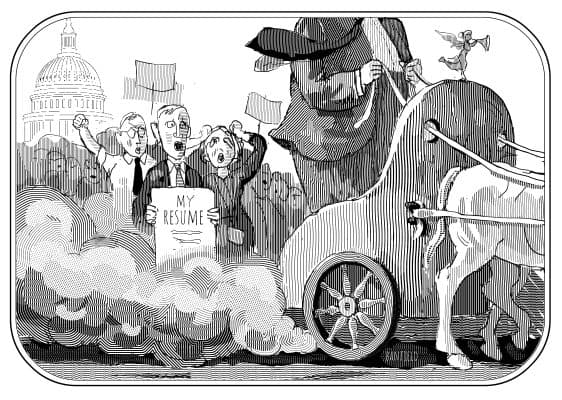
The social media hashtag #NeverTrump first appeared in June 2015, days after Donald Trump announced his presidential candidacy. For the balance of that year, social media derision attracted less attention than Trump himself, mostly due to the widespread belief that Trump’s campaign was self-extinguishing, which argued against pointless efforts to bring about an already inevitable defeat. In election cycles since Ronald Reagan’s 1984 landslide victory, unlikely protest candidates for the GOP presidential nomination—Pat Robertson, Ron Paul, Herman Cain—had briefly surged in the polls, only to give way to a conventional politician who ended up as the party’s nominee. Bill Clinton observed that, when selecting a presidential nominee, there is an almost anthropological difference between Democrats, who fall in love with a previously obscure politician (George McGovern, Jimmy Carter, Barack Obama), and Republicans, who fall in line behind an established one (Bob Dole, John McCain, Mitt Romney).
By early 2016, however, it had become increasingly clear that Republican primary voters were not going to fall in line. Within the first two months of the year, Trump won primaries in New Hampshire, South Carolina, and Nevada, drove presumptive favorite Jeb Bush from the race, and received the endorsement of another vanquished rival, New Jersey’s Governor Chris Christie. By that point, Never Trump had become more serious and less obscure. Disaffected Republican donors and campaign professionals started Political Action Committees whose initial purpose was to deny Trump the nomination, despite his relentless progress toward securing a majority of the Republican delegates with primary and caucus victories, and other candidates’ decisions, one by one, to abandon the contest.
These efforts proved futile, predictably, but after Trump’s nomination became a foregone conclusion the Never Trump focus shifted to an even more quixotic goal: fielding a third-party candidate who would allow Americans to vote against Trump without having to vote for Hillary Clinton. The effort was led by Joel Searby, a Republican political consultant, and William Kristol, founding editor of The Weekly Standard magazine. No one involved in their undertaking expected that any such candidate would win 270 electoral votes, but there was hope that an independent could win some states, enough to ensure that neither Clinton nor Trump received an Electoral College majority. In that event, the House of Representatives would choose the 45th president, keeping alive the possibility that it might be someone other than either major party nominee.
We’ll never know if that deus ex machina might have somehow come together. It required, at minimum, a credible alternative with high name recognition but, as political scientists Robert Saldin and Steven Teles report in Never Trump: The Revolt of The Conservative Elites (2020), each prospect Searby and Kristol approached—Condoleezza Rice, James Mattis, Ben Sasse, Mitt Romney—rejected them with more or less extreme prejudice. Among their reasons, several argued that an independent candidacy would be counterproductive, making it harder for the GOP to pivot away from Trump after 2016. Because Hillary Clinton was sure to win in any case, as a robust consensus of informed opinion maintained, it would be better—clearer and, therefore, more resonant—if it were impossible to blame Trump’s defeat on anyone but Trump.
And yet, Clinton lost. According to Never Trump, which was published just before the 2020 election, “Having failed to stop their party from nominating Donald Trump, or the country from electing him, the network of Never Trump operatives has been reduced to keeping the flame of resistance alive, in the hope that the party will one day come to its senses.”
Switching Teams
From the perspective of 2025, Never Trump is still a thing, but not the same thing, no longer fueled by hopes that the Republican Party will revert to what it was before June 2015. Some of the qualities that Saladin and Teles discerned in the five years following Trump’s entrance on the political stage have remained the same, while others have been upended by subsequent events. At no point did Never Trump possess the basic traits of a political movement: a small number of leaders and large number of followers. Never Trump’s leaders and its constituency are one and the same, as Saldin and Teles’s subtitle suggests. The conservative elites whose revolt the book examines include: 1) experts in foreign policy, economics, and law, the sort of people who end up staffing Republican administrations; 2) campaign professionals, especially those who manage communications and campaign strategy; and 3) public intellectuals, including opinion journalists and academics who write for a general readership.
The first two groups’ career considerations have curtailed their early Never Trump fervor. “Deep sociological forces,” Saldin and Teles observe, lead a political party to “go where its voters are.” As Trump’s voting base has remained solid, and he has demonstrated the ability to expand it, most people who aspire to work in a Republican administration or manage a Republican politician’s campaign either stopped doubting Trump or stopped voicing their doubts.
That leaves public intellectuals firing from the battlements of the Never Trump Alamo. Their career incentives are different, Saldin and Teles point out, since it is less important for them to be team players than to establish and develop “individual brands,” which renders “distinctive judgment and independence…key parts of their self-understanding and socially recognized role.” A few erstwhile campaign managers, such as Stuart Spencer and Rick Wilson, have bolstered the ranks of Never Trump public intellectuals by transitioning from operatives to pundits and talking heads.
Some opinion journalists associated with the most prominent conservative publications of the pre-Trump era—National Review, The Weekly Standard, and The Wall Street Journal editorial page—now write for liberal outlets, where they impart a bipartisan flavor to denunciations of Trump and Trumpism. The scorecard shows David Frum, a veteran of all three, now based at The Atlantic. David Brooks, who worked for the same three publications, also writes for The Atlantic and is a New York Times columnist. Bret Stephens moved from The Wall Street Journal to the Times in 2017. Max Boot, a Wall Street Journal alumnus, became a Washington Post columnist in 2018. Other Never Trump public intellectuals have started new online publications. In 2019 Jonah Goldberg and Stephen Hayes, alumni of National Review and The Weekly Standard, respectively, created the online magazine The Dispatch.
The most ambitious effort is The Bulwark, a webzine launched by Kristol in 2019 after The Weekly Standard’s publisher closed the magazine in 2018. There were business reasons for the Clarity Media Group, which had purchased the Standard from its original publisher, Rupert Murdoch’s News Corporation, to shut it down. The magazine, according to The New Yorker, was losing $3 million per year and had seen its subscription base decline by one-third since 2014. But it was widely understood that politics was the more important reason. Clarity wanted to keep the Standard’s subscription list for a weekly print magazine that became a component of its online, Trump-friendly Washington Examiner. And The Weekly Standard had become increasingly vocal in its opposition to Trump.
Several Weekly Standard figures, in addition to Kristol, signed on at The Bulwark, including Charlie Sykes, its first editor, and Jonathan Last, its current one. Other prominent Bulwark writers and podcast participants include Mona Charen, who started a successful syndicated column in 1987 after leaving the Reagan Administration; and Tim Miller, who prior to 2016 worked for Republican election campaigns, including Jeb Bush’s presidential one. (Kristol and Miller, along with David Brooks, made The Washington Post’s May 2016 list of “The 10 Republicans Who Hate Donald Trump the Most.”)
The Unified Resistance Theory
In its early years, The Bulwark’s slogan was “Conservatism Conserved,” a statement of purpose that was later quietly abandoned. The current mission statement holds that The Bulwark exists to “provide analysis and reporting in defense of America’s liberal democracy” by resisting the “reconsideration of liberalism and democracy that started in Europe and has migrated to America.”
The revision raises the possibility that Never Trump conservatives have become Never Trump post-conservatives, or even Never Trump anti-conservatives. Max Boot is the clearest example. He wrote The Corrosion of Conservatism: Why I Left the Right (2018), and followed it with a critical biography, Reagan: His Life and Legend (2024). In September 2025 Jonathan Last wrote in The Bulwark about the leading candidate in New York’s mayoral election, a member of the Democratic Socialists of America: “You may not like Zohran Mamdani. But if he’s elected mayor of New York City he will be put on the front line against Trump.” In that event, it will be imperative to support him because “in confrontations with Trump, Mamdani represents liberal democracy and Trump represents authoritarianism.” The following month William Kristol endorsed Mamdani, something that several prominent Democratic politicians did reluctantly and others, such as Charles Schumer, did not do at all. “Every one of us will be confronted with allies we do not agree with, or even like,” Last advised. “Solidarity requires making peace with that discomfort.”
But the resulting contradictions are too severe to be merely discomforting. In the speech after his election victory, Mamdani said, “We will prove that there is no problem too large for government to solve, and no concern too small for it to care about.” That battle cry stands as a perfect distillation of the thinking that 23 years of Weekly Standard issues were published to refute and deride. We’ve come a long way from the 1993 memo in which Kristol, in his capacity as the head of a small think tank, Project for a Republican Future, rallied Capitol Hill Republicans to refuse to negotiate the Clinton Administration’s health care proposal. Passing Clintoncare in any form, Kristol argued, would “relegitimize middle-class dependence for ‘security’ on government spending and regulation,” and “revive the reputation of the party that spends and regulates, the Democrats, as the generous protector of middle-class interests.”
People in politics change their minds, of course, and sometimes even change their parties, as Abraham Lincoln did once and Winston Churchill twice. Given that the Never Trump endeavor is based on the axiom that Trump and Trumpism must be defeated, there is a logic to subordinating all other differences to this one imperative. The enemy of my enemy is my friend.
The problem, however, is that Never Trump’s hopes of gaining political traction depend on its identity as an effort undertaken by conservative Republicans: Trump is so dangerous that even people we would expect to support him for partisan or ideological reasons are sounding the alarms. Never Trump, according to a 2019 New York Times article, was the “Other Resistance: The Republican One.” But if the Republican Resistance keeps depreciating its policy differences with the Democratic Resistance, then there really is no Other Resistance, just the Resistance, whose unity is conveyed by embracing that melodramatic self-designation.
Further, the Resistance is so invested in the belief that Trump is odious and absurd, and that Trumpism is an existential threat, that it treats this proposition as self-evident. Those so obtuse, craven, cynical, or compromised as to raise the possibility that this axiom is not true, or not the entire truth, become dangers comparable to Trump himself. Earlier this year, Bari Weiss sold her online Free Press startup to CBS and was named editor-in-chief of CBS News. Vox, part of the Resistance’s Democratic wing, complained that “the standard Free Press take on Trump is that he should be understood as a politician with the support of about half the country who does some good things and some bad things—and not as an appalling aberrant figure and budding authoritarian who [sic] all decent people must despise.” (In a February 2025 interview, Weiss called the journalistic and political opposition during Trump’s first term “overzealous, out-of-touch, [and] hysterical,” labeling it a response “that calls itself democratic, that calls itself progressive, but is actually extraordinarily authoritarian and totalitarian in its impulses.”)
In The Bulwark, part of the Resistance’s Republican-ish wing, Jonathan Last made the same point in denouncing The New York Times for, basically, not being Vox or The Bulwark. The Times executive editor had told an interviewer in 2024 that there are “people out there in the world who may decide, based on their democratic rights, to elect Donald Trump as president. It is not the job of the news media to prevent that from happening.” On the contrary, Last wrote in September 2025, that is exactly the job of the media, which “should have relentlessly explained the stakes of the election and highlighted Trump’s authoritarian promises.” It could have done so by, among other things, making sure that “no stories about Trump [were] presented without emphasizing the dangers of what he promised to do.” His colleague Tim Miller supplied a good lede for the stories Last wants to see when, on The Bulwark’s podcast the day after the 2024 election, he called Trump “the stupidest, most disgusting f—ing person in the entire world.”
Mission Failure
To have a political nemesis who is stupid and disgusting would seem to be a great advantage to those whose purpose in life is to prevent him from winning elections and gaining power. The Resistance, across its ideological spectrum, was unanimous in treating Trump’s 2016 victory as “some kind of aberration,” as David Frum wrote in The Atlantic after the 2024 election. It was, at minimum, a fluke, brought about by the intersection of the Electoral College’s idiosyncratic mathematics with Hillary Clinton’s unpopularity and deficient political skills. At most, Trump’s victory was illegitimate. According to Shattered: Inside Hillary Clinton’s Doomed Campaign (2017) by Jonathan Allen and Amie Parnes, one of the few duties that the 2016 Clinton campaign discharged capably was to settle, within 24 hours of her concession speech, on an alibi that explained Clinton’s defeat entirely in terms of others’ transgressions and blunders: Russia’s cyberattacks on her campaign, FBI director James Comey’s public attention to her e-mail server, and the media’s reckless insistence on making a big deal out of this nothing-burger story. The Resistance was quick to embrace this explanation for 2016, partly to absolve Clinton but mostly because it offered a way to keep from accepting Trump’s victory and normalizing his presidency.
The 2024 election rendered untenable the “comforting assessment,” to quote Frum again, that the Resistance was on the right side of history and Trump was fundamentally at odds with the American experiment. Trump won a plurality of the popular vote and swept all seven swing states. “Since Trump first declared his candidacy in 2015,” David Brooks, also writing in The Atlantic, recently acknowledged, “some 1,400 American counties [out of a total of 3,144] have moved in a more Republican direction, while fewer than 60 have moved in a more Democratic direction.” Nor could Trump’s critics dismiss his 2024 victory, as most had his election in 2016, as the result of a “whitelash,” a squalid last gasp of white identity politics before America becomes a majority-minority nation. Trump, in fact, improved with every racial and ethnic group in 2024 except white voters, winning 48% of Hispanics’ votes, 40% of Asians’, and 15% of the black vote, each proportion better than any Republican nominee has done in living memory.
By any objective standard, the 2024 election showed that the Resistance had failed in its sole mission. Trump had proven impervious to nine years of strident denunciations from every quarter, buttressed by impeachments, lawsuits, and indictments. The failed assassination attempt in Butler, Pennsylvania suggested that he was, both literally and seriously, bulletproof. Insisting that a strategy that had discredited itself so comprehensively prior to November 2024 was the key to thwarting Trumpism in the years to come betrayed an obsessive refusal to acknowledge empirical reality and basic logic.
And yet, the Never Trump battalion of the Resistance was divided over this basic point. A few admitted to misreading the political situation. In post-election analyses for The Atlantic, David Frum posed the question, “What did I get wrong?” and concluded that his biggest mistake was thinking better of the American people than they deserved. Mostly, he counted on voters’ capacity for “seeing through frauds.” The results showed that the number who did was smaller than the number who couldn’t or wouldn’t, revealing an America in which “an overwhelming number of our fellow citizens have chosen a president who holds the most fundamental values and traditions of our democracy, our Constitution, even our military in contempt.” Trump’s victory, Frum advised, depended heavily on his opponents’ unforced errors, which found their most vociferous and disciplined groups advocating their least popular positions, such as open borders, DEI, and a maximal trans-rights agenda. Accordingly, a necessary though not sufficient condition to reclaim the country from Trumpism is for sensible Democrats to get better organized and organized Democrats to become more sensible.
Rather than say that the American people had failed to live up to his expectations, David Brooks admitted, more self-critically, that the 2024 election revealed his deficient understanding of Trump voters’ grievances. “Those of us who condescend to Trump,” Brooks wrote in The New York Times the day after the election, “should feel humbled—he did something none of us could do.” That something was to grasp how deeply the nearly 65% of American adults who do not possess a four-year college degree feel that they have been stymied by the 21st-century economy, and how much they resent the highly credentialed architects of that economy, who just happen to be its most conspicuous beneficiaries. “The Biden administration tried to woo the working class with subsidies and stimulus,” Brooks continued, “but there is no economic solution to what is primarily a crisis of respect.” Trump won in 2024 because he landed one damaging blow after another against the Democrats’ unpopular identity politics fixations, and because his “Queens-born resentment of the Manhattan elites dovetailed magically with the class animosity” of those who feel abandoned and disdained.
Brooks was hardly ready to start wearing a red MAGA hat. His first Times column after Trump’s 2025 inauguration was, “How Trump Will Fail,” followed three weeks later by one about the Trump Administration being staffed, not by genuine populists, but by “right-wing elite nihilists,” whose only serious focus is on “tearing down whatever institutions the left occupies.”
A more decisive pivot away from the Never Trump consensus was executed by Brooks’s New York Times colleague Bret Stephens, one of several journalists—Bari Weiss was another—who left The Wall Street Journal editorial department after the 2016 election, in the belief that its treatment of Trump had been excessively deferential. Immediately after the 2024 election Stephens wrote that he had voted “reluctantly” for Kamala Harris but also believed that the “broad inability of liberals to understand Trump’s political appeal except in terms flattering to their beliefs is itself part of the explanation for his historic, and entirely avoidable, comeback.” That is, their conviction “that the best way to stop Trump was to treat him not as a normal, if obnoxious, political figure with bad policy ideas but as a mortal threat to democracy itself” ended up making “liberals seem hyperbolic, if not hysterical, particularly since the country had already survived one Trump presidency more or less intact.”
Six weeks later, Stephens extended this criticism to his own Resistance cohort in a column titled “Done With Never Trump.” Having written in 2015 that Trump was a “loudmouth vulgarian appealing to quieter vulgarians,” Stephens had by 2024 come to conclude that Trump was better understood as “crass but charismatic, ignorant but intuitive, dishonest but authentic.” Much of his followers’ anger was unwarranted—but not the part “directed at a self-satisfied elite that thinks it knows better but often doesn’t, whether the subject is Covid restrictions, immigration policy or how to get our allies to pay more for their defense.” Like the Resistance as a whole, “Never Trumpers…overstated our case and, in doing so, defeated our purpose.”
This is true, Stephens argued, even with respect to what was thought to have been Trump’s greatest vulnerability. In 2007 Joe Biden had mocked Rudy Giuliani (at a time when both were running for president) by saying, “There’s only three things he mentions in a sentence—a noun, a verb, and 9/11.” In the same way, from 2021 on, no criticism issued by the Resistance reached its second paragraph without offering a noun, a verb, and January 6. (Trump’s second term, Kristol predicted in December 2024, will be “a pro-January 6 administration, staffed with pro-January 6th appointees, supported by a party with a majority in both houses of Congress whose members either endorse or acquiesce in the legitimizing of January 6th.”) While stating that that day’s Capitol Hill riot and “Trump’s 2020 election lies” had led him to vote for Harris, Stephens also wrote, “But if democracy means anything, it’s that ordinary people, not elites, get to decide how important an event like Jan. 6 is to them. Turns out, not so much.” How and why could so many people have arrived at this conclusion? Stephens contends that they also felt lied to by Democrats, and with regard to matters that seemed more pressing and tangible: inflation, immigration enforcement, and President Biden’s “physical and mental decline.”
The next day, in a Bulwark post titled “Never Trumpers Were Right, Actually,” Jonathan Last rebuked Stephens for making a “silly” argument and failing to appreciate that Trump’s critics had understated, not overstated, the case against him. By that point, The Bulwark had already made clear its response to the 2024 election: regret nothing, concede nothing, scorn the possibility that the Never Trump theory of the case needs reassessment or revision. Kristol, following the election, had quoted Churchill: “In Defeat: Defiance.” This exhortation about losing a war, repurposed for losing an election, meant: “We’ll have to keep our nerve and our principles against all the pressure to abandon them.” And also: “There should be no honeymoon for the Trumpists, no honeymoons for authoritarians.”
Mona Charen’s post-election essay for The Bulwark, “Grappling With the Catastrophe,” called the result not just “suboptimal” but “unthinkable.” “With this vote, Americans are turning their backs on basic decency, the founding documents, and the social contract,” all for the sake of “this lying cretin.” The electorate, however, deserved less blame than those who had manipulated and deceived it:
If not for the excusers and explainers; if not for the whataboutism at places like the Wall Street Journal and National Review; if not for the craven capitulation of Wall Street wizards and Silicon Valley prima donnas, if not for the cowardice of 95 percent of elected Republicans, ordinary voters would not have felt comfortable voting for a clown with a flamethrower.
To rework an expression that David Brooks has employed in several contexts (though not the 2024 election), The Bulwark has made clear its intention to say all the same things after November 2024 that it said before, only louder.
The Conservative Book Club
This is a mystifying choice. Charen’s argument about the culpability of Trump-tolerant opinion leaders contradicts Last’s rejoinder to Stephens, which derides the notion that “low-information, low-propensity swing voters” ended up voting for Trump because, “after careful consideration,” they decided that prominent Never Trump public intellectuals had “overstated their cases.” But if swing voters, however well or ill informed, however likely or unlikely to vote, are oblivious or impervious to op-eds and online debates, then who exactly is the Never Trump target audience? As the world enters the second decade since the Trump Tower escalator ride, the number of Americans who still haven’t formed an opinion about the celebrity real estate developer cannot be large. If the various Never Trump exertions are not trying to reach swing voters, or to persuade anyone of anything, then the whole point seems to be running web-based support groups for people who can’t stand the guy and can’t accept that he has been elected and re-elected president. It is difficult to believe that all involved could not find better uses for their time.
It is also true, of course, that the time being wasted belongs to the people who are wasting it, which means that it is no one else’s problem or concern. What is concerning is that a Resistance encompassing both Never Trump public intellectuals and Zohran Mamdani is sowing confusion about what conservatism should stand for once Trump has passed from the scene. Sometimes, an alliance of necessity comes to include members who end up convinced that it is held together by bonds deeper than mere necessity. In the 1940s, for example, some New Dealers followed former Vice President Henry Wallace into opposition against Harry Truman’s Cold War policies on the grounds that, after defeating Nazi Germany, American Progressives and Russian Communists were still brothers-in-arms against deprivation and dictatorship.
Making peace with the discomfort of treating even Democratic Socialists as allies against Trump, as Last urges, has led many of those in the Never Trump sphere to make peace with progressivism more generally. The Resistance is united in its hatred of Donald Trump, but nearly as united in its refusal to consider whether his political success results from the people’s valid, or even merely sincere, objections to governance-as-usual. The scathing, sustained denunciations of Trump make this question all the harder to avoid. If it must consider the matter at all, the Resistance would prefer to ask what the election of a lying cretin says about the voters. The answer after 2016 was that they’re misogynist and racist. The answer after 2024 remains a work in progress.
There has been even less engagement with a more disruptive question: what does the election of a lying cretin say about the alternatives? Trump’s victories stand as votes of no confidence in a leadership class that comprises Democrats and Republicans. Those who, like Bret Stephens and David Brooks, entertain the possibility that Trump’s emergence was possible only because that leadership class had forfeited the public’s trust, are in a Never Trump minority. For most others, any such suggestion threatens Resistance esprit de corps by legitimating the idea that Trump’s most culpable enablers are his bitter critics rather than his defenders. For some, the idea hits even closer to home. “The Never Trumpers have their own history to live down,” former New York Times Book Review editor Sam Tanenhaus wrote in Esquire in 2018. “Many were lusty cheerleaders for the second Iraq War, the event above all others that cleared the path for Trumpism.”
A second problem is that Never Trumpers endorse unreservedly the central Resistance claim that Donald Trump poses a mortal danger to American democracy. By now it is exceedingly doubtful that there is anything left to be said on this question—different from the millions of things already said—capable of changing anyone’s mind. But a collateral effect of going on and on about the threat to democracy is to reinforce the progressive idea that the only dangers to democracy that matter are those posed by anti-democrats, who reject democratic rules and norms, and work to supplant democracy with some less accountable system.
Conservatism has always insisted that democracy can be undermined from within as well, that defending democracy requires warnings that democratic nations can be inattentive or even hostile to prerequisites for the health of democracy. Though this argument has disappeared from the Never Trump playlist, it was once readily available. In the 1990s, for example, William Kristol argued that it was necessary to supplement the “politics of liberty” with the “sociology of virtue.” As recently as 2016 he wrote that conservatives have “often been better…than liberals” at upholding liberal democracy, “because conservatives are more aware than liberals of liberal democracy’s weaknesses and less complacent about its success.”
This analysis is consistent with that of political scientist Harvey Mansfield, who praised the American Founding in a 1988 New Republic essay for understanding that republics are vulnerable because they have enemies but also because they have vices. To mention one application of this thinking, Trumpism appears to believe, and Never Trumpism to deny, that social cohesion and national identity are no less important to democratic nations than to any others. The vice of radicalizing the democratic principle of equality so that non-citizens’ rights resemble ever more closely those belonging to citizens, rendering immigration law unenforceable, is an example of liberal complacency, and also a repudiation of the conservative vigilance that Kristol used to endorse.
The repudiation of conservatism in its entirety would be the culmination of the Never Trump project, the conclusion of thinking that: a) Trump is very bad, but b) only the Never Trump remnant seems to know or care, while c) some conservatives are enthusiastic Trumpists and the rest are to one degree or another Trump-tolerant; all of which shows that d) conservatism suffers from a congenital defect, whose existence was not apparent before exposure to the Trump pathogen. In an April 2025 Atlantic essay, “I Should Have Seen This Coming,” Brooks wrote that when he became involved in conservatism in the 1980s:
There were two kinds of people in our movement back then, the conservatives and the reactionaries. We conservatives earnestly read Milton Friedman, James Burnham, Whittaker Chambers, and Edmund Burke. The reactionaries just wanted to shock the left. We conservatives oriented our lives around writing for intellectual magazines; the reactionaries were attracted to TV and radio…. They were not pro-conservative—they were anti-left.
“Trumpian nihilism,” Brooks concludes, “has eviscerated conservatism.” More plausibly, the reasons for joining a political movement—to achieve certain goals or prevent particular harms—differ from the reasons for joining a book club. When people who thought that they had joined a movement figure out that its leading figures regard it as a book club, they’ll be unhappy in ways that lead them to either change or leave the movement.
Conservatism post-Trump will be distinguishable from Trumpism but also from conservatism pre-Trump. It will not be—in the unlikely event that it ever was—anti-Left for the sake of being anti-Left, but because it regards leftist ideas as grave mistakes and serious dangers. So disposed, it will have much more in common with the Trumpist rejection of Democratic Socialism than with Democratic Socialism’s case against Trumpism. The urgency of resisting a Democratic Party whose moderates are increasingly beguiled or intimidated by its radicals also means that the post-Trump conservative movement will neither seek respectability by proudly embracing its own ineffectuality, nor value comity with activists and intellectuals whose aspirations would inflict irreparable harm on the United States.