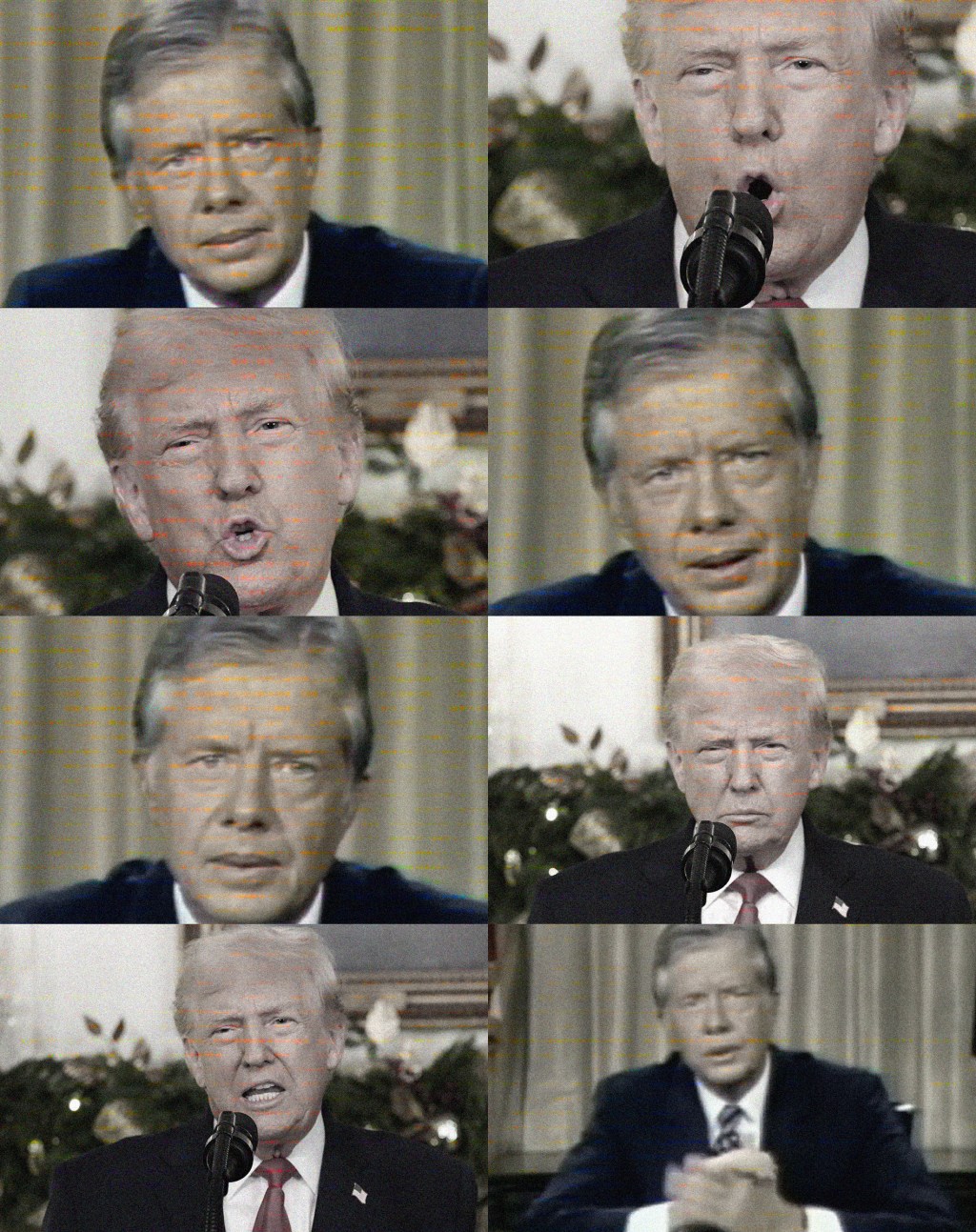
The devoutly religious Carter couldn’t resist interpreting public discontent in spiritual terms. What ails the average joe is a loss of purpose and community, he believed, which feels prescient in 2025 and would be at home in the pulpit on Sunday morning. But it’s not the sort of thing you want to hear from the most powerful person in government, whom you’re counting on to help you make ends meet. If the president wants to solve Americans’ crisis of confidence about the future, we might say, a good first step would be to postpone the sermons and focus on making it easier to afford food.
Trump delivered his own version of a sermon last night. Like Carter, he’s facing a crisis of confidence driven by stubbornly high inflation. And like Carter, he believes the solution has less to do with policy failures than with Americans’ flawed perspective. But his remarks on Wednesday differed from his predecessor’s in two important ways.
Rhetorically, they reflected how much stupider national politics has become under his leadership. “One year ago, our country was dead. We were absolutely dead. Our country was ready to fail. Totally fail,” the president boasted at one point. “Now we’re the hottest country anywhere in the world.” Whatever its flaws, Carter’s speech was written for an audience of basically literate adults and didn’t require a fusillade of made-up statistics to support its thesis. Trump’s is a presidency by juveniles, for juveniles.
The crisis of confidence that he zeroed in on was also distinct from the one that troubled Carter. It isn’t Americans’ lack of faith in each other or, Lord knows, in any spiritual purpose that’s bugging Trump. True to narcissistic form, it’s their lack of faith in him. He’s made America great again, supposedly, and it’s going to be even greater in a few months after the new tax cuts kick in—and yet the fickle public, drowning in bad “vibes,” insists on giving him some of the worst numbers in handling the economy of his nearly five years in office.
The president was asking essentially the same question that Carter did in “malaise” mode, albeit with less of a theory to answer it: What’s wrong with all of you?
Why now?
The interesting thing about Trump’s speech was how, in rattling off a list of accomplishments, it resembled a State of the Union address. Why did he feel obliged to do that now when he’ll get to do it during the actual State of the Union in less than two months, before a much larger audience?
I think he’s panicked that he hasn’t been able to shift the narrative about the so-called affordability “hoax,” a suspicion shared by others who watched the speech.
Trump’s delivery betrayed his anxiety. He spoke quickly and shouted at the camera, as if trying to drum it into the viewer’s thick head that his first year back has been more successful than he or she has been led to believe. His most impressive talent as a demagogue has always been his ability to convince others to accept a reality he’s created for them, most famously in the months after the 2020 election. But that talent has failed him lately with respect to the economy.
He may be suffering a rare crisis of confidence in his own ability to popularize a self-serving narrative about a matter of momentous political importance.
Joe Biden also famously failed to persuade voters that the economy was stronger than the gloomy “vibes” around it would suggest, but I’m sure Trump viewed that as a function of Biden’s feebleness and weakness as a communicator. Imagine how disorienting it must be for him to suddenly find himself in the same boat. He’s legitimately one of history’s most successful charlatans, having fashioned a myth of himself as a business genius so potent that his name became a byword for gaudy wealth before he was 50 years old. He parlayed that into television stardom, then parlayed that into winning the presidency, then parlayed that into nascent autocratic rule.
In 2016, he sold millions of Americans a nostalgic fantasy that the path to national restoration ran through giving a belligerent game-show host as much power as possible, then repaid them for their faith by attempting a coup, then successfully sold them the same nonsense again. To discover that he can’t sell them on the idea that, ackshually, the economy is great must feel a bit like Superman waking up one day to discover that he can’t fly. Bad enough that he flopped when he tried to convince his base that the Epstein files were a Democratic scam, but this? This is an existential crisis.
The great salesman, feeling cornered, instinctively resorted on Wednesday evening to the hard sell to try to wriggle out of trouble.
Pessimism.
There’s another reason for Trump’s urgency. His economic approval rating isn’t drastically lower than what it was three months ago, and is actually up a bit since the depths of the government shutdown. But some evidence suggests that faith in his ability to turn things around is collapsing, possibly with enough speed that a counterargument really couldn’t wait until the State of the Union in February.
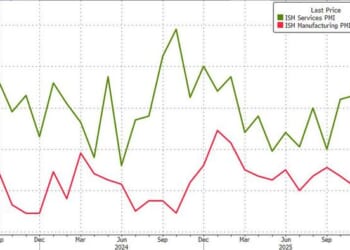
The unemployment rate has risen every month since June and might plausibly be worse than the official numbers indicate. Manufacturing, which is supposed to be the prime beneficiary of the White House’s trade policy, has lost tens of thousands of jobs this year. And polls continue to show that more Americans believe Trump bears greater blame for the state of the economy than his predecessor does, a historical anomaly for new presidents that’s probably explained by the economic kamikaze of “Liberation Day” tariffs.
This new survey from Marist suggests there’s no time to waste in trying to reverse the tide of public opinion. Trump’s overall approval rating (38 percent) and economic approval rating (36 percent, his lowest ever in Marist) are ugly, but here’s the number that brought me up short: “70% in this survey said the area where they live is not very affordable or not affordable at all for the average family. That’s up from 45% when Marist asked the same question in June, a whopping increase and a sign of how much people are feeling the economic pinch.”
A 25-point shift in less than six months. Among independents, it was 30 points. And nearly 6 in 10 respondents told Marist they’re more pessimistic now about what’s ahead for the world in 2026. Things are quickly getting worse and will probably keep getting worse isn’t the mood a majority party wants less than a year out from a national election. I don’t blame Trump and his team for believing that an emergency act of damage control was in order.
“Telling Americans that their own lived experience with the economy is some sort of delusion is like breezing into town, selling a snake oil miracle cure to the locals, and then … hanging around for a few weeks while they test it out.”
As for why perceptions about affordability have deteriorated so rapidly, that’s a pickle. There’s been no sudden spike in inflation or unemployment that would logically explain the sharp turn toward gloominess that Marist has detected. A Dispatch colleague cleverly suggested that it might have to do with the holidays: Nothing is more likely to cause sticker shock over groceries than Thanksgiving, and nothing is more likely to cause sticker shock over everything else like Christmas.
I think there’s something to that, but the October shutdown and the attention it drew to health care costs also look in hindsight like an improbable master stroke by Democrats. The president’s approval rating on the economy dropped below 40 percent as the shutdown wore on and has yet to recover, and the question of whether to extend the Obamacare subsidies has tied him and his party in knots ever since. (His numbers on health care are a horror.) The sense that Trump cares less about the cost of living than about deals with Saudi Arabia or building his ballroom went from a suspicion over the last six weeks or so to a fully crystallized political liability.
But even if there had been no shutdown, I can imagine an organic sense of disappointment setting in right now and depressing the president’s economic approval as the year winds down. Remember, voters had very high expectations for the new Trump economy: Republican pollster Patrick Ruffini recently asked people what it would take to convince them that inflation is no longer a problem, and 74 percent said that nothing short of prices declining would do it. Only 18 percent said that prices holding steady, i.e., 0 percent inflation, would suffice.
A lot of people who voted for the president last year seem to have done so believing that he’d presto-change-o the economy into restoring the cost of living circa 2019. Now they’re rooting for deflation even though that would almost certainly mean a recession and shrinking wages. When I say that Trump’s is a presidency by juveniles, for juveniles, don’t take me to mean that it’s hard to understand how he was reelected.
The tariff trap.
There are a few enjoyable ironies to all of this, one being that the president is trapped for once by his own hype machine. His penchant for Barnum-esque hyperbole is usually an asset to him, as the average joe typically has neither the time nor inclination to fact-check his grandiose lies. But telling Americans that their own lived experience with the economy is some sort of delusion is like breezing into town, selling a snake oil miracle cure to the locals, and then … hanging around for a few weeks while they test it out.
That con doesn’t work unless you disappear before the customers find out that they’ve been had, but Trump and his team will be stuck fielding complaints for the next three years. No wonder they’ve already resorted to nervous assurances that it’ll kick in any second now.
Another irony is that Trump, the great outsider and tribune of the common man, has succumbed to the same political sin as the establishment dinosaur who preceded him. Republicans browbeat Joe Biden remorselessly for insisting that the economy was great and that those who disagreed were being misled by “vibes”—and with good reason, it turns out. The doubters were right, and the Biden White House’s inability to grasp that was Exhibit B in the case that his administration had lost touch with the average American’s reality. (Exhibit A was its gross negligence on immigration enforcement.) If you wanted a government that didn’t callously dismiss economic pain as a figment of voters’ imaginations, you had to elect a populist with a special connection to the working class.
So that’s what Americans did, only to be told that their current economic pessimism is … also largely a figment of their imagination, a sort of modern-day malaise. (Live by the vibes, die by the vibes!) The president managed to avoid the word “hoax” last night in his scripted remarks, but he’ll revert to it many times on the trail during the midterm campaign to come. In fact, that’s another difference between Jimmy Carter’s speech and the version we got last night: For Carter, the malaise was authentic, but for Trump, it’s the result of a cynical left-wing psy op of some sort. Isn’t it always?
We’re left with this tantalizing question: Has the political pain over the economy become so severe that the president might not try to revive his tariffs if the Supreme Court strikes them down?
It’s unthinkable that he would take that defeat lying down instead of moving to reinstate whatever levies might be possible under other statutes, but that’s a political disaster in the making for the GOP. Practically every Republican in Washington and quite a few outside of it will greet the news of the court’s ruling with jubilation. Business leaders will celebrate; the stock market will surge; it’ll be the first jolt of real economic enthusiasm that Trump 2.0 has enjoyed in many months.
For the president to turn around and try to smother all that by reimposing tariffs under other authorities will add insult to injury for Americans excited by a reprieve on the high cost of imported goods. Frustration that Trump isn’t doing enough to bring costs down will give way to anger that he’s actively trying to make things more expensive, never mind the many signals voters have sent him lately in polling and at the polls. Being “out of touch” is one thing, but working against your constituents’ interests is quite another.
I wonder whether the minor revolts we’ve seen recently in Congress might become a proper rebellion. Vulnerable House Republicans could join Democrats on a discharge petition to repeal Trump’s tariff powers, leaving Senate Republicans to face a hard vote, potentially, on whether to show “loyalty” to the president by protecting his latest kamikaze policy or to pander to swing voters by joining the repeal effort—knowing that Trump will be waiting to veto the bill if they do.
That’s what Republicans deserve for having enabled him for so long, a scenario that will bitterly divide their party and inevitably end with a furious president infuriating the public by vetoing the repeal effort. Last month, I called his tariff policy the biggest political mistake of his presidency, but hold that thought pending what the Supreme Court decides. It may be that we ain’t seen nothing yet.