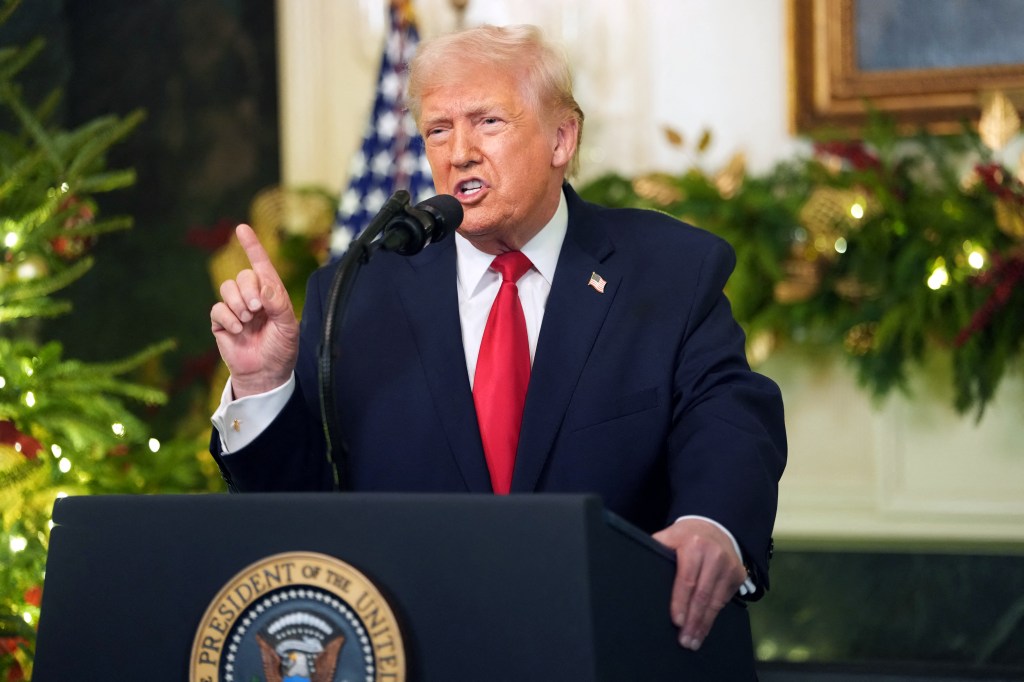
How is Donald Trump’s second term going so far? For clues, just look at his address to the nation this week, delivered from the White House in front of a background festooned with Christmas trees and garlands. And pay particular attention to his choice of words.
Trump made lots of references to bringing costs down: for health care, energy, housing. He mentioned by name his predecessor, Joe Biden, and his Democratic administration’s failures on everything from inflation to immigration. And Trump riffed, as he has for the entirety of his decade-long political career, about the corruption and cowardice of every other politician who came before him.
“For so long as before my election, the vast majority of good and decent Americans were forced to watch as corrupt politicians plundered the halls of power, exploited our taxpayers, and pillaged every system that makes civilized society function,” he claimed. “But not anymore, and you see that every day, not anymore.”
But as Trump approaches the anniversary of his inauguration, following a turbulent year in Washington, it’s striking to see how little he is focused on some of what we might consider the hallmarks of his second term. And that may be for good reason. His dismal approval rating and next year’s looming midterm elections indicate how much the president, behind his typical bluster about the greatness of his administration and leadership, wants to leave much of what happened under his watch in 2025 behind him. His word choice Wednesday night made that clear.
As he has many times before, Trump proclaimed that his “favorite word” is “tariffs.” Yet in his speech of more than 2,600 words, only six times did he utter his most beloved locution, chiefly to assert that his implementation of tariffs has made things better. While it might be Trump’s favorite word, it’s not popular with the majority of Americans, with two-thirds of adults saying in a recent Marist poll they are still concerned about the economic impact of tariffs. It’s not hard to see why the president was relatively judicious in mentioning the word on Wednesday night, eight months since his “Liberation Day” announcement introduced a whole raft of tariffs that were subsequently tweaked, walked back, reimposed, and rescinded in a months-long tumultuous period that rocked financial markets.
Still, that was six times more than he referred to the late Department of Government Efficiency, the Elon Musk-led project that so dominated the early months of Trump’s second term. Neither Musk himself nor any words like “efficiency” cropped up, nor did Americans hear anything about the successful gutting of significant parts of the federal bureaucracy. That’s a marked shift from the focus Musk and DOGE received in Trump’s March address to a joint session of Congress, where the tech billionaire and then-special government employee got plum seating and lots of attention from the president. (And it’s notable that in the bombshell Vanity Fair article on the West Wing published this week, chief of staff Susie Wiles made clear her disdain for Musk and bemoaned some of the wanton cuts, particularly to the relief agency USAID.)
Trump was also selective Wednesday in his discussion of foreign policy, concentrating on his successes in the Middle East. “I’ve restored American strength, settled eight wars in 10 months, destroyed the Iran nuclear threat, and ended the war in Gaza, bringing for the first time in 3,000 years peace to the Middle East, and secured the release of the hostages, both living and dead,” Trump bragged. But the president did not spare a word for Ukraine or Russia (whose war he has insisted for months is close to an end), Venezuela (on which has been upping both the rhetorical and show-of-force pressure for weeks), or China.
In fact, among these obvious, defining policy subjects of 2025, the only one he spent much time on was immigration enforcement, touting his boost in border security, the reduction in taxpayer dollars being spent on services for foreign migrants, and his administration’s efforts to stop the illegal drug trade. But as the public approval on Trump’s signature issue goes down, there was just one scant mention of the word “deport.”
Instead, the singular idea informing much of his address was a buzzword that he has previously dismissed as a Democratic talking point: “affordability.” As Democrats from the democratic socialist mayor-elect of New York, Zohran Mamdani, to New Jersey’s incoming moderate Gov. Mikie Sherrill found electoral success this year by calling for policies to make life more affordable, Trump appears to be both vexed by the salience of those economic issues and eager to appropriate that message for himself. He promised to “dramatically reduce the price of prescription drugs,” prattled on about providing cheaper health insurance, claimed that energy prices will “fall dramatically,” and pledged early next year to “announce some of the most aggressive housing reform plans in American history.”
This litany of promises to address affordability laid it all bare: What was an asset for Trump and the Republican Party just a year ago has now become a serious liability.
The economic news isn’t all bad for Trump. Inflation has “cooled” this fall, rising less sharply than it had been in the beginning of the year or throughout much of Biden’s term. The stock market recovered from the instability caused by Trump’s Liberation Day tariff announcement earlier this year, and the overall economy seems to be experiencing solid, if not outstanding, growth.
But warning signs in the unemployment numbers and the persistence of rising costs don’t bode well as Trump enters the second year of his second term. And his remarks on Wednesday suggest he and his team recognize that their first year in power has not gone as they hoped. For the first time in a while, Trump seems to be behind the latest political trend, racing desperately to reach the front of the parade.