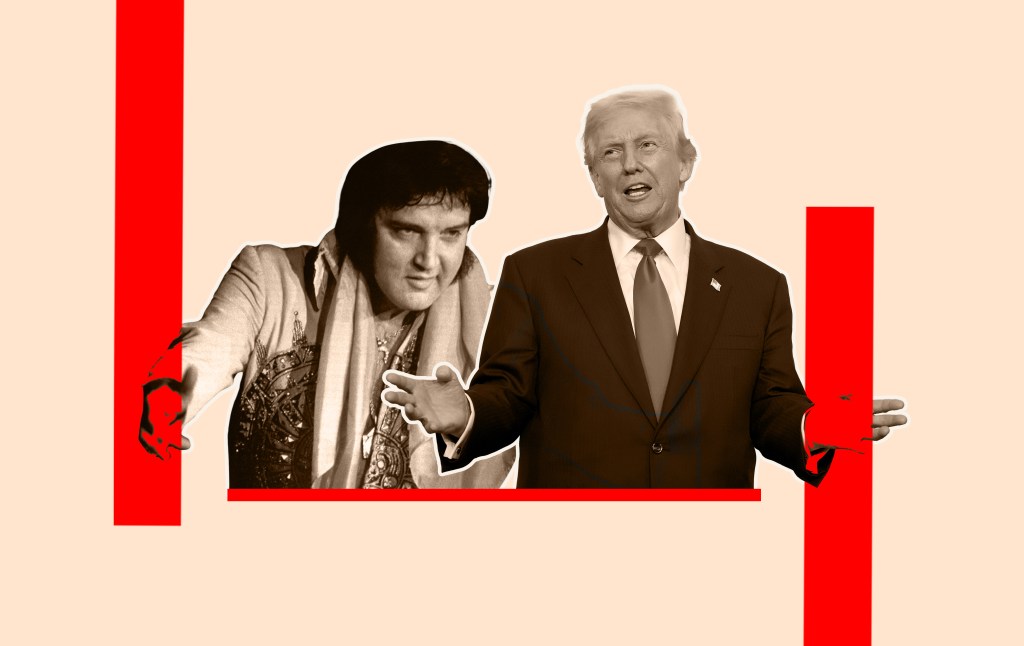
Anxiety.
Elvis coped with stress by ingesting fried peanut butter and banana sandwiches and handfuls of pills. Per the Times, Trump copes differently:
The Trump administration just renamed the Institute of Peace the Donald J. Trump Institute of Peace. It announced that Mr. Trump’s birthday, which is the same day as Flag Day, would be a free-admission holiday at national parks next year while ending free admission for Martin Luther King Jr. Day. Park annual passes in 2026 will have Mr. Trump’s image on them alongside George Washington’s. So may commemorative Trump coins that the Treasury Department is considering for next year’s 250th anniversary of the Declaration of Independence.
New federal child investment accounts created this year were designated “Trump accounts.” In his speech on Wednesday night, Mr. Trump touted a new government website called TrumpRx to help Americans get lower-priced prescription drugs. Few doubt that Mr. Trump might name the gargantuan new White House ballroom he is building after himself. He has even suggested that the Washington Commanders name their new stadium after him.
His latest move to make parts of the federal government a subsidiary of Trump Inc. came yesterday when the board of trustees of the Kennedy Center for the Performing Arts voted to rename it the Trump-Kennedy Center—sort of. Technically, an act of Congress is needed to change the name officially, but that feels like nitpicking in 2025. If the president can usurp the legislature’s power to declare war and set tariffs, surely he can also seize its authority over naming stuff for the sake of smearing his personal brand all over public life, no?
In third-world America, the relevant consideration for the White House isn’t, “What law authorizes us to do this?” The relevant consideration is, “Who’s gonna stop us?”
Less than a day after the change was ordered, the center’s facade has already been updated. (Big government moves fast when a national priority is urgent.) Some might say, “Great! I’d rather have him preoccupied with nonsense than with selling out Ukraine to Russia,” but I think that’s silly for two reasons. One is that the Trump administration can walk and chew gum at the same time: The president might be consumed with building ballrooms and Ozymandias-ing federal arts centers, but Stephen Miller will still rise from his coffin when night falls to hatch some fashy new policy initiative.
The other was described by our friend Andrew Egger at The Bulwark. “There is something sinister here that goes beyond the ridiculous ego-polishing,” he wrote. “These renamings are … just the latest assertion of a particular kind of presidential authority over truth itself.” Nothing says dystopian authoritarianism like a strongman imposing his cult of personality on arms of the state by forcing them to bear his name or likeness. Like the surprise demolition of the White House’s East Wing, adding Trump iconography to buildings and currency signals that the president and his team mean for his influence to be enduring and are willing to smash a lot of norms to make sure that it is.
Which may tell us something about how they’re likely to react to election defeats in 2026 and, especially, 2028.
If Trump were still on a roll like he was at the start of his term, with his job approval north of 50 percent and a postliberal cultural revolution seemingly gathering force, the name changes lately would alarm me as an obvious ploy to further consolidate power. But he isn’t, so they don’t. Just the opposite: They feel pathetic. They radiate the president’s anxiety that he’s weakening politically and doesn’t know what to do about it. He has no ideas on how to solve inflation, so he’s soothing himself with a would-be Caesar’s equivalent of fried peanut butter and banana sandwiches.
His shocking viciousness toward the Reiner family and the excruciatingly childish plaques about his predecessors that he installed on the White House colonnade are further examples. “Trump sees his own ruination coming—and sees the upcoming battle over the extension of Obamacare subsidies as perhaps the final fracture point,” Jeff Blehar said of the plaques at National Review. “He is frustrated, pinned, and doing the same thing he always does when he finds himself without any good options: He’s lashing out in a meaninglessly petty tantrum, designed to do nothing except satisfy his own ego.”
The president is suddenly insecure about his economic legacy, so he’s using his powers to try to immortalize himself. The ballroom, the name changes, his image on the money: Fat Elvis will never leave the building.
The coming backlash.
That’s one reason I’m cheered to see him and his cronies change (or pretend to change) the name of the Kennedy Center. It’s evidence that they feel their power slipping. That’s ominous in one sense—rats are never more dangerous than when they’re cornered—but it might breed a little overdue humility in some of them. Trump’s lieutenants plainly operate on the assumption that their enemies will never be in power again; a few might behave more circumspectly as they consider potentially being held accountable for their actions as soon as 2029.
Another, bigger virtue of the recent Trump iconography is that it’ll accelerate the public backlash against him.
I can’t think of a lower-risk way to convince the average joe that the “No Kings” demonstrations were right about the president having autocratic ambitions. There are many high-risk ways: Trump could ignore court rulings or deploy the regular military against American citizens or seize even more powers from Congress (assuming there are some still unseized), any of which would place the constitutional order in enormous peril. Instead we’re getting the trappings of monarchy from a guy whose job approval is lower than Joe Biden’s was at this point during his first year, minting coins with his face on them and bumping JFK to second billing on an arts center that’s been associated with Camelot for 60 years.
Better still, we’re getting those trappings at a moment when voters are already angry at Trump for having screwy priorities. Fifty-eight percent believe the president is focused on the wrong things, according to a new Fox News poll, a slightly higher share than said so of Biden in December 2021 when inflation was beginning to take off. Messing with the Kennedy Center and bulldozing the East Wing to make way for a new ballroom in a political climate as sour as that feels like “let them eat cake” material. Even someone whose opinion of Americans is as abysmal as mine can’t help but suspect that the average joe will be honked off by it.
There might also be a twinge of popular resentment at seeing landmarks with some historical patina treated so rudely. We tend to associate postliberal right-wingers with complaining about that sort of thing, but that’s just because it’s usually monuments to their beloved Confederacy that are being vandalized. When the White House or, to a much lesser extent the Kennedy Center, is targeted, the wider public might feel annoyed to see familiar civic touchstones being defaced to serve one faction’s political agenda.
Why, it might even lead some to wonder about the sincerity of the president’s nostalgia for America’s past. If the point of MAGA is to restore the country to greatness, it’s strange to want to “update” some of the architectural symbols associated with that era of greatness. It doesn’t make sense—unless you understand that nationalists’ nostalgia is all about reestablishing right-wing cultural hegemony, in which case there’s no contradiction in graffiti-ing Trump’s name over Kennedy’s or replacing the East Wing with a gilded clearinghouse for the president to extract bribes from special interests.
There’s one more thing I like about the iconography of late. It will impel any eventual Democratic successor to scrub the government of nearly all traces of Trump.
I maintain that the new White House ballroom, if it’s built, won’t be torn down by a left-wing administration despite the demands of the Resistance. It will certainly be renamed, assuming Trump’s name ends up on it. And I expect that it will be repurposed from a party space to something more functional, possibly an attraction from the public. But it would be too wasteful to incinerate $400 million by knocking it down on day one. Some other way to repudiate the president will need to be found.
Removing any mementos of his time in office from the presidential mansion and reversing the official tributes to himself that he’s ordered are obviously that way.
“The thing with these plaques is that they guarantee the next Democrat president burns everything that even mentions Trump to the ground. He’ll be erased from the White House,” a writer for Red State warned of the juvenilia that now adorns the colonnade. That’s correct, and I don’t think it would have been that way if fat Elvis hadn’t gone on this latest narcissistic binge. Trump’s portrait would have been grudgingly included along with the rest of his predecessors for the sake of completing the historical record.
But not anymore. The impulse to fumigate the federal government after Trumpism will necessarily also lead to rebuking his autocratic egotism. The worst thing you could do to him without resorting to the same degrading trollishness he displayed in the plaques about Biden and Barack Obama would be to remove his image from the executive branch as comprehensively as impossible. That starts in the White House: Every photo will be taken down, every tacky gold knick-knack pulled from the walls, every remnant packed up and warehoused. Fat Elvis will leave the building.
There’s irony in that, of course: After complaining for four years about Trump messing with American history, Democrats would be messing with it themselves by memory-holing his presidency. But I wouldn’t look at it that way. In removing his fingerprints from the federal government, they won’t be pretending that he was never there; they’ll simply be broadcasting the immense shame Americans should feel that he ever was. No one will scrub the orange stain from our national history, I promise. It’ll never wear off.