The Vance dance.
I wrote about the VP’s anti-anti-antisemitism in October when he declined to rebuke his friend Tucker for hosting groyperfuhrer Nick Fuentes on his show.
“Vance will … do his best not to take a side” in disputes over whether racists should or shouldn’t be tolerated in the GOP, I predicted. “Occasionally, he’ll be cornered on it and will tactfully affirm that antisemitism is wrong before changing the subject. Meanwhile, he’ll continue to seize opportunities to defend right-wing bigots whenever those opportunities present themselves to show the Tuckerites that he has no problem with them, even if the political realities of winning a general election prevent him from allying with them forthrightly.”
And that’s just what he did when he spoke on Sunday. He’s opening the so-called Overton window on prejudice to show the right’s sleaziest cohort that they have a place in his party.
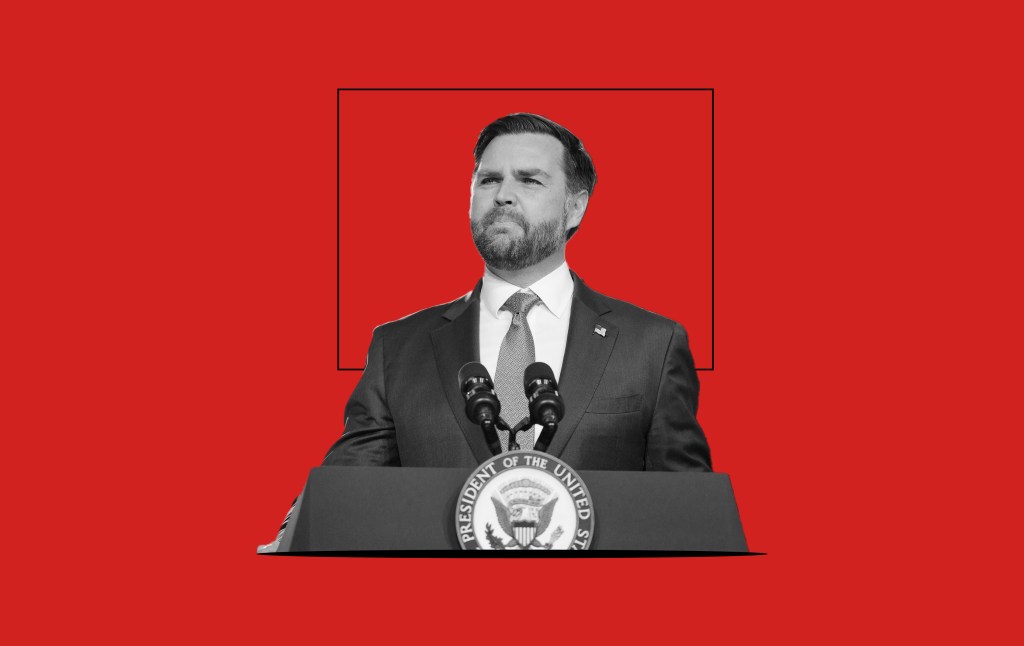
Everyone is welcome in the America First movement, the vice president assured the crowd, sounding an inclusive note. And when he said “everyone,” it turned out he meant everyone. “I didn’t bring a list of conservatives to denounce or to deplatform,” Vance clarified, alluding to Ben Shapiro’s righteous attack on Carlson, Owens, and Fuentes in his own speech at the conference on Thursday. “The best way to honor Charlie [Kirk] is that none of us here should be doing something after Charlie’s death that he didn’t do in life. He invited all of us here.”
Charlie Kirk did indeed continue to invite Carlson to Turning Point events long after Tucker became the Joker of postliberalism. (Carlson spoke at the conference on Thursday a few hours after Shapiro did, in fact.) No enemies to the right: The moral standard for President Vance’s GOP, it seems, will be a clout-chasing podcaster who frequently pandered to the worst elements of his base in order to protect his audience share from Fuentes.
Groypers will need more aggressive vice-signaling than that to warm up to the idea of the VP inheriting Trump’s movement, though, seeing as how he’s married to an Indian American—or “jeet,” in case you’re not up on the latest “based” racist lingo. So Vance complied. At one point in his speech, he borrowed from the president’s recent Two Minutes Hate aimed at Somali Americans by singling out Minnesota Democrat Omar Fateh, whom Vance said was “Ilhan Omar’s candidate for mayor of Mogadishu—I mean, Minneapolis.” (Fateh was born and raised in the U.S.) Later, and more to the point, he declared, “In the United States of America, you don’t have to apologize for being white anymore.”
I don’t know what more one could want from him by way of “showing the Tuckerites that he has no problem with them.” Vance even had the stones to claim that “President Trump did not build the greatest coalition in politics by running his supporters through endless, self-defeating purity tests,” a lie so brazen that it might make his own boss blush. No politician of our lifetimes has imposed litmus tests on his own party as aggressively as Trump has; a few months ago he tried to excommunicate his supporters for wanting the Epstein files released, for cripes’ sake.
But Vance’s lie had a purpose. What he meant is that Trump doesn’t impose moral tests on his voters. And that’s true: The only moral standard in the modern Republican Party is whether you support or oppose the president. That’s the type of nihilism the vice president is now embracing as an excuse not to rebuke the bigots in his own ranks. If you want the biggest possible army against the left, it seems, you need to accept people who are both pro- and anti-Holocaust.
The closest he came this weekend to a real repudiation of groyperism was in a print interview with UnHerd’s Sohrab Ahmari, and even that was a lesson in moral cowardice. Asked about the slurs aimed at his Indian American spouse, he replied, “Anyone who attacks my wife, whether their name is Jen Psaki [the former Biden press secretary] or Nick Fuentes, can eat sh-t. That’s my official policy as vice president of the United States.”
Psaki didn’t attack Vance’s wife, though. She attacked Vance himself by wondering how his wife, Usha, copes with his racially coded fire-starting. She certainly didn’t use any slurs about Usha Vance, as groypers routinely do, and she didn’t say that she’d prefer it if Mrs. Vance were a Christian, as the vice president himself has. Vance name-checked Psaki, I suspect, because he calculated that framing his criticism in both-sides terms would make his jab at Fuentes more tolerable to right-wing bigots. It’s a form of moral equivalence: If Fuentes is only as offensive as a former White House press secretary, how offensive can he really be?
These are the games a politician must play when his chances of easily winning a national primary depend on not making guys who find “Camp Auschwitz” T-shirts funny too angry at him.
‘Heritage’ foundations.
It’s revealing that Vance felt most emboldened to speak out against Fuentes when the subject of his spouse was raised.
On the one hand, that’s basic manhood at work. Even the Indian-hating dregs of Trump’s base might grudgingly respect the VP for defending his wife.
But it’s also a common thread between the vice president and influential right-wingers like Shapiro and Vivek Ramaswamy who aren’t as willing as Vance to accept a bigoted wing of the GOP as a fact of political life. All three men seemed content with being members of the Leopards Eating People’s Faces Party as long as it was other people’s faces being eaten. Now that they or their families are on the menu, suddenly it’s time for figures like Fuentes to “eat sh-t.”
Ramaswamy was another speaker at last week’s Turning Point conference and used his remarks to condemn prejudice on the right. He published a well-received op-ed on the same subject in the New York Times, and good for him. But traditionally he isn’t a guy known for telling lowbrow populists things they might not want to hear. And so I find it hard to take his newfound moral indignation seriously for the same reason I find it hard to cheer on Shapiro, who employed Candace Owens at his site, The Daily Wire, right up until she began targeting people of his own faith.
Is Ramaswamy really alarmed by right-wing prejudice, or is he alarmed by right-wing prejudice toward Indian Americans specifically because it’s affecting his chances of becoming governor of Ohio? If Vance were married to a white woman, would Nick Fuentes still need to “eat sh-t” for calling people “jeets”? If groypers offered to steer clear of Indians and Jews going forward and restrict their bigotry to groups whom Republicans have traditionally found undesirable, like Muslims, would Shapiro and Ramaswamy consider the right’s bigotry problem more or less solved?
There’s a paradox at the heart of this. Political parties have an obvious incentive to expand their coalitions, which points them toward being more inclusive. That’s why aspiring president J.D. Vance wants everyone from Jews to Jew haters to feel welcome (somehow) in the GOP. But a postliberal nationalist movement like Trump’s will be xenophobic and exclusionary by nature, forever seeking to solve social or political problems by reducing the population of some minority scapegoat. How does MAGA reconcile those competing interests? How can it get bigger and smaller, winning the votes of Jewish and Indian Americans while making clear that it considers them second-class and their presence in this country a cause of what’s ailing it?
The answer, I think, is the “Heritage American” garbage that Jonah Goldberg wrote about last week.
Ramaswamy addressed the concept in his Turning Point speech. “The idea of a ‘Heritage American’ is about as loony as anything the woke left has actually put up,” he told the crowd, rightly scorning the notion of a nationalist caste system based on ancestry as a form of identity politics. “There is no American who is more American than somebody else. … There’s no nonbinary American. It is binary. Either you’re an American or you’re not.”
That’s a noble idea, and a smart play politically by a candidate who can’t afford to have nonwhites in Ohio angry at him and his party in case the “Heritage American” nonsense breaks through into the mainstream. But it’s no exaggeration to say that the entire point of the nationalist movement to which Ramaswamy belongs is for the traditional governing majority—white, Protestant, male-dominated—to reestablish its cultural preeminence and right to rule over the nation’s other, lesser tribes. We’re all Americans under the law, but the Republican base is keenly aware that we don’t all hail from that white, Protestant, male-dominated cultural tradition.
“Heritage American” is a way to square that circle. People like Ramaswamy and Shapiro who are willing to re-empower the traditional majority by voting Republican will have their formal American-ness recognized but they can’t be granted cultural stature equal to other right-wingers. They’re Americans but they’re not American the way those who descend from the 18th– and 19th-century white guys who made America great in the first place are. Lacking that cultural inheritance, they shouldn’t wield significant influence over the rest of us. They’re entitled as citizens to stay, but they should know their place.
That’s how the movement gets bigger and smaller. It gets bigger at the bottom, theoretically, by attracting new voters with anti-crime, border-enforcing policies while getting smaller among its leadership class by ideally limiting it to all but “Heritage Americans.” Jonah called it “DEI for nationalists” but I’d say it’s more like DEI for white underachievers. Which, admittedly, is probably a distinction without a difference.
The other reason that “Heritage American” appeals to so many postliberals as a concept, I think, is that it excuses them from having to honor their country’s civic traditions.
Numerous populists pushed back against criticism like Jonah’s on social media this weekend by pointing out that a nation is more than its “creed.” You might find 350 million people in Africa willing to swear allegiance to the U.S. Constitution, they argue, but you couldn’t swap them in for the population of the United States and expect the country to run precisely as it did before. “America” as we understand it isn’t merely a set of legal principles or founding ideals, it’s the product of 250 years of cultural evolution. You can’t have one without the other.
True enough. But if creed without culture does not a nation make, neither does culture without creed—which is precisely what postliberalism is offering. It wasn’t Omar Fateh who proposed overturning a national election or defying Supreme Court rulings in order to impose his policy vision on America, remember. It was J.D. Vance who did that because Vance, like so much of the chud right, regards the constitutional order as an obstacle to political and cultural domination. Nationalists don’t believe in the Founders’ vision, so go figure that a blood-and-soil concept like “Heritage” would come to supplant fidelity to liberal democracy as their north star for what makes someone more or less American.
As we’ve spent the past year discovering, if you take 350 “Heritage Americans” and put them in charge of the federal government, the country also won’t run precisely as it did before.
2028.
It’s no coincidence that the question of which cohort should rightly lead the GOP has become a hot topic among Republicans as they watch the president decline before their eyes and steer his party toward a midterm disaster.
I wonder, frankly, if the “Heritage American” argle-bargle is some sort of early nationalist push to try to narrow the range of acceptable prospective challengers to Vance, the Great Postliberal Hope, in 2028. I doubt that Marco Rubio will take him on—but in case he does, it can only help the VP if Republican voters broadly regard Rubio as, uh, less “Heritage” than him.
I also expect that Usha Vance will be a great political asset to her husband on the presidential campaign trail, assuming he ends up as nominee. J.D. will have a bulletproof defense for casual voters when he’s reminded that he turned a blind eye for years to the Candace-ization of his party: Hey, one of my best friends is Indian!
As for the rest of the party come 2028, I think the quasi-official Vance-approved Republican line on bigotry will be something like this: It’s bad, but it sort of depends on who it’s directed at, and in any case we shouldn’t do anything about it unless it’s coming from the left and can be used as a cudgel against Democrats.
To which our leftist readers will say, “That’s always been the Republican line on bigotry!” Maybe so. Although I expect the number of groups that it’s okay to be bigoted toward will shortly be quite a bit larger than it used to be.
If you want a little further reading on this subject that’ll curl your hair, I recommend the focus group of young Republicans that researcher Jesse Arm conducted recently for City Journal. That’s a right-wing publication, so we can safely assume that it didn’t go “nutpicking” in search of kooks whose views would make the GOP look bad. Yet even so, some of the answers read like a caricature of how bigoted the Gen Z right has become. Asked for his views about Jews, for instance, the looniest guy in the bunch (a Fuentes fan) called them a “force for evil” and, when given a chance to retract, doubled down. “This is my country, my people have been here since the American Revolution, so I say what I want to,” he retorted.
Now that’s a “Heritage American.”
Most of the panel is all-in on J.D. Vance as their party’s nominee in 2028, too, of course. Remember them whenever Vance is asked about Carlson or Fuentes or Owens and declines to call them bad influences to whom Republicans shouldn’t be listening, which he’ll do many, many times between now and the next election. Aside from his boss, no one on the right has as much say as the vice president does over how wide the moral Overton window for his party should be—and, for his own selfish sake, he’s decided he wants it open as far as possible. No matter how much brain-poisoning results.