from the but-this-one-goes-to-11 dept
Here’s a fun game the Trump administration keeps playing: destroy a successful government program, wait a few months, then breathlessly announce you’ve “invented” the exact same thing but with obvious corruption mechanisms baked in.
Last week, the administration excitedly announced a new “Tech Force”—a program to bring tech talent into government for two-year stints to modernize federal technology. If that sounds familiar, it’s because that’s precisely what the US Digital Service (USDS) and 18F successfully did for over a decade. You know, until Elon Musk and DOGE gleefully fired the entire 18F team in March and gutted USDS into a husk of what it once was.
USDS and 18F were genuine success stories. Obama-era programs that brought engineers from Silicon Valley into government to help all Americans by modernizing creaking federal systems. Here’s how USDS described itself two years in:
In the early days, we worried if more than ten people would apply to join the team. Two years later, folks from Google, Facebook, Amazon, Twitter and the likes have joined to put their skills towards helping Veterans, students, small businesses, and all Americans.
That institutional knowledge, that decade of learning what works and what doesn’t, that careful balance between public service and private sector expertise? All gone. Torched by Musk as part of his faux “efficiency” crusade earlier this year.
And now they’re reinventing it. Badly. I used to joke that the Elon Musk Twitter era was all about throwing out all of Twitter’s carefully thought out ideas and then bringing them back in a dumber, more dangerous way. This seems like that, but in the federal government.
The United States Tech Force, announced Monday, is meant to source the artificial intelligence talent the government needs to win the global AI race and modernize the government, the administration says. The goal is to recruit an initial cohort of around 1,000 technologists who will be placed in agencies for two-year stints, potentially as soon as March.
“We need you,” said Scott Kupor, the director of the Office of Personnel Management. “The U.S. Tech Force offers the chance to build and lead projects of national importance, while creating powerful career opportunities in both public service and the private sector.”
Welcome to Temu USDS, everyone.
Same basic concept—rotate tech talent through government—but stripped of all the institutional knowledge about what actually works, run by political operatives instead of civil servants, and riddled with conflicts of interest that the original programs were specifically designed to avoid.
The especially galling part? Watching the same tech bros who helped destroy USDS and 18F now celebrate “Tech Force” as some brilliant innovation:
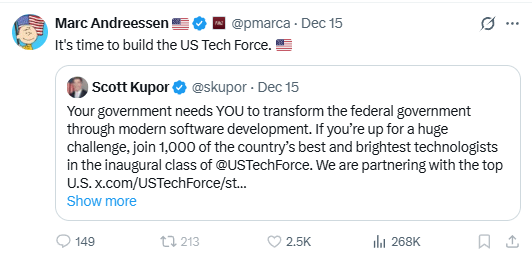
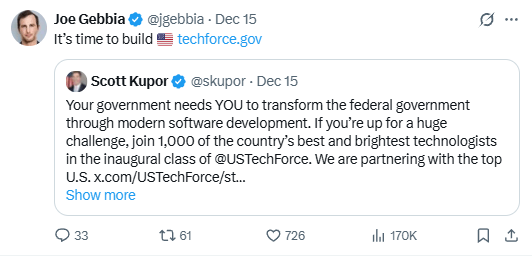
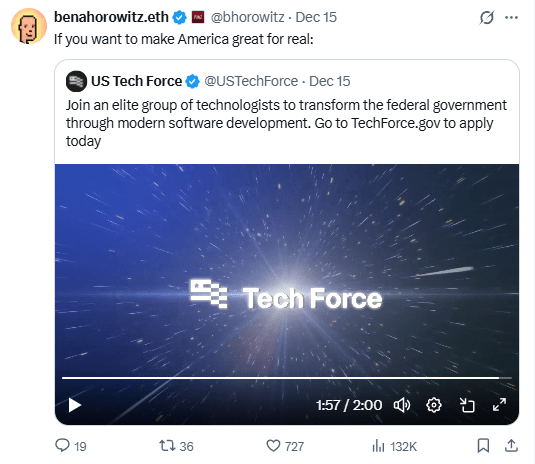
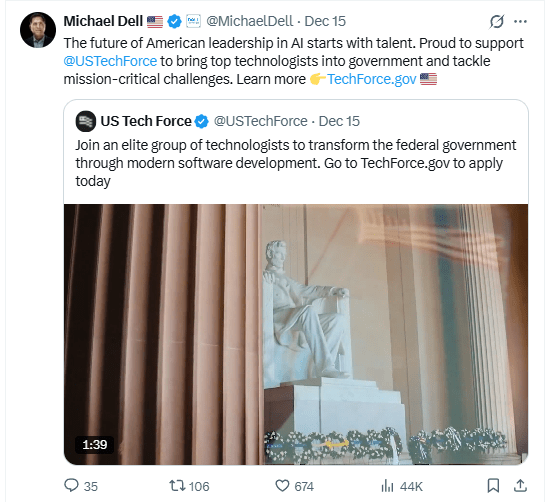
These are the people who either stayed silent or actively cheered when Musk gutted the actual working programs. Now they’re acting like this is some breakthrough moment of government-tech collaboration. Looking through the boosters, it looks like every partner at A16Z felt the need to support this. None of them seem to mention how this only came after the destruction of the programs that were doing such great work over the past decade (including during the first Trump administration).
Again, conceptually, there is merit to the idea of bringing in techies to help make government work better for the public. But it seems pretty obnoxious for these tech bros to jump into this without acknowledging (1) this existed and worked really well for over a decade until (2) they and their tech bro buddy Elon went in and destroyed it all. Also, given how the Trump admin has acted towards the public for the past 11 months, pretty rich to assume anything done by this new “Tech Force” will be in the interest of the public.
The one actual “innovation” in Tech Force creates a corruption vector that should alarm anyone who cares about government integrity: companies are guaranteeing participants can return to their old jobs after their tour of duty.
USDS never needed this because it wasn’t a problem—people could always go back to industry if they wanted. What this guarantee does is fundamentally change the incentive structure. Now you have engineers building government systems who know exactly where they’ll be working in two years, and whose interests they’ll be serving. They won’t divest from their stock. They won’t sever ties with their employer. They’ll just be on “leave” while accessing sensitive government data and making technology decisions that could directly benefit their future (and current) employer.
As the NextGov piece notes, this should set off every alarm:
“My first question with any programs like this are, ‘What are the rules that are in place to guard against conflicts of interest?’” said Rob Shriver, former acting OPM director and current managing director of Civil Service Strong at Democracy Forward.
This is especially worthy of attention, he said, given DOGE’s approach to data — “coming in and taking over agency systems and accessing data without going through the regular procedures” — which has been at the center of several lawsuits.
Scott Kupor, who is running this is a former Andreessen Horowitz partner, who was there for 16 years (basically since A16Z started) before taking this job. And he insists that there are no conflicts, so don’t worry about that at all:
The setup may vary by company, but the managing engineers from private companies participating in the program will “effectively take a leave of absence” to become full time government employees during the program, Kupor told reporters Monday. They won’t be required to divest from their stocks.
“We feel like we’ve run down all the various conflict issues and don’t believe that that’s actually going to be an impediment to getting people here,” said Kupor. “The huge benefit to the government will be getting people who are very skilled in the private sector at managing engineering teams.”
The idea is that the participants can return to their old jobs with new skills and expertise after working for the government, he said.
“We’ve run down all the various conflict issues”—except for the part where participants will keep their stock, maintain their guaranteed employment at private companies, and have access to sensitive government systems and data. But sure, no conflicts.
The value of tech expertise in government is real. That’s why USDS and 18F existed and succeeded for over a decade. What made those programs work was their careful construction to minimize conflicts while maximizing the transfer of knowledge and expertise.
This isn’t that. This is a hastily rebuilt version of a program they deliberately destroyed, now run by political appointees from the very industries that will benefit, with explicit mechanisms that invite corruption. They gutted the institutional knowledge, fired the people who knew how to do this right, and replaced it with a system where people from private companies get guaranteed access to government data and decision-making through employees who are explicitly planning to return to those same companies.
That doesn’t seem like innovation. It seems much more like regulatory capture with better branding and a cool “force” name.
Filed Under: 18f, corruption, doge, donald trump, elon musk, scott kupor, tech force, usds
Companies: a16z