YUMA, Arizona—From the air, Yuma looks like an urban peninsula surrounded by a sea of farmland. The Colorado River wraps around the western edge of the city that 100,000 people call home. A maze of levees, canals, and pipelines channel water from the river, turning the desert into squares of green. Yuma is the sunniest place on earth, and its irrigated fields put all that sunshine to work, producing 90 percent of the country’s leafy green vegetables during the winter months.
Yuma is also a border city, with California to the northwest and Mexico to the south and west. The Colorado River once served as a natural barrier to anyone looking to cross. But the Morelos Dam, built in 1950, now spans the river, diverting nearly all of the Colorado’s remaining water into a canal servicing Mexico’s Baja California farmlands. The southern side of the dam offers a mostly dry walking path between Los Algodones, Mexico, and the United States. Just a few short years ago, the path was ground zero for the southern border crisis, a place where many of the 310,000 people who crossed the Yuma sector in fiscal year 2022 surrendered themselves to Border Patrol agents.
Now, it’s almost entirely dormant.
Nearly a year into President Donald Trump’s second term, Border Patrol agents have encountered the fewest people at the southern border since the Nixon administration. In FY 2025, which includes the last three months of the Biden administration through September 30 of this year, encounters were 237,000. In FY 2024, it was 1.5 million, 2 million the year before that, and 2.2 million in FY 2022, the year that Yuma became one of the busiest Border Patrol sectors in the nation.
“Three times the size of my city came through my city,” said Yuma Mayor Doug Nicholls, reflecting on the peak of the crisis. The city had seen spikes in migrant flows before, including during the first Trump administration, but nothing like the waves of people that crossed in 2021 and 2022. “As the leader of the community, I was petrified, not because I think they were going to be causing problems or damage, but they were just trying to exist, and that humanitarian need that would be created by that we couldn’t meet as a community,” Nicholls added.
Border Patrol and local authorities had to figure out what to do with the waves of people showing up at their doorstep, often more than 1,000 every day. “It happened like an avalanche,” said Jonathan Lines, a member of the Yuma County Board of Supervisors. “It impacted every segment of our life here in Yuma.”
“People were showing up in droves at food banks, at the hospital, going through the agriculture fields,” said Chris Clem, the Yuma sector Border Patrol chief from 2020 t0 2022. “We only had two transportation buses.” Officials scrambled to find ways to transport people to Department of Homeland Security (DHS) facilities in larger cities like San Diego and Tucson lest they be forced to release people in Yuma and risk the city’s municipal resources becoming entirely overwhelmed.
Yuma’s fire department and EMS became inundated with 911 calls from border crossers, some with legitimate emergencies, others simply wanting a ride into town. The city’s only hospital spent $26 million caring for migrants over a year and a half that included the peak months of the surge. Lines recalled one point where between 3,000 and 4,000 people were on the ground waiting at the border during the winter as local churches mobilized to deliver as many blankets as they could.
“We weren’t callous, we didn’t turn them away, we took care of the humanitarian need, but we begged for the flow to stop,” Nicholls said.
Lines and Nicholls felt that their city was dealing with a national problem the community couldn’t handle and the federal government was neglecting to address. Their requests for the Federal Emergency Management Agency (FEMA) to deploy to Yuma during the height of the crisis went unanswered; some federal emergency funding would flow to help reimburse local nonprofits providing shelter, food, and transportation to migrants.
Local law enforcement would frequently respond to calls from farm owners dealing with migrants crossing into produce fields directly adjacent to the border. “You’ll see babies coming across and abandoned children,” Yuma County Deputy Sheriff Frank Duarte said. “It was very crazy.” He described dealing with anger and frustration from migrants who didn’t speak English or Spanish: “Someone could be aggressive, and then there’s that language barrier where we couldn’t communicate. It was just hard.”
The people coming to Yuma were not just from Central and South America, and most didn’t make the perilous trek up through the Darién Gap between Colombia and Panama. Migrants hailed from more than 100 countries, including India, China, and Uzbekistan. “The majority of the people we encountered, they weren’t walking up from Guatemala,” Clem, the former Border Patrol chief, said. Instead, people flew into Mexicali, in Baja California, he explained, and then smugglers would put them in stash houses before driving approximately 45 minutes to areas near Yuma where people could walk across the border. Since the overwhelming majority of migrants were claiming asylum, most simply surrendered themselves to Border Patrol agents for processing once they crossed.
“These people that we encountered, they hadn’t been walking through the desert,” Clem said of the crossers at the Morelos Dam. “They literally walked a quarter mile to come into the United States unimpeded.”
Clem and local officials say that part of what made the dam crossing such a hotspot were a few hundred feet of gaps in the border wall on the U.S. side of the river. More than 100 miles of border wall had been completed in the Yuma sector during the first Trump administration, but the day that President Joe Biden took office, he signed an executive order pausing all wall construction along the entire southern border. The Yuma gaps became a focal point for opposition to Biden’s border policies when Arizona Gov. Doug Ducey temporarily filled some of the gaps with shipping containers in the summer of 2022.
Critics of the Trump administration’s border wall construction effort have often argued that it’s more of a symbol than an effective barrier, citing how frequently the wall has been scaled or cut through by smugglers and traffickers. Clem agreed that a wall alone is not a panacea for border enforcement, but he emphasized that barriers in certain locations can be a key tool in helping the Border Patrol manage large numbers of migrants. “It’s not going to stop everybody, but it’s going to stop enough to where it gives us the tactical advantage,” Clem said.
In July 2022, the Biden administration reversed course and authorized filling some of the gaps along the border in the Yuma sector while simultaneously denying the wall was being finished. The openings across from the Morelos Dam would eventually be closed but not until after the migrant flows had peaked in the Yuma sector. Today, the former gaps stand out, since the Biden administration filled them not with the rust-colored bollards of the first-term Trump barriers but with gray metal fencing.
Even if the barrier had been completed earlier, it’s unclear how effective it would have been in stemming the surge of migrants. A few miles south of the dam, there’s another break in the wall where Cocopah Indian Reservation land begins, and many migrants also crossed there during the peak and when the shipping containers were installed by the dam. But the Yuma gaps came to symbolize the Biden administration’s broader neglect of the border crisis.
The New York Times published an exhaustive and damning account earlier this month of Biden’s border policies, and how the president and close aides ignored warnings—including entreaties from his own policy advisers even before he won the 2020 election—that the country’s southern border would see a migration surge. The president waited until he had six months left in office before limiting who could seek asylum, a move that immigration analysts believe largely contributed to the subsequent drop in border encounters in the final months of Biden’s term.
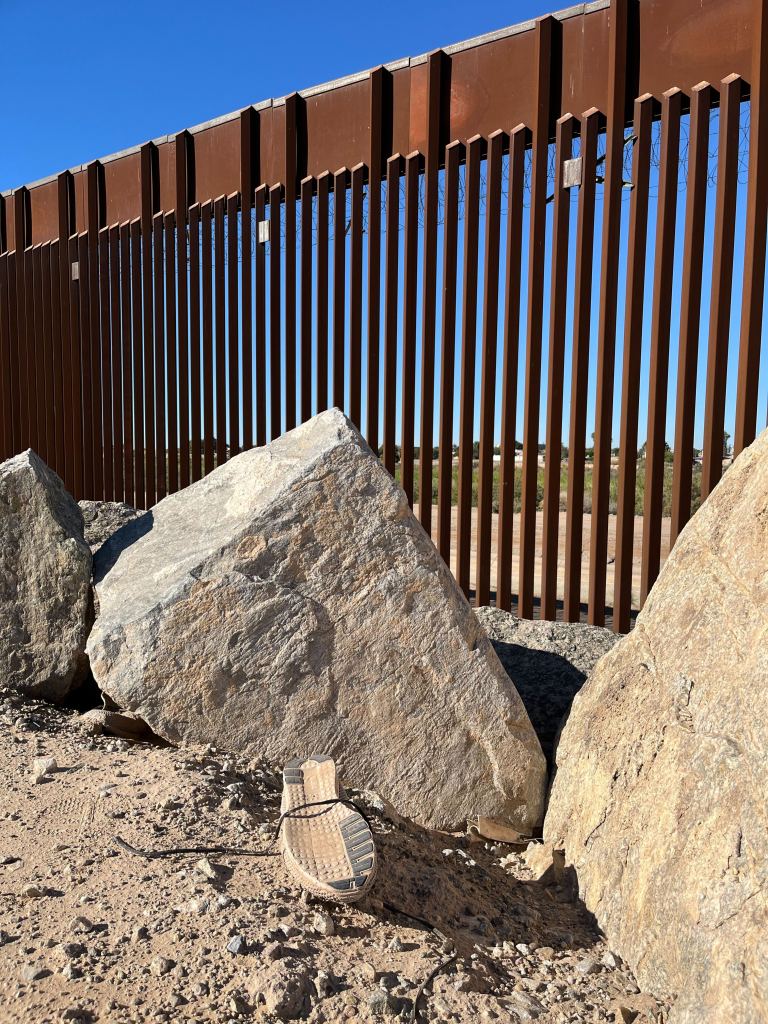
The Border Patrol was once encountering more than 1,000 people per day along the Yuma sector; now it’s only five people per day. Farmers are no longer having to plow under fields where crops have been contaminated by people walking through or sleeping in them. Near the Morelos Dam crossing, there are some remnants of a hectic scene: an old sneaker half fossilized in the dirt, a yellowed Customs and Border Patrol manual on “documenting the use of force” abandoned along an access road. No migrants in sight.
Local leaders are thankful for the calm. But they’re still worried about how Washington could deal with future surges, especially if border enforcement relaxes. Nicholls, Yuma’s mayor since 2014, emphasized that Congress needs to pass laws to make permanent the immigration and border policies that work. “This is my fourth presidential administration since I’ve been in office,” he said. “Effective policies need to be codified into something sustainable through administrations.”
He acknowledged such an effort would involve revisiting decades-old immigration laws that many grand legislative bargains have tried and failed to reform. “There’s a lot of politics in, ‘Well, if I don’t get what I want, you’re not going to get what you want,’” he added. “We’ve got to get beyond that if this is going to get solved with any sort of permanence.”