Lakurawa, the insurgents the U.S. military (authorized by … oh, something!) supposedly intended to attack in Nigeria—it is not clear that there were any Lakurawa in the area targeted—are bandits who aspire to stationary status. But they aren’t yet stationary enough, apparently!
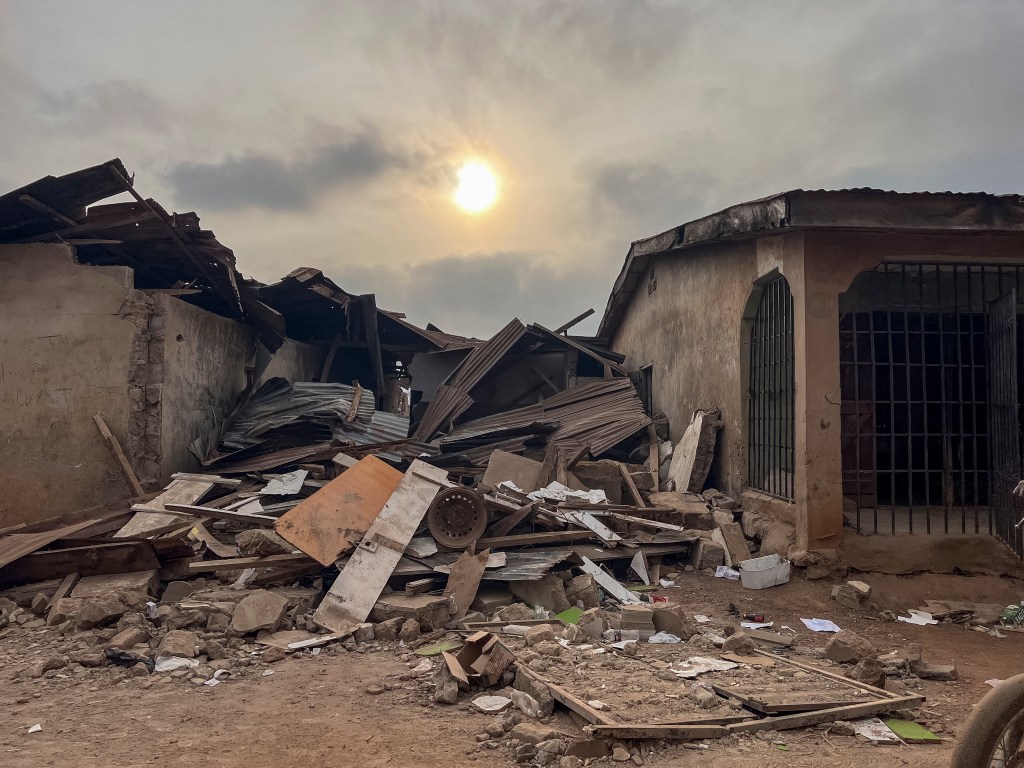
A day after part of a missile fired by the United States hit their village, landing just meters from its only medical facility, the people of Jabo in northwestern Nigeria are in a state of shock and confusion.
Suleiman Kagara, a resident of this quiet and predominantly Muslim farming community in Tambuwal district of Sokoto state, told CNN he heard a loud blast and saw flames as a projectile flew overhead at around 10 p.m. on Thursday.
Soon after, it came crashing down, exploding on impact with the ground and sending the villagers fleeing in fear.
…
While parts of Sokoto face challenges with banditry, kidnappings and attacks by armed groups including Lakurawa—which Nigeria classifies as a terrorist organization due to suspected affiliations with Islamic State—villagers say Jabo is not known for terrorist activity and that local Christians coexist peacefully with the Muslim majority.
…
Bashar Isah Jabo, a lawmaker representing Tambuwal in the state parliament, described the village to CNN as “a peaceful community” that has “no known history of ISIS, Lakurawa, or any other terrorist groups operating in the area.”
He said the projectile had struck a field “approximately 500 meters” from a Primary Health Center in Jabo and that, while there were no casualties, the incident had “caused fear and panic within the community.”
Some of you are having flashbacks to the Clinton administration’s 1998 bombing of a civilian (and, in part, veterinary) pharmaceutical factory in Sudan. (“American officials have acknowledged over the years that the evidence that prompted President Clinton to order the missile strike on the Shifa plant was not as solid as first portrayed,” the New York Times reported in 2005. “Indeed, officials later said that there was no proof that the plant had been manufacturing or storing nerve gas, as initially suspected by the Americans, or had been linked to Osama bin Laden, who was a resident of Khartoum in the [1980s].”) American presidents too often adhere to an unstated maxim: DON’T JUST STAND THERE—BOMB SOMETHING!
Parts of Nigeria are quite lawless and apparently ungovernable (at least by the ladies and gentlemen in Abuja), and Lakurawa fighters have at times ingratiated themselves with the locals by, as Olson would have predicted, clearing out bandits—bandits not associated with Lakurawa or its loosely organized set of allies. Like terrorist groups such as Boko Haram (with which Lakurawa reportedly has a relationship) or certain white-power prison gangs (or antifa, a theme to which I will return below), Lakurawa (meaning “the recruits,” a Hausa adaptation of the French les recrues) is not a tightly organized hierarchy or, as far as outside observers can tell, an organization with a clearly defined membership or specific shared goals.
What the organization is not, as both the Nigerian government and Nigerian Christian leaders insist, is a traditional ideological Islamist organization persecuting Christians or engaged in a anti-Christian genocide. It is, rather, a hybrid terrorist-criminal group. Most of its victims (who are subjected to “taxes”) are Muslim, because most of the local population is Muslim. Lakurawa does not target Muslims and Christians because they are Muslims and Christians but because they are there and because they have something worth stealing (“taxing”), in much the same way that the Revolutionary Armed Forces of Colombia (FARC) largely targeted Catholics with its “taxes” not because of anti-Catholic sentiment but because it operated in Colombia, which was almost entirely Catholic at the apex of FARC’s predations. That Lakurawa is a terrorist organization is not much contested; that it is an Islamic State affiliate waging war against Nigerian Christians is, for the most part, unsupported hogwash, to paraphrase the Institute for Security Studies:
Some analysts have speculated that the group affiliates with the IS, either through the ISSP or Islamic State West Africa Province, but there is no evidence for this. There are no traces of traditional bay’a ceremonies or allegiance pledge, through which groups assert their association with larger entities, such as al-Qaeda or the IS. Furthermore, these global terror networks communicate intensely about their achievements and those of their affiliates, whereas IS propaganda channels have never broadcast Lakurawa’s attacks.
Like Boko Haram (boko from the English books, boko haram meaning, roughly, education is forbidden), Lakurawa seems to represent a confluence of vague slogans, mutual criminal interests, and a complex network of social relationships and attitudes—in which sense it is very much like a traditional criminal gang, although it obviously differs from such gangs in important ways. Stationary bandits and bandits aspiring to stationary status exist across a spectrum of establishment and respectability.
The Taliban, for example, was for many years as much a narcotics syndicate as it was a coalition of religious and tribal factions, and it evolved as it took on formal stately functions. The current president of Syria, an actual jihadist recently feted in the White House by President Donald Trump, was previously the leader of an important al-Qaeda faction and continues to maintain many jihadist connections. What we came to know as “the mafia” at times simply was municipal government in certain parts of Sicily, providing arbitration and physical security while also acting as a kind of Catholic mutaween, policing public morality. King John of England was, if the complaints of his barons are to be believed, a lot less like King Arthur and a lot more like Saddam Hussein. Olson was onto something with that “stationary bandit” stuff.
If you’ll forgive the abrupt turn, it is probably worth noting here that this has no obvious connection to the national security or national interest of the United States of America.
President Trump, having found little opposition to his entirely lawless campaign of mass-murder theater in the Caribbean, has now entered the United States into an illegal—because unauthorized—war in Nigeria. Trump insists that Lakurawa is a proxy of the Islamic State and that it is engaged in the persecution of Nigerian Christians. While such claims are widely cited, there is little well-documented evidence for either of these assertions. And while the current “authorization for the use of military force” dating to the post-9/11 era is very broad and very much in need of repealing, there is nothing in it that could plausibly be interpreted to empower the U.S. president to wage a unilateral military campaign against local bandits in the backwaters of Nigeria. But there isn’t anything in the law empowering the president to slaughter seafaring Venezuelans or to deport U.S. citizens or to engage in any number of his current initiatives, which range from the imbecilic to the positively criminal. Mike Johnson, John Thune, and such fair-weather friends of the Constitution as Sen. Ted Cruz roll over and present their bellies, hoping for a scratch, while Democrats howl impotently.
Donald Trump is no kind of Christian—he is a toxic blend of atheist and idolator—but he knows that those in the pews are his most unshakeable supporters and that he is going to need all of the support he can get as his failure to deliver on his absurd economic promises becomes a more painful and undeniable fact of everyday life for millions of Americans watching the national debt skyrocket even faster than their grocery bills. Trump wants to pose as a crusader, coming to the aid of persecuted Christians—but only when doing so is a very low-cost proposition. It is not clear that the abuse of Christians in Nigeria is anything more than incidental to the general banditry and oppression of Lakurawa et al.—it takes too credulous a view of the fig leaf of “zakat” covering ordinary robbery—but there are places in the world where the active, brutal, ruthless repression of Christians is a real thing: In the so-called People’s Republic of China, for example—but Trump is far too low a coward to try to do anything about that, in much that same way the Russian shadow fleet is permitted to flout U.S. sanctions while Venezuelan boats are blown out of the war on unsupported drug-war pretexts that would not render the attacks any less illegal or immoral even if they were true. It is not the case that all bullies are cowards, but many bullies are cowards, and Trump is one of those, as are many of the men and women who serve him.
The jihadi-mafia hybrid terrorism of Lakurawa and allied groups is potentially destabilizing and is transnational in character. Nigeria is a strategically important country (it is Africa’s most populous country, one of its largest economies, Africa’s largest oil producer, etc.), and there may be a case for U.S. intervention there aimed at fortifying its stability. If the Trump administration would like to try to make such a case to Congress—which still retains the power to declare wars, a power not constitutionally entrusted to the president—then the case should be made, publicly, and a vote should be held. One can imagine that if, say, Paul Wolfowitz were asked to make such a case on behalf of President Mitt Romney, the chorus of those jeering like a troop of neurotic baboons would be led by supposed anti-interventionists like J.D. Vance and Donald Trump and their like. Expenditures in pursuit of actual U.S. interests (in Ukraine, for example) are, to such men and women, contemptible evidence of our national weakness. Brutal autocracies such as the one administered from Beijing are to be coddled, while third-rate caudillos such as Vladimir Putin and Kim Jong Un are objects of admiration and even friendship. Every time Putin murders a hospital ward full of expectant mothers, you can count on Donald Trump to out-Mahatma even Mohandas K. Gandhi himself in speaking of peace. But a carelessly executed and bloodthirsty crusade on the probably pretextual and certainly exaggerated assertion that the victims of ordinary banditry, terrible as their situation is, are Christian martyrs threatened by scary-looking, fez-wearing, black Muslims? Sign the Trumpkins up for that.
And Furthermore …
In search of a metaphor to describe our political period, I have settled on epilepsy as a useful one. (I ask the indulgence of non-metaphorical sufferers of that disease. As the ghost of Susan Sontag can attest, illness as metaphor has its limits. “I guess her cancer wasn’t metaphorical after all. Sorry.”) In particular, I think of American democracy as being in its grand mal era, marked by “sudden loss of consciousness” followed by violent spasms that often result in the victim’s soiling himself. That really does kind of capture the mood, doesn’t it?
There are a few of us working on projects of center-left/center-right cooperation in support of the fundamentals: the rule of law, democracy, free speech, etc. It is slow going, and annoying. One reason for this is stupidity. I don’t intend to do a “one for you, one for you” thing like I’m handing out cookies to my toddlers, but the gobsmacking imbecility of the populist right is at least matched by the stupidity of the bedwetting left, a fact of which I am reminded during my daily reading of progressive-leaning opinion. (I do not need to read very much right-wing opinion.) You can read the toddler-level droppings of, e.g., Mike Lofgren writing in Salon, where he savages conservative Trump critic George Will for being … a conservative Trump critic, one who remains committed to that “conservative sensibility” that Will writes about, meaning the controversial idea that the political wisdom of conservatism is in working to conserve the founding ideals of the United States against reckless innovation and irresponsible novelty.
You can read stuff so dumb and dishonest that I will not link to it insisting “SCOTUSblog Falls Into the MAGA Orbit,” because it has been acquired by … us, Dispatch Media, where you can get the latest from the author of The Case Against Trump and “Witless Ape Rides Escalator,” from Jonah Goldberg and Steve Hayes, from Nick Catoggio, from podcast regular David French, from Megan McArdle, and other such non-obvious personifications of the MAGA tendency.
You can also read such sentences as this:
Those on the far-right believe that antifa is a terrorist organization, when being anti-fascist is literally one of the reasons why we fought Nazi Germany during World War II.
That sentence, from Brian Karem, also writing in Salon, is surely the work of someone who has never heard of the Baader–Meinhof Gang or Shining Path or other similar terrorist organizations supposedly committed to an antifascist agenda, as though simply declaring oneself “antifascist” were the beginning and end of the thing. Vladimir Putin says that his war against Ukraine is an anti-Nazi campaign, which, if we were to take seriously the mode of analysis offered by such a numpty (I’m thinking of adding a “Numpty of the Week” section) as Karem, would put the Russian rape and pillage of Ukraine on the same moral footing as the Normandy invasion.
If our friends on the left were serious in their insistence that the United States is in a condition of national crisis—and I believe that it is—then they would take a more serious and responsible approach toward the project of working with those who believe Trump and Trumpism to be an assault upon our national institutions and values (with the occasional failed coup d’état in the mix to really drive home the point) than they are.
But rather than rising to the occasion, we get another variation of the grand mal political seizure—spasms, loss of consciousness, and the predictable mess that needs cleaning up.
Economics for English Majors
Part of the mess that is going to need cleaning up is, of course, the national debt, which continues to grow dangerously under the fiscal incontinence of Donald Trump and Trump-aligned Republicans in Congress. The absolute size of the debt—currently pushing $40 trillion—is one metric to watch.
Another relevant metric is the size of debt relative to GDP (currently pushing 120 percent), which helps give you an idea of the load-bearing capacity of the United States when it comes to public debt.
Yet another useful metric is the growth of the debt relative to the growth of the economy—useful but too alluring for those who are vulnerable to the politics of wishful thinking, people like my friend Larry Kudlow who argue that if we could just get growth high enough then we wouldn’t have to worry very much about the deficit, which is true as a matter of math but irrelevant as a matter of history and current economic conditions. For the past 20 years, average real GDP growth has been less than 3 percent, while average deficits have run closer to 4 percent of GDP. Other than the significant reduction in debt as a share of GDP in the late 1990s (from 64 percent to 54 percent) the trend has been ever-upward under many different presidents and Congresses and economic policies: Debt as a share of GDP is about three times today what it was when Lyndon Johnson was president—a much larger share of a much, much larger economy.
Another metric: maturity of debt. We sell 30-year bonds, but the average maturity of U.S. debt is less than six years—meaning that most of our debt is due to be paid or refinanced every 71 months. That relatively short maturity schedule means that our national finances are relatively exposed to sudden changes in interest rates. We don’t have our debt locked down for 20 years or 30 years. And that matters because of …
… who holds the debt. For most of our history, U.S. government debt was held by other governments, by central banks and big public institutions of that kind, which held U.S. debt for reasons that were not primarily profit-driven. As Geng Ngarmboonanant reports in this eye-opening New York Times column, that has changed radically in recent years, with private actors—hedge funds and the like—emerging as the largest buyers of U.S. government debt. The Bank of Japan (Japanese institutions—not the Chinese—are the largest overseas holders of U.S. debt) probably isn’t going to suddenly dump its holdings of U.S. debt in response to a change in market conditions. But a profit-seeking investor might—moving quickly in response to changing conditions is, after all, what successful investors do.
The Treasury market is now more exposed to profit-driven market forces than before, and the country has high amounts of debt, making upswings in interest rates and changes in other borrowing terms very costly. As we sustain and potentially increase our extraordinary deficits, the return of the private sector into our debt markets will most likely result in higher interest rates, as private investors demand greater compensation for holding U.S. debt than their policy-driven counterparts. Rates will probably be more volatile as well, swinging more sharply in response to data, policy signals and America’s now chronic political dysfunction.
U.S. officials are especially nervous about the growing role of hedge funds, whose highly leveraged trades can be disrupted by market turbulence and amplify turmoil in the Treasury market. Over the past four years, hedge funds have doubled their footprint in the U.S. debt market, making the Cayman Islands—where many hedge funds are officially based—the place where the most U.S. debt outside the United States is held, according to the Fed. Typically, people flock to Treasuries for safety in times of crisis. Yet, driven in large part by hedge fund activity, the Treasury market went through unusual turbulence during recent shocks, including the onset of the Covid-19 pandemic in March 2020 and President Trump’s “Liberation Day” tariff announcement in this past April.
Recently, the United States has seen investors demanding higher premiums to invest in our long-term debt—a reflection of growing uncertainty about the country’s economic and fiscal outlook. According to the most commonly used measure, this premium currently clocks in at roughly 0.8 percentage points for the all-important 10-year Treasury, a seemingly small number that translates into billions of dollars in extra interest costs. These costs aren’t felt just by bond traders on Wall Street or by the government. Higher rates squeeze household pocketbooks and businesses’ bottom lines. They slow economic growth as new public debt crowds out private investment.
I suppose that’s good news … if you are a cheap demagogue. Blaming Wall Street or hedge funds or whatever is going to be a lot more attractive than blaming the dolts in Congress and the dolts who put them there.
And Furtherermore …
Jim Beam will suspend bourbon production at its main distillery for a year, a result of a glut in the market due in part to Trump’s idiotic tariffs (which have hurt U.S. whiskey exports) but also in part to reduced consumer demand for cheap bourbon. About the latter, I will say: Mea culpa. For many years, I drank all of the cheap bourbon I could and some pretty good stuff as well, and if I had thought that the unintended consequences of my recent efforts at self-improvement would inconvenience the ladies and gentlemen at Suntory so greatly, I might have tried to organize something to make up for that lost volume. So, I guess what I’m saying is, I need … about 20 volunteers.
Words About Words
Paul Finkelman, writing in Slate about Trump’s habit of naming everything in sight after himself like some bottom-shelf third-world potentate:
Josef Stalin appeared on numerous stamps while he was the dictator of the Soviet Union and renamed a major city Stalingrad, after himself.
Stalin named it Stalingrad, after himself, you’re saying?
What a relief! It would have been weird if he had named it Stalingrad after someone else. Like if there was a baker named Stalin who made really, really good pryaniki and the murderous dictator named a major city after that guy, because of the cookies.
New York Times headline: “How One Father Created an Organ Empire.” I was hoping he was going to be a man named Wurlitzer.
Elsewhere
You can buy my most recent book, Big White Ghetto, here.
You can buy my other books here.
You can check out “How the World Works,” a series of interviews on work I’m doing for the Competitive Enterprise Institute, here.
In Closing
Assuming the weather cooperates and nobody changes his mind, I’ll be on The Fifth Column podcast with some old friends on the episode to be released January 6. I have thoughts about that date! And I’m looking forward to sharing them.