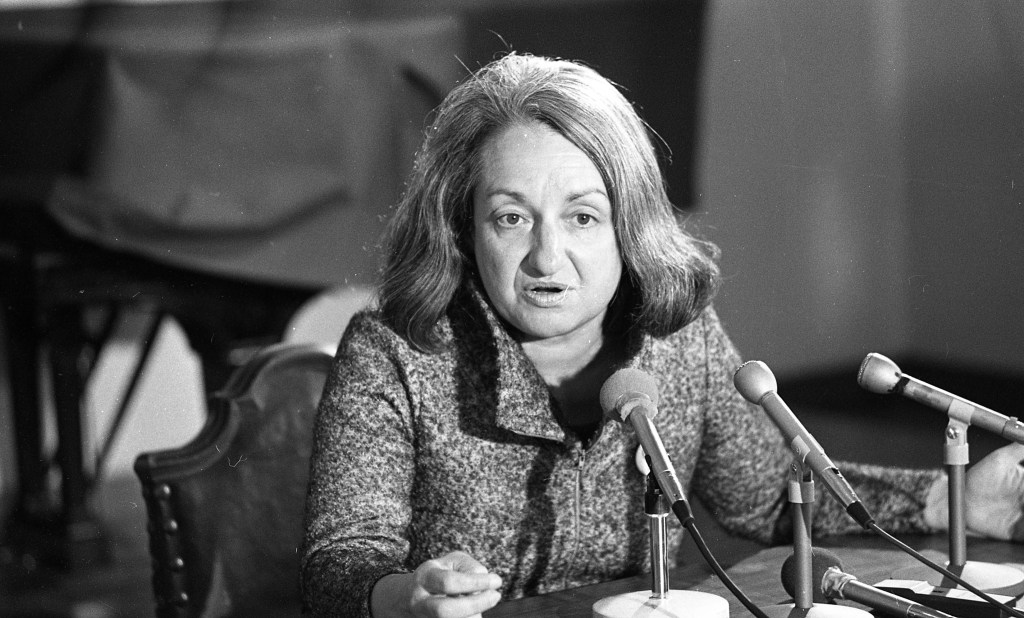
In 1963, a book written by a depressed and frustrated stay-at-home wife and mother effectively launched second-wave feminism. For Betty Friedan, a left-leaning, pro-labor journalist before she was a mother, there was nothing good about an intellectual woman staying at home with her children as her main companions. The three Cs—cooking, cleaning, and (worst of all these) child care—were drudgery of the worst kind, she declared. The Feminine Mystique reads today as the sort of things one might tell one’s therapist—and, indeed, Friedan had approached her therapist about coauthoring the book with her. He demurred.
And yet, the popularity of the book shows that it hit a nerve. To some extent, this nerve is still a sore point even for mothers who have never heard of Friedan. The question Friedan posed is remarkably common, in fact: How might an intellectual woman cultivate a flourishing life of the mind while raising children? And even: Why might a woman cultivate a life of the mind while raising children? What’s the point of it, or what good is it, if it does not contribute to the household income or the ever-important GDP? To be clear, for Friedan these were rhetorical questions: In her view, the life of the mind was incompatible with the homemaker’s life. This view persists in our society, and there are multiple problems with it, but I will mention just two.
First, such a view presumes a naively compartmentalized idea of mothers—they can be mothers or they can be intellectuals. They cannot be both at the same time for mysterious reasons that no one talks about, but whose origins we can perhaps attribute to Aristotle and other scientific misogynists of yesteryear. Ancient writers and poets, from Semonides to Aeschylus to Aristotle to Ovid repeatedly portrayed women as intellectually lightweight and lazy. Some of these authors also disputed just how much women actually did to contribute to the creation of a child, other than offering their body as a container for growing offspring. Aeschylus’ Apollo holds up Athena, the warlike goddess of wisdom, as the ideal goddess and female: Lacking a mother, she was born fully formed from Zeus’s head, and she remained a virgin, never having children of her own. Implicitly, this is what feminine brilliance in the Greek imagination looked like.
We have clearly moved beyond this, and yet the demands of careers and of motherhood remain difficult to reconcile in many workplaces, including in the academy. It is fundamentally impossible to be in the office for 40 or more hours per week while simultaneously caring for an infant. Except, while Friedan bemoaned the norms of her day that required women to leave work upon the birth of children, today’s societal norms are only too happy to have women get back into the workplace full-time once the baby is six weeks old, placing said baby in daycare. But either scenario presents motherhood and career as almost completely mutually exclusive.
Second—and no less insidiously—Friedan’s view dictates a low anthropology of children as beings not worth the attention of adults, whose very intellect beckons them outside the home, the outside being the only place where good ideas can flourish. In a 2023 interview for Public Discourse, the talented editor, writer, and erstwhile homeschooling mother Haley Stewart told a striking tale of her own journey through this issue. After she was offered placement into a doctoral program in art history, she spoke with one of the female professors in the program as she was trying to decide whether to accept the offer:
She was basically saying that all of the work of caring for a toddler, which is where I really felt called to be at the time, was just meaningless drudgery. I was going to become intellectually stagnant. My life would be over. And then the really interesting thing she said was, “at your son’s age” (he was eighteen months old), “a dog could take care of him.” She was talking about how I could compartmentalize my life, have someone else to do this meaningless drudgery, and I could do something interesting. And I didn’t want to compartmentalize my life. I wanted to integrate my life.
Based on this interview, Stewart decided to skip the Ph.D. program. Instead, she built from home a successful intellectual career as a writer and editor—its beginning years coinciding deliberately with her years taking care of her small children and homeschooling them.
Intellectual motherhood is not a contradiction in terms. It’s just that the intellectual life of a homemaker mother will look drastically different from anything you might see described in productivity books, most of them written by men and for men. Even one of my personal favorites, Antonin Sertillanges’ brilliant The Intellectual Life: Its Spirit, Conditions, Methods, is sure to drive a mother of small children to tears and existential despair, writer and mother Laura Fabrycky found. Among the most obvious hurdles, Sertillanges’ recommendation for creating “a zone of silence” proved utterly impossible while caring for two preschoolers and a newborn. In reading Sertillanges, Fabrycky realized that the work of homemaking that consumed her days did not square with descriptions of intellectual life and work that she read about, even as she remained instinctively convinced that the work she was doing in the home was intellectual too.
Such a conviction has been part of my motherhood journey as well: It is possible to be both a mother and an intellectual in the same body and mind, but such a life may look different from what we have been conditioned to expect, whether in secular or Christian circles. So what might this other intellectual life look like? It took some trial and error for me to find the answer to this question for my own life—and it looked a bit different at various stages.
I received a doctorate in classics, and my oldest son was born while I was in the throes of writing my dissertation. I then worked for 15 years as a professor, rising to the rank of full professor of history at a state university in the South. But then I walked away from full-time work outside the home and reconfigured my working life, instead, into part-time writing and editing. Two and a half years later, the vast majority of my waking hours each of the seven days of the week are spent with my children, because I believe that this is the best way I can spend my time in this season of life. Perhaps the best word to describe this is vocation—a calling that is more than just instinct, that is spiritual in nature as well. I have a vocation as a wife and mother.
At the same time, I continue to pursue intellectual work as a writer and an editor, because I delight in the intellectual life and cannot imagine happiness without it (perhaps this is the one conviction I hold in common with Friedan). Furthermore, I believe that my children deserve a mother who continues to grow and flourish as a thinker—and can discuss ideas with them, cultivating their own life of the mind.
But there is more to it than that. It is because of homeschooling—not in spite of it—that my intellectual life is richer than it was when I was a full-time academic. This may sound counterintuitive, but it has to do with that same demon that haunted Betty Friedan: drudgery.
Whenever we speak of drudgery, we generally mean tasks endlessly repeated that seem unproductive or soul-sucking. You sweep the floor, but then you feed your people a meal, and now the floor is covered with crumbs yet again. (Solution: Create a chores system in your home. Teach your children to sweep the floor.) Or you do laundry, but then all these people who spent the day wearing those clothes are going to put those same clothes in the laundry hamper at the end of the day. So rude!
But then, you may be teaching (as I was for 15 years) freshman history, increasingly more often online, to students who are not interested in the class material, skip lectures, and keep cheating on writing assignments. And this was before AI became rampant on most college campuses. That, too, is drudgery. I also spent hours each week on committees that, often, accomplished nothing but had to meet nevertheless for reasons no one quite understood. At least I did not have to serve on the special committee on committees (it was supposed to figure out a way to reduce all the committees proliferating on campus, so naturally only a committee would do for the job). By the time I had completed all the other required tasks as part of my job as an academic, there were no hours left for an intellectual life, I realized. As a full-time professor, I had an intellectual life and career in name only, not in practice.
By contrast, I recently spent an hour sitting next to my 10-year-old son at the piano, helping him with a piece he is learning. I spend hours each week reading aloud with my children, working on Greek and Latin with my 10-year-old, phonics with my 6-year-old, and helping both with various projects they have going at any given moment. There are half-complete puzzles all over the downstairs, strange crafts half-finished in multiple room corners, and someone is always humming something. It is a chaotic life with exciting and different creative activities each day. The result is inspiration, never drudgery, for any of us. Even if, yes, the laundry never ends, and everyone is always asking for a snack. At least they sweep up the floor after.
Since leaving academia, I have published three books and a full first draft of the fourth one is complete. Much of this writing happens while my husband handles the bathtime-and-bedtime parenting shift after dinner, although sometimes I stay up late after everyone in the house is asleep. I am convinced this writing pours forth so easily now because I only have a limited time to write each day, but significant time to think, process, and experience life with children who are fully present, engaged, and delighted to explore the world and have deep discussions with me. It is not up to Sertillanges’ standards of solitude, but it is something. I also have part-time responsibilities as an editor and, as of August of last year, interim director of the master’s program in creative writing at Ashland University. Like my writing, these too energize me and give me new ideas. But for these responsibilities as well, I am more convinced than ever that success at these tasks is only possible because I have clear boundaries around the time I am able to give them.
Not every mother would delight in this kind of intellectual life. But I hope every mother will find a way to integrate her life, seeing the beauty of a motherhood filled with ideas, inspiration, and time with image-bearers who are worth the time and attention we give them. When it comes to cultivating the intellectual life of mothers, children are not the enemy. They are cherished companions on the path to a flourishing mind—and spirit.