Thirty-six states will also hold gubernatorial elections, five of which—Arizona, Georgia, Michigan, Nevada, and Wisconsin—the Cook Political Report categorizes as toss-up races.
America is not the only country heading to the polls this year. A few notable elections:
- Thailand: Thailand will hold a snap parliamentary election on February 8 after Prime Minister Anutin Charnvirakul dissolved the House in December amid issues with the opposition People’s Party and heightened nationalism tied to a border dispute with Cambodia. Given Thailand’s fragmented party system, the election will likely result in another coalition government.
- Bangladesh: Days later, Bangladesh will hold parliamentary elections on February 12—its first national vote since a student-led uprising forced then-Prime Minister Sheikh Hasina to flee in August 2024, replaced by an interim government led by Nobel laureate Muhammad Yunus. Hasina’s Awami League is barred from contesting, upending the usual two-party contest. The center-right Bangladesh Nationalist Party (BNP) is the perceived frontrunner, with the once-banned Islamist party, Jamaat-e-Islami, predicted to come in a close second. A coalition government is possible.
- Colombia: Voters will elect a new president on May 31 to succeed the term-limited left-wing President Gustavo Petro, who departs with an approval rating under 40 percent, and late last month declared an “economic emergency” after the Colombian Senate voted down legislation to increase taxes. Left-wing candidate Iván Cepeda, a senator, will be on the ticket for Petro’s political party and faces several other contenders, including right-wing lawyer Abelardo de la Espriella and the centrist Sergio Fajardo. If no candidate secures at least 50 percent of the vote, the race will go to a runoff between the top two finishers later in the year.
- Sweden: Sweden will hold elections on September 13 to seat members of its legislature, the Riksdag, as the center-right coalition of Swedish Prime Minister Ulf Kristersson looks to maintain its parliamentary rule. But Kristersson’s Moderate Party currently trails in polls to the left-wing Social Democrats, led by the opposition leader in parliament, Magdalena Andersson. Kristersson also trails the right-wing populist Sweden Democrats and their leader, Jimmie Åkesson.
- Brazil: 80-year-old President Luiz Inácio Lula da Silva—who was elected to a third, non-consecutive term in 2022, and previously served from 2003 through 2011—is not ready to retire and has announced he’s running for reelection in October. Lula leads in the polls, but faces competition from the right, including from Eduardo Bolsonaro, the son of jailed former President Jair Bolsonaro, who attempted a coup following his own electoral loss to Lula in 2022. The younger Bolsonaro also faces charges for appealing to Trump, allegedly urging him to intervene in his father’s legal case.
Apart from elections, global conflicts continue. Fighting persists in Sudan, the Congo, and on the Thai-Cambodia border, but nothing has as much focus—for the world or the American president—as the conflict between Russia and Ukraine, now almost four years since Putin’s invasion.
Negotiations to end the conflict have been progressing but haven’t reached the point of a breakthrough. According to Zelensky, Trump has offered a 15-year security guarantee to Ukraine, stating he would provide protections similar to those stipulated under NATO’s Article 5 clause, which provides that an attack against a NATO ally “shall be considered an attack against them all.” Though neither country has provided specifics to the prospective arrangement, France is hosting officials from the U.S., European nations, and Ukraine in Paris today to discuss security guarantee proposals.
Russian President Vladimir Putin has made clear that he wants Ukrainian territory included in any potential peace deal, including the entirety of Ukraine’s eastern Donbas region, and pledged as recently as last month to seize the area through military force should Ukraine not withdraw its troops and cede the region. Late last month, Zelensky told reporters he was open to withdrawing troops from Ukraine’s eastern Donetsk oblast, situated in the Donbas, provided that the area is transformed into a new demilitarized “free economic zone” and not absorbed into Russia’s borders. But Zelensky said he would not surrender territories in Donetsk that Ukrainian forces continue to hold and defend from Russian invaders, terms that Putin has deemed unacceptable. Russian state-sanctioned news outlets reported late December that Putin informed select Russian business leaders that he would be open to an unspecified territorial swap with Ukraine to achieve a peace deal, but reaffirmed his desire to control all of the Donbas region.
The U.S. economy entering 2026 doesn’t appear to be trending toward an economic Golden Age or a recession:
- According to the Bureau of Economic Analysis, nominal GDP grew to $31.1 trillion in the third quarter of 2025, about 2 percent higher than in the second quarter. Real GDP—which accounts for inflation—increased 1.1 percent in Q3 on a quarterly basis and 4.3 percent at an annual rate.
- In November 2025, the consumer price index (CPI), a key measure of inflation, increased 2.7 percent year over year.
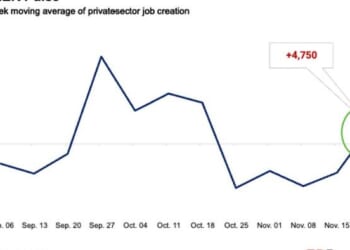
- According to Bureau of Labor Statistics data, the economy added 64,000 nonfarm jobs in November, following a 105,000-job decline in October, exceeding the Dow Jones month-over-month job-gain estimate of 45,000.
- The unemployment rate grew to 4.6 percent in November, a 0.2 percentage point increase from September.
This is a more optimistic outlook than the first quarter of 2025—when real GDP shrank—but there are reasons to be skeptical about correlating recent GDP gains with substantive economic growth.
Looking at the private sector, there are many business stories to keep an eye on this year—the Netflix purchase of Warner Bros., a potential Hollywood writers strike, the fate of TikTok, SpaceX possibly going public, and so on—but the biggest story to watch will be artificial intelligence. Is this an enormous bubble, bound to pop? Or the beginning of a technological revolution that could replace your job altogether?
Millions are using chatbots as personal assistants and even digital companions, and AI power users do not generally share the argument that AI model advancement has slowed, with late 2025 models—such as Anthropic’s Claude Opus 4.5 and Google’s Gemini 3—making significant capability gains over the best models available in Q1. These were made largely without benefiting from the largest AI data center buildouts, which should start yielding more results this year.
But AI’s advance hasn’t yet led to widespread workplace adoption. A mid-2025 McKinsey & Company survey found that almost two-thirds of respondent firms had not yet begun scaling AI across their organizations, and that AI deployment has occurred primarily in insurance, tech, media, telecommunications, and health care, and mostly to handle IT work and knowledge management tasks. The promise of fully autonomous AI “agents” has yet to be fulfilled.