Editorial note: this essay originally appeared at The Giving Review.
***
This year, Independent Sector’s (IS’s) “trust survey looked more closely at American trust regarding nonprofit involvement in elections,” according to its newly released Health of the U.S. Nonprofit Sector. “Tax-exempt nonprofits are not legally permitted to endorse or oppose candidates in political elections—a rule known as the Johnson Amendment—but just 27% of Americans say they have high trust in nonprofits to remain neutral during elections.
“When the Johnson Amendment is explained to respondents,” the IS report continues, “a plurality of both liberal and conservative respondents say the existence of the rule makes them more likely to trust nonprofits and repealing it would make them less likely to trust nonprofits,” as the below chart from the report shows.
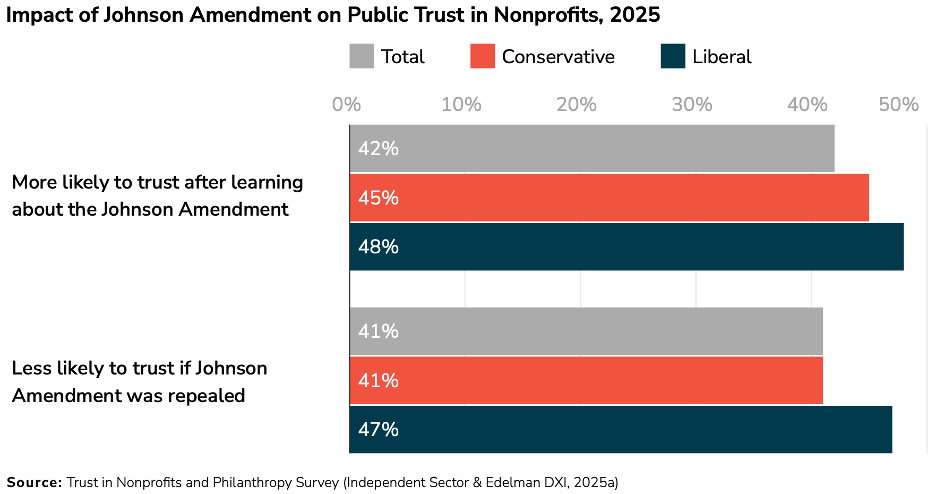
IS “strongly supports retaining the Johnson Amendment to sustain public trust in the nonprofit sector,” its report reminds readers three pages later. “Tearing down the wall between the sector’s charitable and public interest missions and partisan politics could seriously harm the ability of the sector to bridge societal gaps and provide vital services.” It then urges readers to contact their Congressional representatives about protecting the Johnson Amendment.
Lamentable decreases, new questions
The next section of IS’s Health of the U.S. Nonprofit Sector documents what it considers to be lamentable decreases in “the number of nonprofits who say they lobby or otherwise do public policy advocacy” from 74% in 2020 to 31% in 2022 and in nonprofits’ “understanding of which advocacy activities are legally permissible for nonprofits,” as shown by the below chart from the report. IS supports nonprofits’ policy advocacy, and it offers various resources to help nonprofits engage in it.
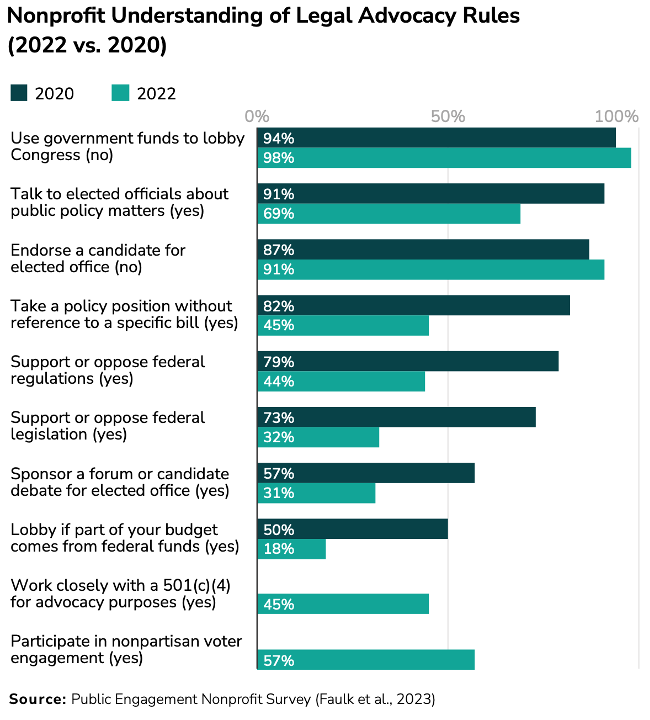
In 2022, the dataset from which this documentation comes additionally includes answers to new questions about nonprofits’ understanding of their ability to “[w]ork closely with a 501(c)(4) for advocacy purposes” and “[p]articipate in nonpartisan voter engagement.”
Specifically, according to the ’22 survey, less than half of nonprofits understand that they can work closely with a (c)(4) group—which have much more leeway to engage in politics, including voter registration, and lobbying than nonprofit charities categorized under § 501(c)(3) have, but contributions to a (c)(4) are not tax-deductible. Almost six in 10 respondents understood that their nonprofits could participate in nonpartisan voter engagement.
Skepticism, neutrality, and nonpartisanship
Then, though, Health of the U.S. Nonprofit Sector tells us, Americans overall
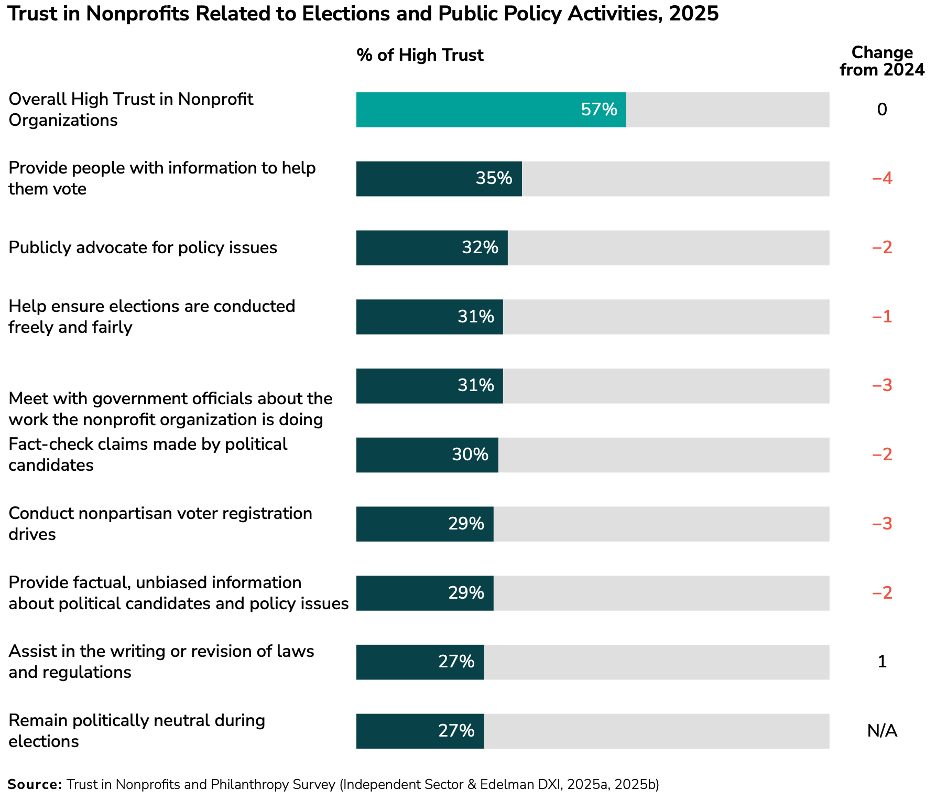
are less certain they can trust nonprofits when it comes to engaging in public policy. For instance, though 57% of Americans say they have high trust in nonprofits in general, just 33% say they have high trust in the sector to publicly advocate for policy issues. These attitudes were slightly more negative in 2025, a worsening of already low trust in 2024. This likely reflects general skepticism about the role and trustworthiness of government and relationship of nonprofits to government rather than a specific belief that nonprofits are likely to be worse at advocacy than others would be ….
(Citation omitted.)
Specifically, according to the report, only 27% of Americans say they have high trust in nonprofits to “[r]emain politically neutral during elections” and only 29% have high trust in nonprofits to “[c]onduct nonpartisan voter registration drives,” as shown in the below chart from the report.
The public interest and partisan politics
So, IS’s survey results evince a tension about nonprofits’ involvement in politics and elections—not so much among Americans answering its questions, but within its own positions on them. Both the survey respondents and IS, according to its data, have concerns about nonprofit charities’ direct involvement in political elections. IS is also concerned about how such involvement adversely affects the level of trust in all nonprofits.
Americans, according to the IS data, also sure seem skittish about—distrustful of—charities’ supposedly nonpartisan voter-registration and many other election- and politically adjacent activities. IS, not so much; in fact, it actually wants them to engage in more of it, seeing Americans’ distrust of them in this context as a challenge to be met and overcome.
The answers to IS’s various survey questions beg another, of IS: why less worry about what those purportedly charitable voter-registration and election-adjacent activities are doing to trust in nonprofits?
More specifically: if, as the reports says about any contemplated demise of the Johnson Amendment, “[t]earing down the wall between the sector’s charitable and public interest missions and partisan politics could seriously harm the ability of the sector to bridge societal gaps and provide vital services,” why don’t existing and ongoing voter-registration and related election and political activities do the same?