President Donald Trump has a plan for Venezuela. American oil companies will return to the country, rebuild its decaying petroleum infrastructure, and reclaim what Trump called “the greatest theft in the history of America.”
“The oil companies are going to go in and rebuild their system. They’re going to spend billions of dollars, and they’re going to take the oil out of the ground, and we’re taking back what they stole,” Trump said on Sunday. “Remember, they stole our property. … Nobody has ever stolen our property like they have.”
But Trump’s vision of a swift return to Venezuela for American oil companies faces a complex reality. Venezuela still operates under the same laws that forced American companies out nearly two decades ago, the country’s oil industry infrastructure has deteriorated to an unknown extent, and major oil companies remain wary of reentering a market where their assets were once seized without compensation. On top of that, the Trump administration has been largely silent, at least publicly, about its long-term plans for Venezuela, leaving the very investors it’s depending on to rebuild the country’s oil industry torn between the wishes of the White House and an uncertain reality in Caracas.
One indication of how the administration plans to proceed emerged yesterday when Energy Secretary Chris Wright said that the U.S. will take control of the sale of oil from Venezuela moving forward. Oil exports from the country have been subject to sanctions since 2019, but, according to Wright, will now be sold on the global market with proceeds going to U.S. government accounts and, eventually, used to benefit the Venezuelan people.
Trump is correct about at least one thing: Venezuela has largely squandered its immense natural resource wealth and is ripe for foreign investment. Despite having the largest oil reserves in the world—more than 300 billion barrels, surpassing even countries like Saudi Arabia and Iraq—Venezuela has never approached maximum extraction of its most valuable national resource. In the first half of the 20th century, that production deficit was the result of a general lack of infrastructure, refining capacity, and technical expertise. After World War II, however, foreign investment into production, transportation, and refining infrastructure soared, nearly quadrupling from $1.2 billion to $4 billion between 1947 and 1958. As a result, Venezuela’s oil production more than doubled from 1.2 million to 2.6 million barrels per day during that period. Total crude oil production in Venezuela eventually peaked at 3.7 million barrels per day in 1970.
However, much of the infrastructure that made such output possible is now in decay, and the country’s oil production has plummeted. In 2024, Venezuela produced only around 900,000 barrels of oil per day, a substantial decrease from the more than 3 million barrels per day it was producing before President Hugo Chávez took power in 1999. Under Chávez’s socialist regime, the Venezuelan government seized assets from international oil companies, and proceeds from the oil industry were redirected away from investments in infrastructure and toward political and social projects. “All the funds were going into the government, and the industry didn’t have the budget to continue improving their operations and continue investing in their infrastructure,” Luis Zerpa, a Venezuelan-born professor of petroleum engineering at the Colorado School of Mines, told The Dispatch.
Chávez wasn’t the first Venezuelan leader to encroach on the country’s oil industry. The Venezuelan government’s involvement in oil production is about as old as the industry itself. In 1943, buoyed by Allied reliance on oil during World War II and emboldened by Mexico’s nationalization of U.S. oil assets five years earlier, Venezuela issued the Hydrocarbon Law of 1943, which introduced heavy royalties on oil production and income taxes on foreign companies operating in Venezuela, many of which had flocked to the country in the aftermath of World War I. While it was a far cry from nationalization, it resulted in the Venezuelan government taking around a 50 percent share of gross profits from oil operations in the country.
American and European oil producers, however, saw the country’s 50-50 profit share as a worthwhile cost of business, and continued to invest heavily in the region. But in 1976, the country fully nationalized its oil industry, replacing numerous affiliates of U.S. oil companies like Exxon, Mobil, and Phillips with affiliates of a new state-run oil company called Petróleos de Venezuela, S.A. (PDVSA). The transition was both expected and relatively smooth, and U.S. companies were compensated—though not entirely—for losses of equipment and other investments.
In the 1990s, Venezuela’s Apertura Petrolera policy—intended to increase investment and development of production in the oil-rich Orinoco Belt—introduced agreements with international oil companies like ConocoPhillips, Sincor (a partnership between Total and Statoil), Ameriven (a partnership between ChevronTexaco and ConocoPhillips), and ExxonMobil. While the agreements did not denationalize Venezuela’s oil industry, and oil resources remained under state ownership, they did allow international oil companies to operate and invest in new oil projects. Oil production increased to a peak of 3.5 million barrels a day in 1997.
Upon taking power in 1999, however, Chávez began slowly rolling back and tightening Apertura Petrolera’s more liberal arrangements. In 2007 Chávez forced foreign oil companies to renegotiate their contracts and enter into joint ventures where PDVSA, under the control of the Venezuelan government, would now hold a majority stake. Some firms, like Chevron, accepted the new terms and became minority partners in joint ventures. Others, like ExxonMobil and ConocoPhillips, refused and saw their assets seized without compensation as a result. Both ExxonMobil and ConocoPhillips sought compensation for investment losses and have won billions of dollars in international arbitration cases—awards that Venezuela has largely avoided paying.
Trump’s hope that American oil companies that were once expelled by Venezuela will now choose to return depends on his administration’s ability to facilitate stable reform within the country—which remains the biggest unanswered question following Saturday’s capture of Maduro. As of now, the country’s oil industry is still controlled by allies of Maduro and governed by the same laws that forced American companies out decades ago. “The same laws that expropriated Conoco and Exxon, we have them now,” Evanan Romero, a petroleum engineer and former Venezuelan government minister who has worked closely with the country’s opposition, told The Dispatch. “We need to change it. We need to convene a congress or legislature, and there is no political way of organizing one. So how are we going to attract [international oil companies]?”
The capital-intensive nature of extracting oil from Venezuela’s rich reserves is one obstacle. Most of the country’s oil reserves are made up of heavy and impure crude. Crude oil that contains very little sulphur—known as light sweet—is easier to extract and refine due to its lower viscosity and higher purity than heavy crude with high sulphur content—known as heavy sour. Most of Venezuela’s proven oil reserves are very heavy and very sour, which creates significant logistical and technological hurdles to its extraction, transportation, and refinement.
However, many of the oil refineries in the U.S., especially those concentrated around the Gulf and West Coasts, were designed specifically to process the heavy crude oil extracted from Venezuela and Mexico, so they are particularly well suited to take up additional production demand should Venezuela’s oil output grow.
But growing Venezuela’s output will hinge on resolving some of the nation’s political and economic uncertainty, and reassurance on both are needed from the Trump administration. “The main barriers have to do with political risk and security,” Antoine Halff, co-founder of the environmental intelligence company Kayrros and a fellow at Columbia University’s Center on Global Energy Policy, told The Dispatch. “I think big companies are going to be hesitant to go back until they have more visibility on what the political outcome is, because right now, there’s a lot of uncertainty.”
Halff thinks that while large international oil companies like ExxonMobil may be hesitant to return to Venezuela quickly, smaller private companies with bigger appetites for risk could be excited by opportunities there, especially surrounding revitalization projects. “They’re going to be looking for opportunities, and they’re going to try to find the low-hanging fruit projects that might not take too much to get on track and that might deliver returns very quickly,” Halff said. Another upside for investment in Venezuelan oil is that, because the country’s oil reserves have already been comprehensively mapped, there is very little exploration risk for companies looking to enter the market: They already know where the oil is. This makes standing up shorter-term operations more attractive, especially for smaller firms.
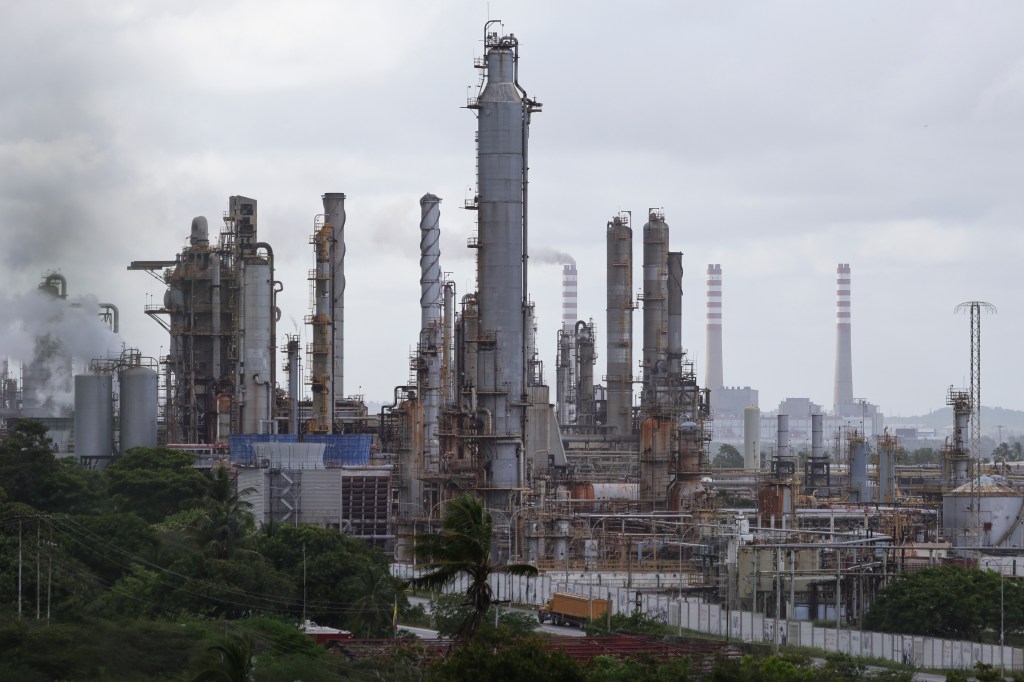
Another uncertainty for oil companies is determining just how broken Venezuela’s existing oil industry is. While Venezuela is still producing millions of barrels of crude every day, it has not sufficiently invested in maintaining its infrastructure or upgrading its technology in decades. The infrastructure that once existed to extract and transport the country’s heavy crude oil, such as drilling equipment and pipelines, is largely dilapidated and would need substantial capital investment to repair and expand it. “My understanding is that every element, from the wells themselves to the upgraders to pipelines and even the ship loading equipment at ports is thoroughly rusted over and broken,” Clayton Seigle, senior fellow in the Energy Security and Climate Change Program at the Center for Strategic and International Studies, told The Dispatch. But because most foreign oil companies have been absent from Venezuela for decades, the true extent of the country’s infrastructure problems are unknown. “The first step is going to be to assess the extent of the damage,” Halff said. “I’m not sure anybody has a comprehensive view of the country.”
Iraq and Libya’s efforts to maintain oil production following political upheavals could be illustrative of the difficulties that a post-intervention Venezuela might face, according to an analysis published last November by the Atlantic Council. In Iraq, for example, oil production temporarily fell to zero during the 2003 U.S. invasion and did not return to pre-invasion levels until eight years later. In Libya, oil production has still not returned to the levels it managed prior to the country’s first civil war, which concluded nearly 15 years ago.
However, Romero believes that, if Venezuela can successfully reform its oil industry and attract foreign investment again, the country could return its oil production to previously high levels. “We can rehabilitate or reconstitute capacity, which is quite different to building a new capacity,” he said. That sort of recovery could happen, Romero thinks, in only a few years—but it won’t be cheap. “We need tons of money, at least $15 billion or $20 billion,” Romero said. It could cost even more: In 2021, researchers at the Energy Policy Research Foundation estimated that nearly $30 billion in investment would be required to rehabilitate the entirety of Venezuela’s oil infrastructure and return its production output to 1990s levels.
Trump is reportedly set to meet Friday with oil company executives to discuss opportunities in Venezuela, and Romero is hopeful that, as long as the White House takes durable political reform seriously, U.S. investment will follow. “I think we’ll get the money and that U.S. companies will be coming to Venezuela, but we need to get the environment adequate for proper investment and reconstruction of the industry,” Romero said. “I don’t think they will come to Venezuela under the current circumstances.”