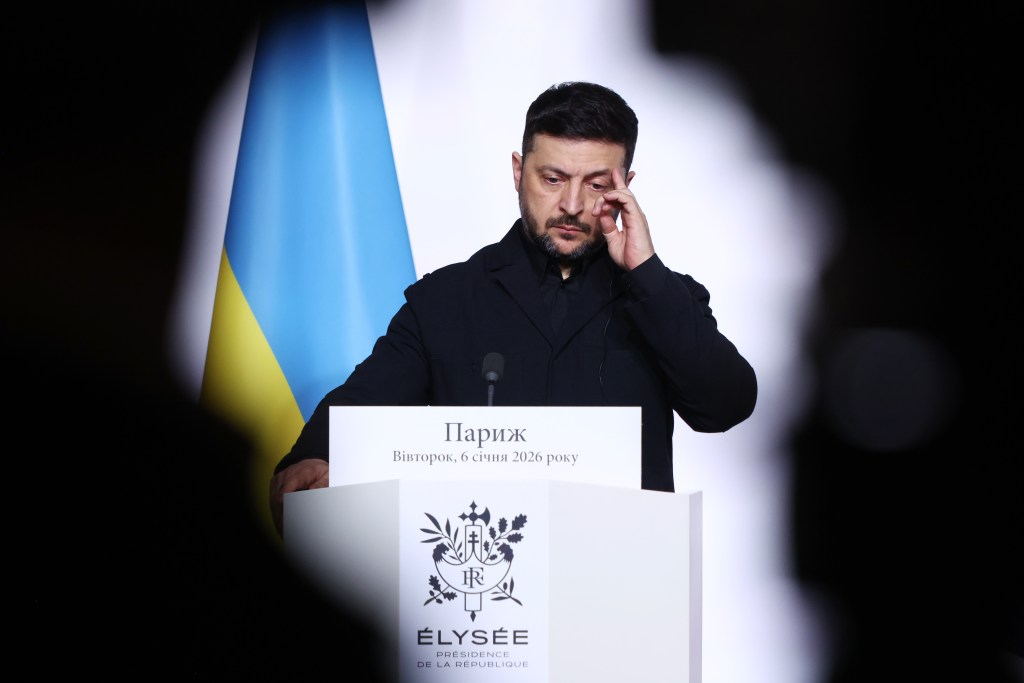
Whether Europe would follow through is another matter. Coming out of the meetings on Tuesday, Ukrainian President Volodymyr Zelensky hailed the talks as a “huge step forward”—but, by Wednesday, he was less optimistic about Europe’s resolve. “I see the will, the political will, and that the partners are ready … to give us strong sanctions, strong security guarantees,” he said, but claimed that no leader had yet given him an unambiguous commitment to defend Ukraine with military force. “As long as we don’t have such security guarantees—legally binding, supported by parliaments, supported by the United States Congress—this question cannot be answered,” he warned.
Even so, the Paris summit was a major diplomatic victory for Ukraine, while the front lines have barely moved. Throughout 2025, Russian ground offensives in Ukraine mainly focused on one (roughly Delaware-sized) chunk of territory: the remaining part of Donetsk province, in Ukraine’s eastern Donbas region. The going is slow, and the price is grievous. In the 18-month battle for Pokrovsk, a strategically located city in Donetsk, Russia has lost tens of thousands of men, peaking at 700 to 800 Russian casualties a day. According to battlefield maps published by the Institute for the Study of War, at its current rate of advance, Russia would need until February 2028 to seize the entirety of the four regions it claims.
Michael Kofman, a senior fellow at the Carnegie Endowment for International Peace who regularly visits the front lines in Ukraine, told TMD that while the front in Donetsk hasn’t exactly stalemated, a decisive breakthrough by either side is extremely unlikely: “The ongoing fighting is best characterized as attritional and positional in character.” In other words, Russians and Ukrainians are intent on grinding down each other’s forces rather than trying to force a rapid battlefield defeat.
Ukraine, while slowly losing ground, has mostly weathered the storm. “If you look at the results of 2025, it was actually a fairly good outcome for Ukraine,” said Kofman. “At no point in the year was there an operational level collapse.”
Ukrainian forces are stretched thinly along the front lines—occasionally with as few as five soldiers per 1,000 meters—but drones have allowed them to hold the line. Small units of Ukrainian soldiers act as observation units, spotting Russian troops using drones, then calling in strikes with artillery or other drones. “Everyone sees everything on the battlefield,” Bob Hamilton, the president of Delph Global Research Center and an analyst of the Russian military, told TMD. This has short-circuited what until now has been the main way for ground forces to conquer territory: quickly exploiting breaks with armored formations. And with neither side able to move large numbers of troops quickly, Russia can’t make decisive incursions, and Ukraine will struggle to regain lost territory.
With the front lines largely static, the war has become a contest of economic attrition. Russia continually strikes Ukrainian civilian centers, along with energy infrastructure: “a punitive campaign” intended to grind down Ukrainian popular will, Kofman noted. “Historically, these have not proven effective in the absence of a force’s ability to achieve any breakthroughs on the battlefield.” Meanwhile, Ukraine continues to hit Russia’s military production and energy facilities, striking 24 oil and gas sites within Russia in December, a monthly record. And after following a tacit agreement during the first few years of the war that Russian merchant shipping would be off-limits, Ukraine has expanded its use of naval drones, striking tankers in the Black Sea and even conducting a strike off the coast of Libya last month. These attacks are blows aimed at the “shadow fleet:” a murky constellation of clandestine merchant vessels that Russia uses to transport oil and evade sanctions, and a vital source of cash for the Russian government during the war.
In a sign that the U.S. and allies may begin more aggressively tracking the shadow fleet, U.S. Coast Guard vessels seized the Bella 1 on Wednesday: a Russian-flagged oil tanker that attempted to run the current blockade on Venezuela, leading U.S. ships on a chase all the way into the North Atlantic. The same day, the U.S. Senate indicated it may take further action against Russia’s oil industry. Sen. Lindsey Graham of South Carolina told reporters that Trump had “greenlit” a bipartisan bill that would impose severe sanctions on countries that purchase Russian oil and other exports, and that it could go to a vote as early as next week. The legislation currently calls for a 500 percent tariff on countries that trade for these resources with Russia, hitting major economies like India and China. Due to its potentially devastating effects on the global economy, Fried argued the current bill is “not usable.”
Russia is adamant that it remains economically resilient. But it faces three main pressures on its economy, Howard Shatz, an expert on the Russian economy at the RAND Corporation, told TMD. Oil revenue continues to decline, inflation remains high—the Bank of Russia claims it’s at 5.8 percent—and the government spends roughly 40 percent of its budget on the military. “The war and the sanctions have made Russia a highly distorted economy,” Shatz argued, with military production becoming an increasingly large portion of the economy (crowding out other sectors) and placing enormous pressure on the central bank.
Ukraine’s economy, buffeted by Russia’s air campaign against energy infrastructure and population centers, is “in really bad shape” too, Shatz said. Total GDP is lower than before the war, inflation remains in the high single digits, the country has a deficit of more than $40 billion, and it’s reliant on EU loans and financial measures to keep it afloat. But Shatz also said that, with European support, Ukraine will have “pretty clear sailing for a year, maybe a bit more.”
As it stands, it seems that neither side will quickly be able to tip the balance of the war through purely military means—and the Paris Declaration remains largely hypothetical until Putin comes to the table. But last week’s flurry of diplomacy represented one of the clearest signs yet that Ukraine’s allies won’t let it be subject to Putin’s domination, even with uncertainty about the overall U.S. commitment. And Russia seems to agree. On Thursday, a statement by the Russian Foreign Ministry called the declaration “militaristic” and said any multinational force “will be considered legitimate combat targets of the Russian Armed Forces.”
“If this were nothing, the Russians would not be reacting as they are,” Fried argued. “They are reacting with alarm.”