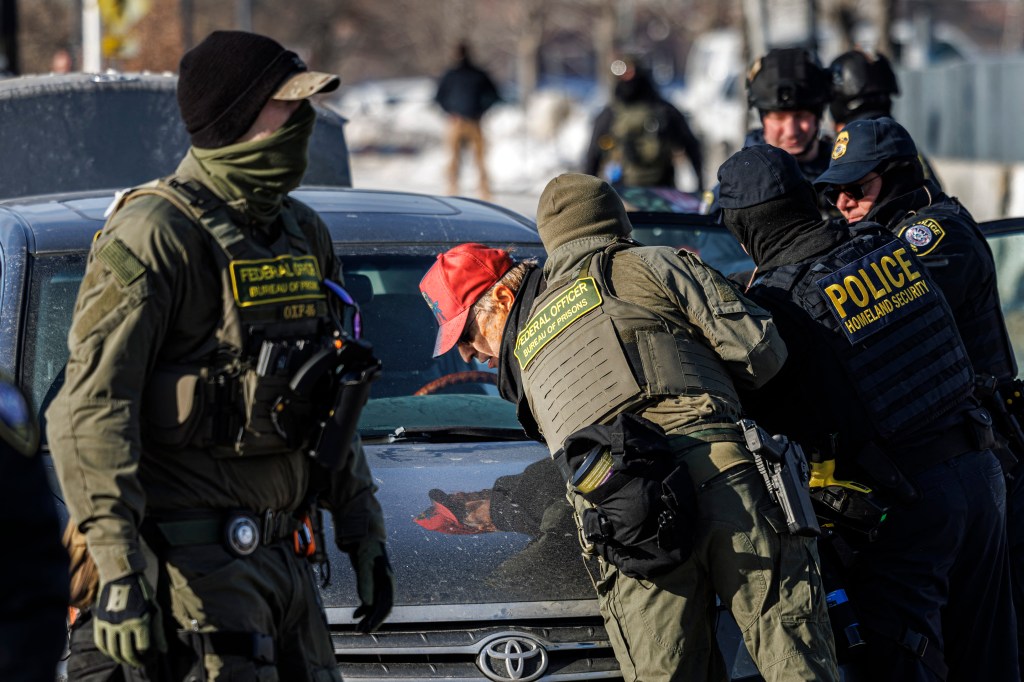
Following reports that Minnesota state funds for child care and other social services had been funneled into fraudulent enterprises for years, the Trump administration announced plans last Tuesday to send more than 2,000 federal agents to the state, mostly from ICE, in an operation that the agency championed on X as its largest ever. ICE vehicles were seen around Minneapolis schools on Tuesday and Wednesday morning—and though this large-scale, on-the-street deployment has become relatively common during the second Trump administration, it isn’t what ICE officers are trained for.
Doris Meissner—the former commissioner of the Immigration and Naturalization Service, the agency that conducted immigration enforcement until 2003, when those duties were transferred to ICE, Customs and Border Protection, and Citizenship and Immigration Services—told TMD that, under previous administrations, ICE “traditionally preferred not to be on the streets” making immigration arrests, because the agency found it more efficient to cooperate with local law enforcement to identify non-citizens who were arrested and convicted of crimes. “Immigration enforcement officers are trained in immigration law, and in pursuing criminal aliens and deportation proceedings, and what actually constitutes a violation of immigration laws,” Meissner explained. “They’re not really trained in crowd control or in street policing, neighborhood policing—that’s what local law enforcement does.”
The scale of these deployments—in support of the Trump White House’s ambitious deportation goals—has led the administration to fast-track training for recruits. In August, Nick Miroff reported in The Atlantic that, though new ICE deportation officers used to receive five months of federal law enforcement training, that time was cut roughly in half last year. Academy training was reduced to just 47 days, according to three sources Miroff spoke to, a number chosen as a nod to Trump being the 47th president.
That said, Good’s alleged shooter, Jonathan Ross, was not part of this new cohort of recruits. Ross previously served in the Indiana National Guard and was deployed in Iraq from November 2004 to November 2005 before joining the U.S. Border Patrol in 2007. There, Ross worked as a field intelligence agent based in El Paso, Texas, until moving to Minneapolis in 2015 to begin work as an ICE deportation officer. In June, while arresting Roberto Carlos Muñoz—an illegal immigrant who had previously been convicted of sexually assaulting his stepdaughter—Ross was injured during a traffic stop, dragged behind Muñoz’s car for 100 yards. State and federal law enforcement have not officially identified the officer involved last week, but a law enforcement source confirmed Ross’ identity to the Minnesota Star Tribune.
According to Homeland Security Secretary Kristi Noem, ICE officers were returning to headquarters Wednesday morning after completing an operation when one of their vehicles got stuck in the snow. Video footage shows at least five ICE vehicles on the scene, and it’s at this point that Good stops her Honda Pilot perpendicularly in the road, blocking one lane of traffic. Good seems to have done this intentionally to break up the ICE vehicles. There are more than a dozen ICE officers in the vicinity, and two minutes before the shooting, at least three masked federal officials approached her vehicle, one of whom is Ross. He moves from the hood to the rear of her vehicle, filming the exchange and capturing her licence plate as she slowly reverses her car before stopping.
Good and her wife can be heard speaking angrily to the officers, with Renee saying in Ross’ general direction, “You want to come at us? I say go get yourself some lunch, big boy. Go ahead.”
Ross passes in front of the car twice, and several other officers emerge from a truck stopped on the driver’s side of the vehicle. Throughout the interaction, Good has multiple opportunities to ram ICE officers with her car. She doesn’t.
“Get out of the f—ing car,” one ICE officer can be heard saying to Good. The brake lights of her Honda are still on, indicating it’s probably in “Drive.” Good reverses the car, and when it stops, one of the officers tries to open the driver door, presumably to arrest Good for obstruction. The car is stopped on compact ice, and an agent is seen slipping in the background.
Her wife, Becca, shouts, “Drive, baby, drive!” Good turns her wheel hard to the right, away from Ross, before the vehicle moves forward.
Ross—standing on a slippery surface, with a gun in one hand, a phone in the other, and trying to prop himself up—is a few feet in front of the Honda’s driver’s side when Good begins moving forward. It’s unclear whether the car drives into Ross, but he has his left hand against it, while drawing his weapon with his right. He fires through the front windshield. As the car turns right, he seems to be pushed backward—seemingly less because of force than because he lost balance after his contact with the car broke. As the open driver’s side window passes him, he immediately fires a second and third time through the side window. A veteran police officer who leads his agency’s training unit told TMD that, though the first shot through the windshield was likely not fatal, the second or third almost certainly was.
Good’s Honda accelerates away to the right and crashes into a parked car. A voice behind Ross’ video can be heard exclaiming, “f—ing b–tch.”
On Sunday, when Peter Doocy of Fox News asked Acting ICE Director Todd Lyons why Ross had no body camera and chose to draw his gun while simultaneously holding his cellphone to videotape the incident, Lyons answered that the agency was “still in the process” of handing out body camera gear to federal officers, placing blame on the previous administration for what he described as a lack of funding. “In a split-second decision on [Ross’] part,” Lyons added, “he had to draw his weapon while he was still filming, and his training kicked in.”
Justin Nix, an associate professor at the University of Nebraska at Omaha’s School of Criminology and Criminal Justice, told TMD that shooting in the driver’s direction was not the best practice. “The best policies [and] training … all inform officers that shooting into a moving vehicle is usually not going to produce a good outcome,” he said. “Even if you’re successful and you strike the driver, now you’ve rendered a 2,000-pound vehicle driverless, and that can create more mayhem most of the time.” Nix added that, while not every case is the same, generally, if officers have time to draw their weapons, they usually also have time to dive away from the vehicle.
What happened in the aftermath of the shooting has also raised questions. “I think my main concern when I saw the video is there are an awful lot of officers standing around, and not a single one of them appears to have attempted to provide any emergency care,” Austin Kocher, a professor at Syracuse University who studies U.S. immigration enforcement systems, including ICE policing practices, told TMD. Once officers determine there is no longer an imminent threat, law enforcement—including the officer responsible for the shooting—“has a responsibility to provide first aid care to try to save the [suspect’s] life,” Kocher said.
None of the agents provided medical aid, however, suggesting that it isn’t something on which they are trained. The officers can instead be seen gathered around the vehicle, holding back bystanders and witnesses—including a man who identifies himself to officials as a physician and offers to provide emergency aid. He is refused entry, which is standard procedure, as it’s difficult to verify a stranger’s medical qualifications—which is why most law enforcement agencies require that all field officers be trained in first aid. EMTs didn’t arrive until six minutes after the shooting.
Five days later, there’s still plenty we don’t know about the shooting—including whether Ross positioned himself in front of Good’s vehicle before drawing his weapon. As the veteran police officer, who requested anonymity due to the sensitivities of his job, told TMD, even video footage can be misleading. “Cell phone video is to police work what television was to warfare during Vietnam,” he said, “in that it took abstract accounts of complex, fast-moving events and made them graphic, immediate, and compelling, to the point that we falsely assume it tells us everything we need to know.”
According to the Minnesota Bureau of Criminal Apprehension (BCA), the FBI initially agreed to work with the agency and state prosecutors to investigate the shooting, before reversing that decision on Thursday. BCA Superintendent Drew Evans said later that day that the agency would “no longer have access to the case materials, scene evidence, or investigative interviews necessary to complete a thorough and independent investigation.” On Friday, Minnesota state officials announced they would be conducting their own review of the shooting, but that they could not conduct a full use-of-force investigation without federal officials restoring their access.
Theron Bowman—the chief executive officer of The Bowman Group, a public safety consulting firm, and a former police chief—expressed concern that alienating state officials could raise levels of distrust toward federal law enforcement. “We don’t want the public to discredit the investigation,” Bowman told TMD. “We don’t want the public to believe that the only way to obtain a fair investigation is public disorder, public rioting, public disobedience of the law. We don’t want that to be the outcome, so it’s easier, and it makes more sense upfront, to engage in an investigative process that the public will perceive as being fair and transparent.”